

































100 Cities / 100 Memorials & Memorial Hunters Club
#9, Tsingtau Blog Photo Series: German and Chinese Preparation for Naval Blockade by Japanese and British at Tsingtau Seaside, by Mark Facknitz

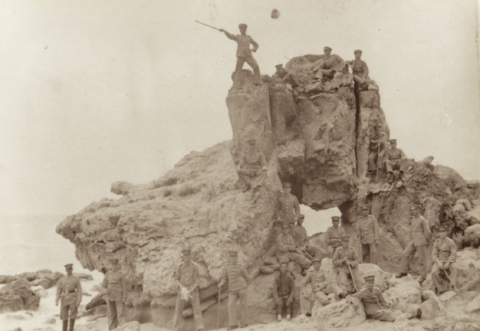
A picturesque and madcap set of poses at seaside.
#9, Tsingtau Blog Photo Series: German and Chinese Preparation for Naval Blockade by Japanese and British at Tsingtau Seaside, by Mark Facknitz
Main cover photo (and first photo below) shows a picturesque and madcap set of poses at seaside.The blurry single Chinese, bottom center, suggests that photographer's command to hold still was sometimes lost in translation. A special limitation of the photograph as historical evidence is precisely the hegemonic blurring of the cultural topography, so novel and obvious are the contours of the physical landscape. Photographs are deceptive precisely because of their immediacy, their stability.
With the assistance of the British, the Japanese began a naval blockade of Tsingtao at the end of August, 1914, a few weeks after the declaration of war in Europe.In the first week of September Japan began to land the 18th Division of Infantry at Lungkow and Laoshan Bay.The Germans, outnumbered by more than six to one, prepared to defend Tsingtau.At this moment my grandfather, disguised in civilian dress, made his way by train back to Tsingtau from Tientsin, where he had been attached to a diplomatic guard unit.Well-provisioned, the Germans spent September and October waiting, establishing trenches lines, redoubts, and artillery batteries.In 1915, American journalist Jefferson Jones wrote of Tsingtauthat "Germany has . . . been forced to surrender all this magnificent work," and "the Tsingtau of 1914 will clearly standout in the memory of its visitors and Far Easterners as the finest, the prettiest, most modern and sanitary city in the Orient" (153).Post-war, still believing in the promise of the city, several dozen of my grandfather's fellow P-O-W's came back to Tsingtau to settle.
The photographs from this moment make plain the severity of landscape as well as the remarkable similarity of German defenses in China to the trenches of the Western Front.
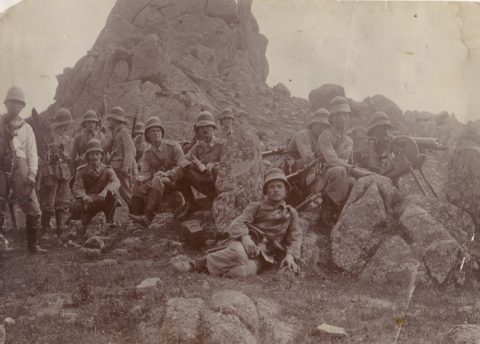
Machine gunners take up a position in the rocks and wait.
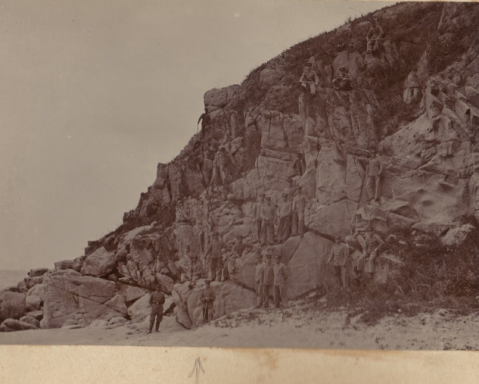
Spreading out over rocks—here at the seaside—seems to have been a motif. My grandfather is just above the penciled arrow.
Author's bio

Mark Facknitz is Roop Distinguished Professor of English at James Madison University. The 1989 winner of the Virginia Prize for fiction, his creative work has appeared in The Georgia Review, Shenandoah, Story Quarterly, The Iowa Review, and other journals. His essays on Raymond Carver, Anthony Powell, Henry Green, Joseph Conrad, Michel Tournier, and others have appeared in Studies in Short Fiction, CEA Critic, The Journal of Modern Literature,Twentieth-Century Literature, The Journal of Narrative Technique, and other publications. In recent years he has divided his research interests between the Great War and Willa Cather. His essay "Kitsch, Commemoration, and Mourning in the Aftermath of the Great War" appears as Chapter 16 of Jonathan Vance's The Great War: From Memory to History (Wilfred Laurier UP, 2016). He has published on Ivor Gurney's shellshock in The Journal of the Ivor Gurney Society, on war cemeteries and the margins of memory in Bridges, on Luytens and Thiepval as paradigms of commemoration in Crossings, and on pre-1914 gardens as trope for the soldier's remembered self in a/b Autobiography Studies. His not purely academic interest in the Great War depends on a German grandfather, prisoner of war in Japan 1914-1919; an American grandfather, an engineer in the AEF; and a great uncle who died for Canada. He holds an MFA from the University of Iowa and a Ph.D. from the University of New Mexico.