






























California Couple Visit France Investigating WW1 & Make a Connection for Two Cities
[Part One of a Two Part Article]
California WW1 Centennial Task Force Co-Director and Fiancée Take Enviable Trip to the WW1 Monuments of France and Find Treasures and Unexpected Surprises.
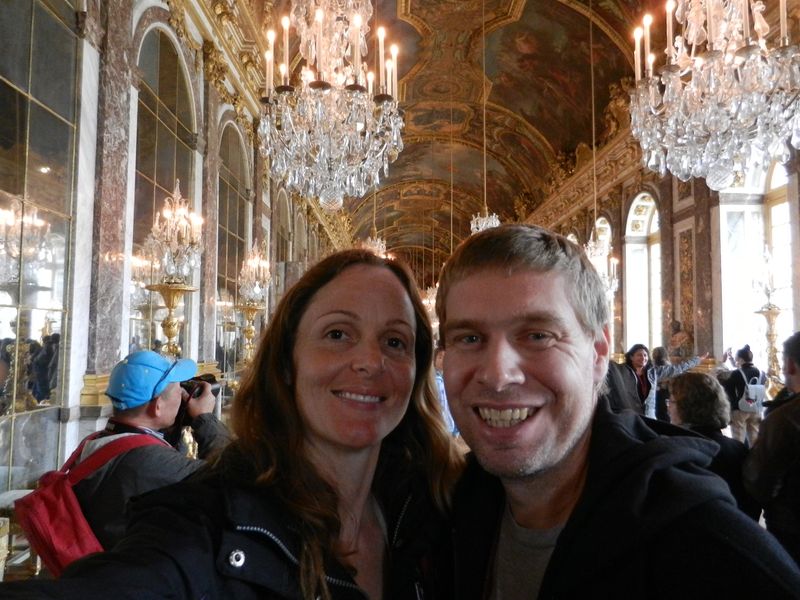 Many Americans are choosing to commemorate the centennial of World War One by taking a trip to the battlefields of France over the course of the centennial. This year, one of those was one of our own Co-Directors of the California WW1 Centennial Task Force, Courtland Jindra who traveled with his fiancée, Melissa to Northeastern France to do just that. Courtland is also the organizer for the Victory Memorial Grove restoration project in Los Angeles, one of the 100 Cities/100 Memorials selected by the US WW1 Centennial Commission and the Pritzker Museum for repair and renovation.
Another of our Co-Directors, Bill Betten, interviews Courtland, and then (with permission) digs into Melissa’s journal of their trip in this report.
Bill: “Melissa's chronicle of your trip is stupendous, but before we get to her entries I’d like to open with a few questions to you Courtland that I think people would like to know your answers to if you don’t mind.
Courtland: Go right ahead.
Read more: California Couple Visit France Investigating WW1 (Part 1)
California Couple Visit France Investigating WW1 & Make a Connection for Two Cities - Part Two
[Part Two of a Two Part Article]
(To read Part One click here)
California WW1 Centennial Task Force Co-Director and Fiancée Take Enviable Trip to the WW1 Monuments of France and Find Treasures and Unexpected Surprises.
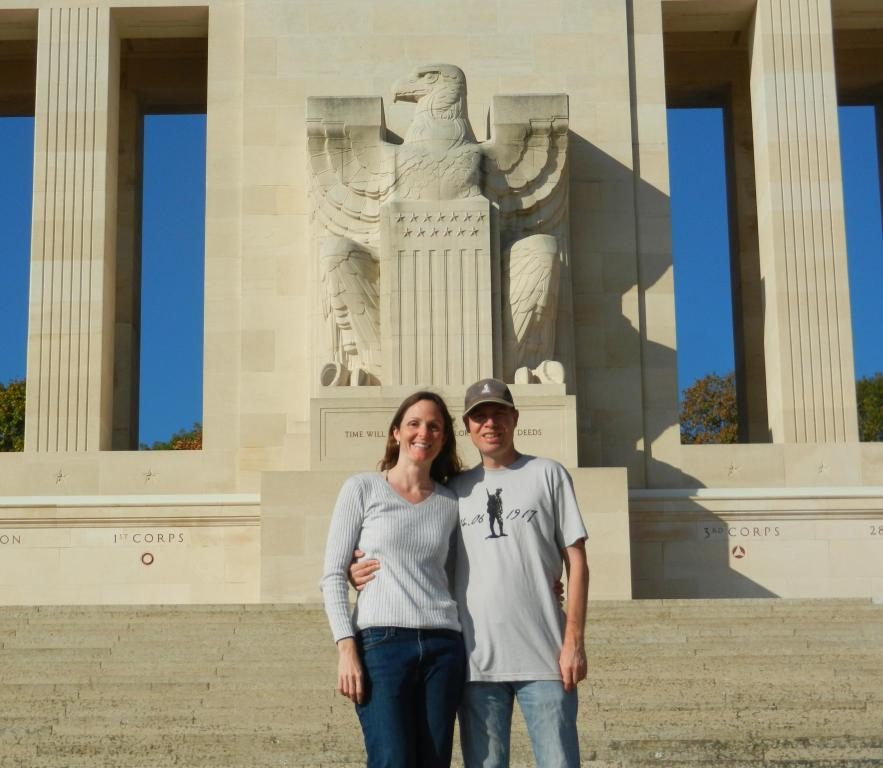
Choosing to commemorate the centennial of World War One by taking a trip to the battlefields of France, one of our own Co-Directors of the California WW1 Centennial Task Force, Courtland Jindra, traveled with his fiancée, Melissa to the battlefields and monuments to do just that. To read Part One click here. Following is the continuation of their journey from Melissa's journal, picking up on:
Saturday October 13th
After breakfast we checked out of our chateau and drove to Marre, France, a small town outside of Verdun. The drive was beautiful; more scenic roads passing vast fields of crops and yellow flowers, and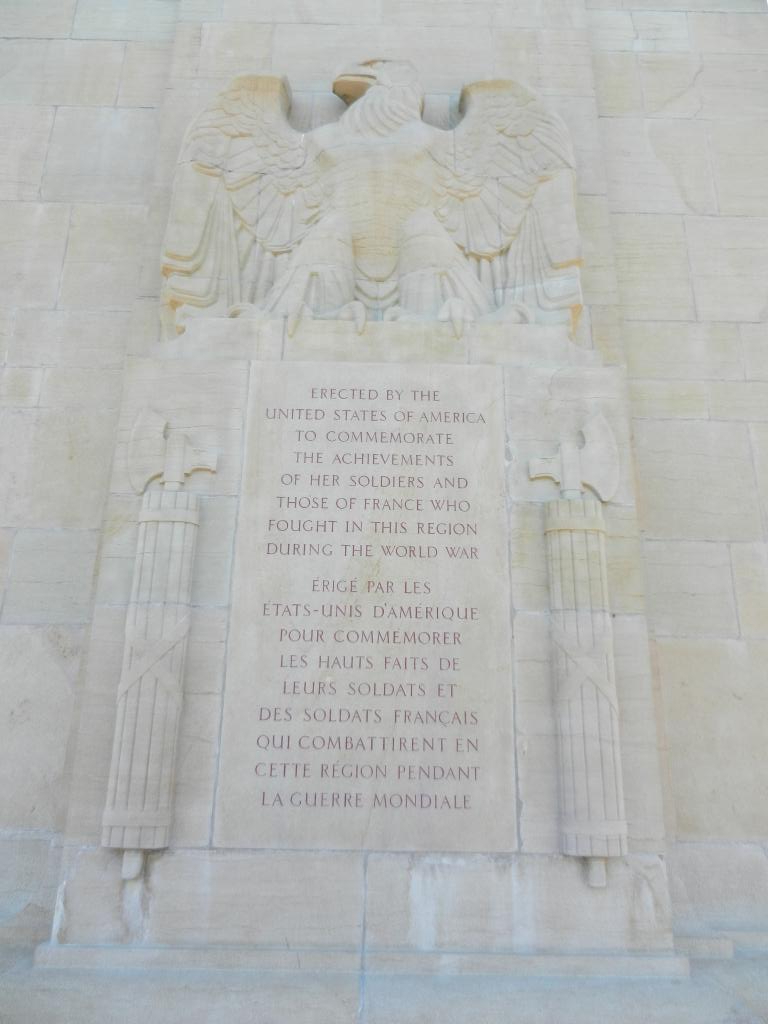 forested areas with leaves changing colors. Some roads were wider, and some were very small! We took a detour to the Sommepy American Monument, which was way, way off in the countryside, but maybe our favorite monument yet. We had the place to ourselves. It sits on the hilltop of Blanc Mont,
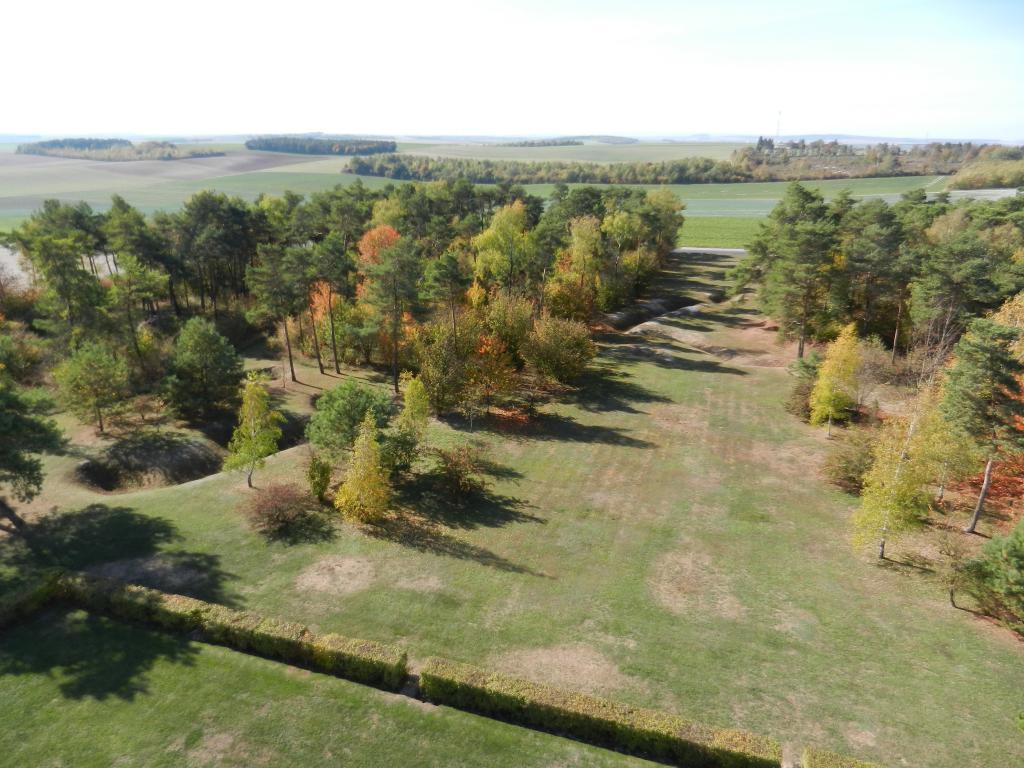 in the middle of vast farm fields. It commemorates the achievements of the Americans and French who fought in the Champagne region of France, and sits at a spot that was hard to capture from the Germans, who had dug into the hill and fortified it well. The monument itself is a tall tower that one can ascend from within the structure,
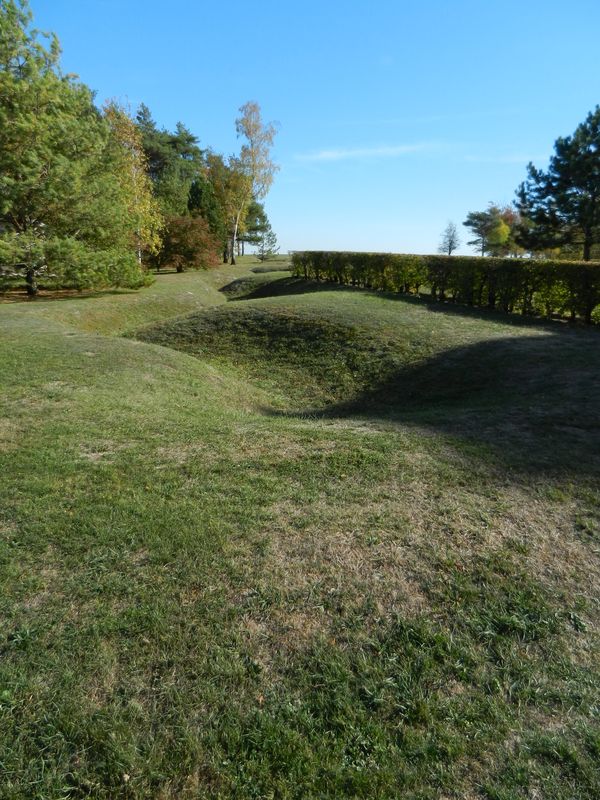
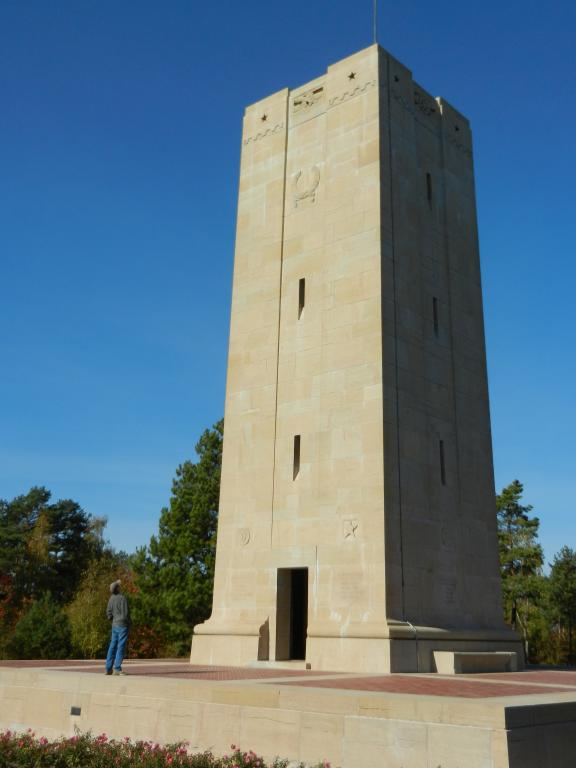 which we did and had lunch at the top. The view from the top is amazing, and gives a 360 degree view of the battlefields and terrain. The monument is surrounded by grounds that are filled with trenches,
 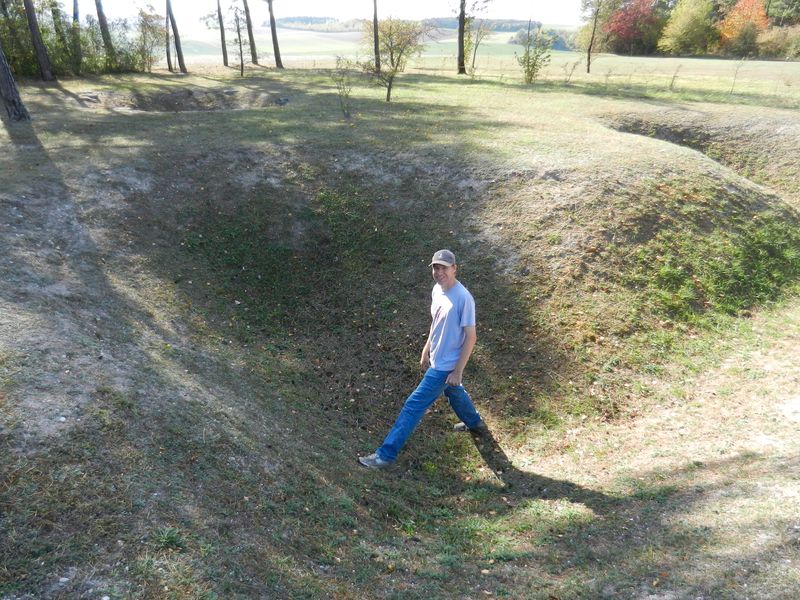 dugouts and artillery emplacements. We walked around for a bit before reluctantly leaving. It is truly a hidden gem of France.
As we left, we saw a military Humvee with a few guys who looked like they were hanging out on the road right in front of the monument. Then down the road as we left the monument behind, there was a lone soldier standing on a hill by the road. We guessed that they were doing some sort of exercise. As we got back into the closest little town, we passed another Humvee. We were starting to wonder if something was going on that we weren't aware of, perhaps another French Revolution, but then Courtland saw the driver of the Humvee looking irritated with his passenger, who was holding a big map in front of him. Clearly, they were lost, and it was a comfort that tourists aren't the only ones who get lost on the roads of France. As we left them behind, they made the correct turn toward their companions. I guess between the two of them they figured out the map!
We arrived at our hotel around 2:30pm. The hotel is situated in a VERY small town about 15 minutes outside of Verdun.
Sunday October 14th
After our run this morning along the country road that runs through our small village, we had breakfast at the hotel. The breakfast area of the hotel restaurant is in a circular stone room that looks like something out of Lord of the Rings; very neat! We're lucky they're open on Sundays, most places aren't!
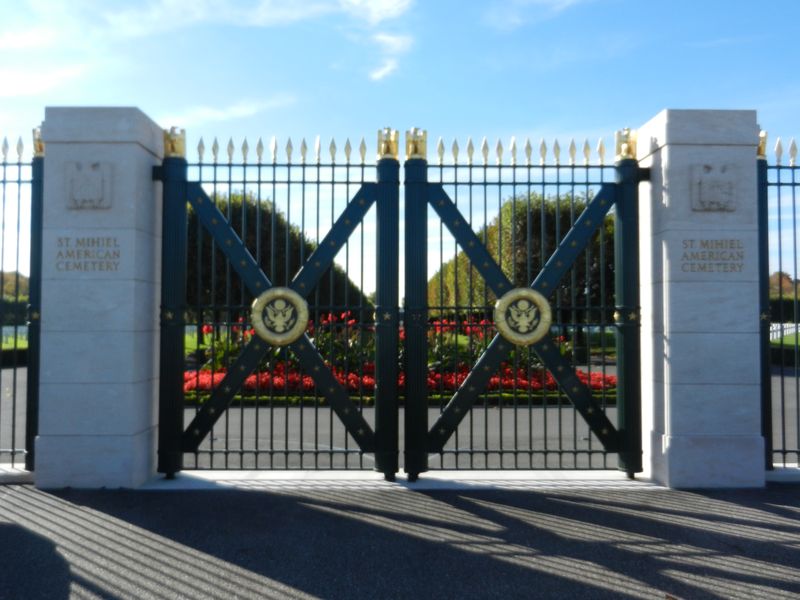 After getting ready, we drove to the St. Mihiel American Cemetery and Memorial. This was the closest we would come to my Fatherland of Germany (about 150 miles away), and to where Courtland's great grandfather served in WWI in Epinal, France (about 75 miles away).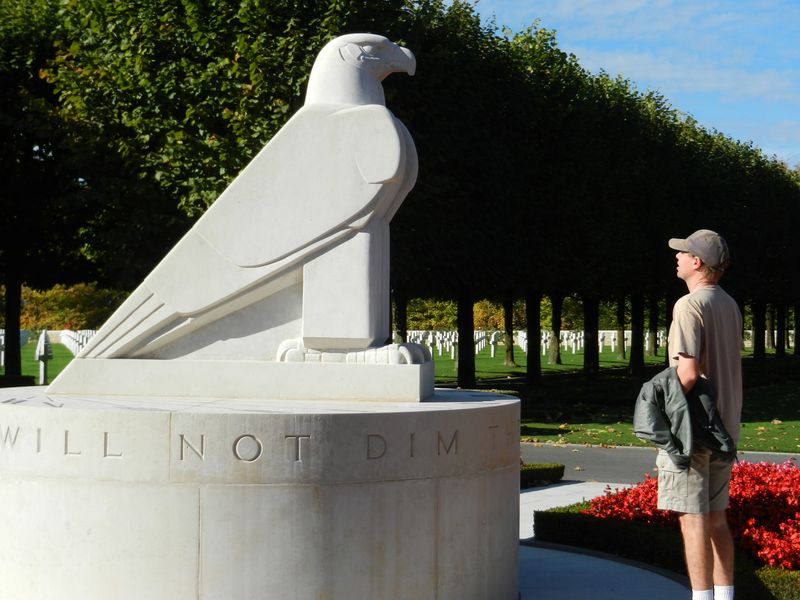
St. Mihiel Cemetery has 4,153 Americans buried there, with 117 unknown soldiers. Unlike other cemeteries, which generally are limited to soldiers who died in a particular vicinity, this cemetery has fallen Americans from all over France, including nurses. We briefly visited the reception center and then walked through the grave plots. There is one medal of honor recipient and we also found Greayer Clover's grave.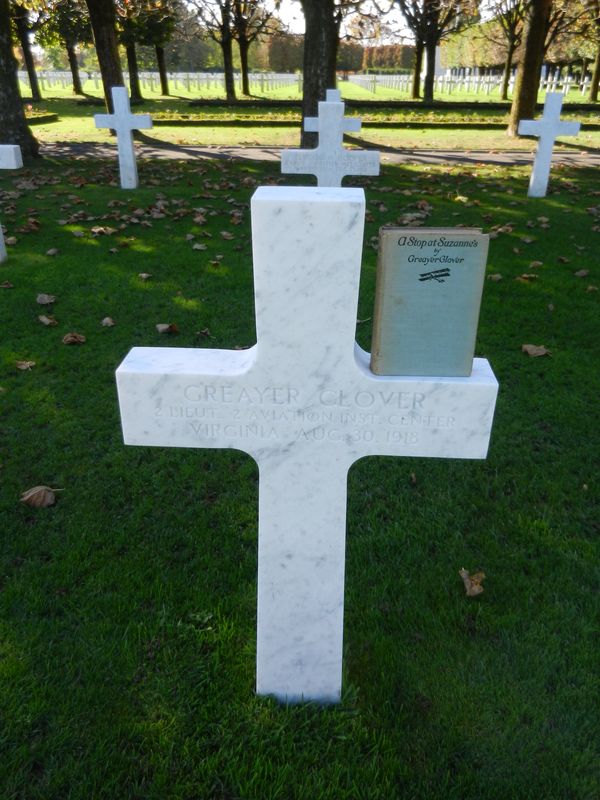 Courtland brought his first edition book of A Stop at Suzanne's with us to France so that he could set the book on his grave and get a photo. Not sure if anyone else has ever done that, but we did! The book is a collection of his short stories, published by Clover's family after the war. In the center of the cemetery is probably our favorite aspect of it, a large white stone eagle facing north surrounded by striking red and pink flowers encircling it. On the sides of the cemetery were sculptures of a Doughboy and of an urn. At the back of the cemetery is a large memorial with numerous white stone
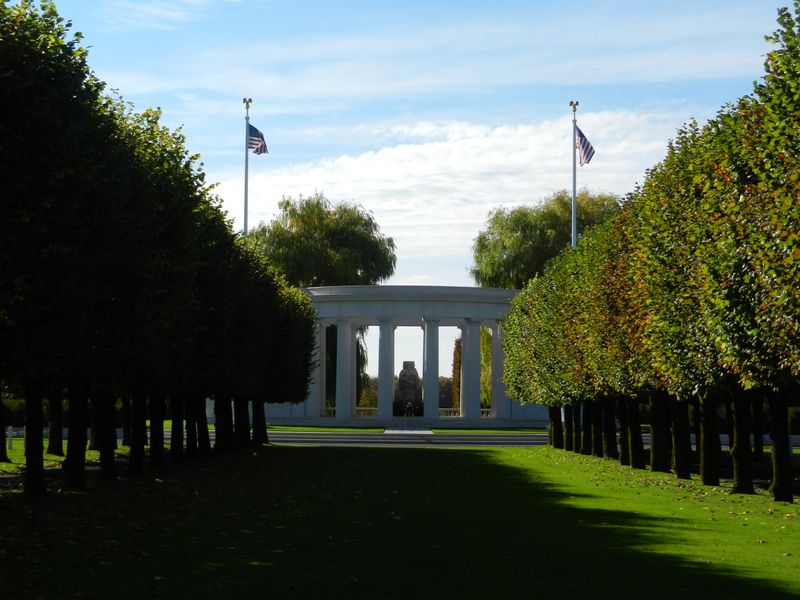 columns. To each side are rooms with a chapel to the left (whose walls are covered in a golden mural made by tens of thousands of tiny glass tiles, depicting the Angel of Victory) and to the right a marble wall map of the battle at St. Mihiel. That wall map actually isn't the original; the original fell off the wall and broke due to the humidity, and thus both rooms to the sides of the monument had dehumidifiers in them. Here, as depicted on the maps, the German army's defensive line bulged (known as a "salient") into France and the Allied Forces fought for four days to eliminate this final salient of the German army. They were ultimately successful and this paved the way for the Meuse-Argonne offensive.
Behind the memorial are beautiful willow trees with low branches. The tress within and outside of the cemetery were all still changing color for fall, which continues to please us. In the center of the memorial is a pink granite urn with a Pegasus, which symbolizes taking the souls on their voyage thereafter. We then met up with the assistant to the supervisor at the cemetery, Marie, who showed us around some more and was very kind to see us during her lunch break!
We then drove into town less than a mile away and walked to the church, which is bullet ridden from both World Wars. Next to the church is a statue of an American Doughboy and a French Poilu shaking hands, and symbolizes the friendship of the two nations. Fittingly, we parked near a building in town that appeared to be a residence whose window boxes were filled with French and American flags. The statue was also bullet ridden from WWII, when the same town was attacked again.
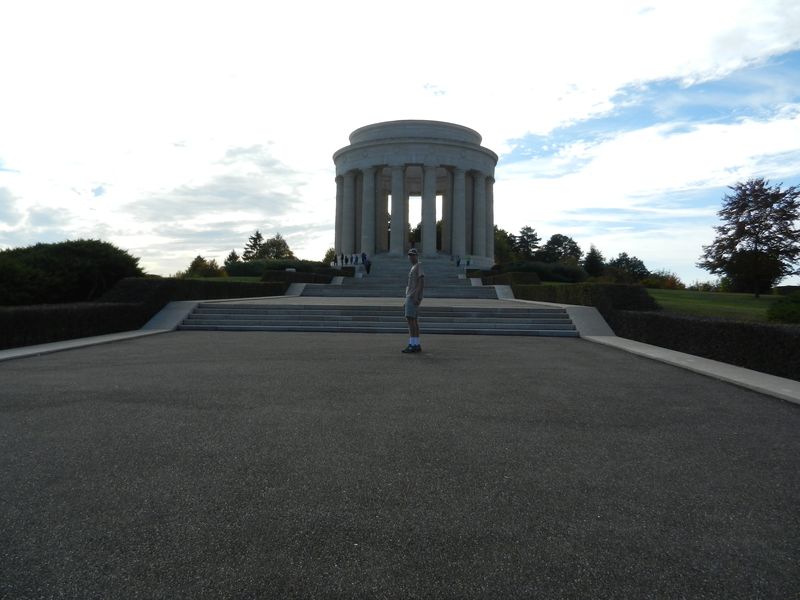 After the statue, we drove to the Montsec Monument. We could see it for miles before we got to it. It was the biggest hill of the monuments on hills we'd yet seen, and a giant monument itself! It commemorates the reduction of the St. Mihiel Salient by the U.S. First Army and the operations of the U.S. Second Army, as well as all combat services of other U.S. divisions in the region. After driving up the hill, one is greeted by many stairs leading up to the circular colonnade monument. The view from the hill was amazing; we felt like we could see all the way to Germany from there, and had great 360 views of the valleys and Meuse River below. And it was very windy up there! We had lunch on the monument, which was the most well-visited monument
 we've seen our whole trip. Motorcyclists and European tourists favor the site. We walked around for a bit and even went back up to the monument a second time before departing.
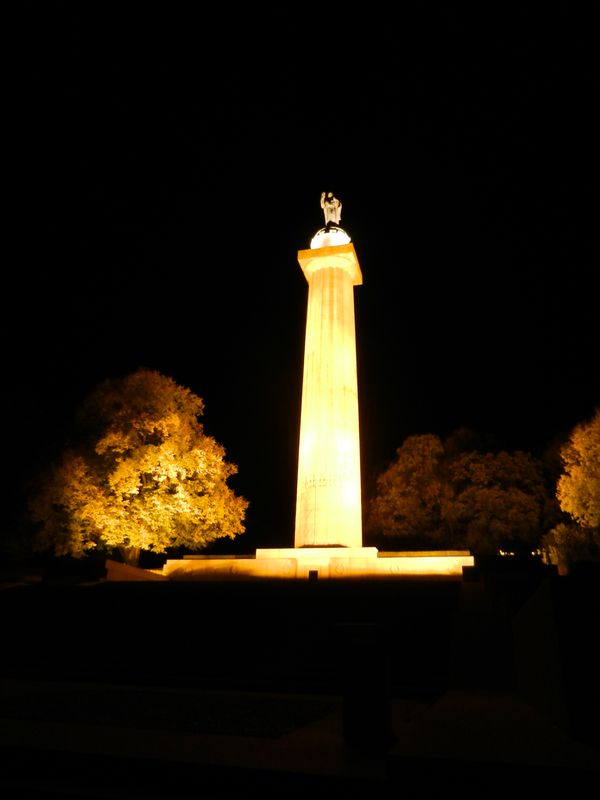
We went back to the hotel for a few hours before meeting up with Courtland's Facebook friend Randy Gaulke, who lives in France a good bit of almost every year and is a tour guide. We drove to Verdun and had dinner at the Sherlock Holmes pub and restaurant, which was very good. After dinner, he offered to drive us to the Montfaucon monument lit up at night. It was very prettily lit and we walked around a bit before heading back to the hotel. Another full day ahead tomorrow!
Monday, October 15th
We began our day with a run on some of the town roads, which turned quickly into gravel farm roads, radiating from the town center, which is the church. Got a pretty good workout going up a hill, upon which we spotted our first and potentially only poppy flowers on the trip. The nice weather might have tricked them into blooming so late in the season.
 After that, we headed for the Meuse-Argonne American Cemetery and Memorial. It is the largest American WWI or WWII cemetery in Europe, and thus the largest one we'd seen. It is home to 14,246 Americans, and 954 names on the walls of the missing. Whereas most cemeteries we've seen have had two to four grave sections, this one has eight. We began at the Visitor's Center, and decided to eat our lunch before we got started. Thanks to poor signage, we parked incorrectly and were admonished by a security guard.
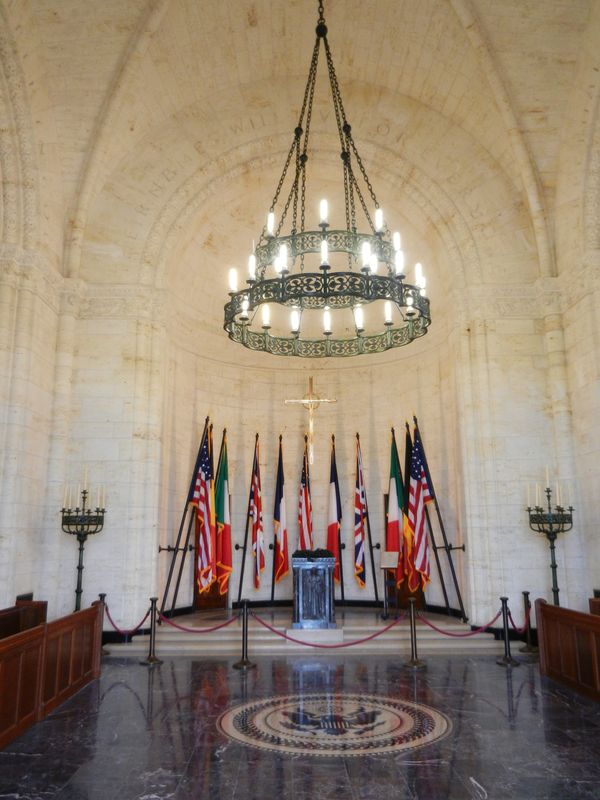
The visitor reception area is probably the most well-done one we saw at any of the cemeteries. It had various information boards, a short film, and some displays of artifacts. From there, we drove to the middle of the cemetery and parked (not sure if that was allowed, but another car did it and Courtland said he's seen photos of cars parked there before). My favorite element of the whole cemetery was there in the middle – a large circular pool 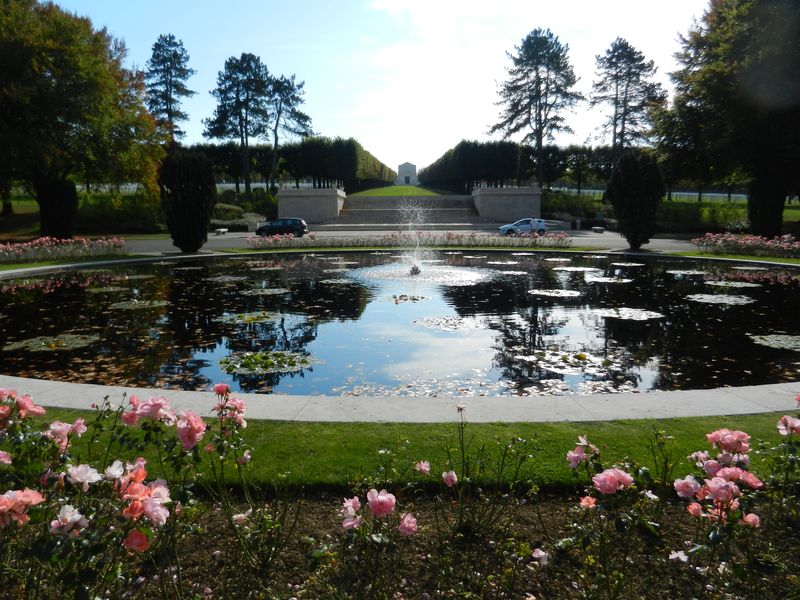 surrounded by roses with a dainty fountain in the middle. It was very pretty. The roadways in the center of the cemetery and the pathways along the grave sections are lined with trees, which weren't quite as glorious as we'd seen at other cemeteries but it is edging closer and closer to winter, so I can't fault the trees. We walked up stairs to get to the level of the graves. We walked past them to the Memorial chapel, hoping to hear the carillons play at the hour, but we didn't hear them the whole time we were there. The chapel was pretty, with stained glass that had numerous insignia of the various divisions that fought in the area. To the sides of the memorial are hallways with decorative columns. The halls include the names of the missing. As we left (the chapel,) some British soldiers came in many carloads to do a ceremony (the security guard admonished the first one not to park where he had, as well. At least he was rude to everyone, not just us. But the joke was on him, the military guys ended up parking everywhere because there were so many of them).
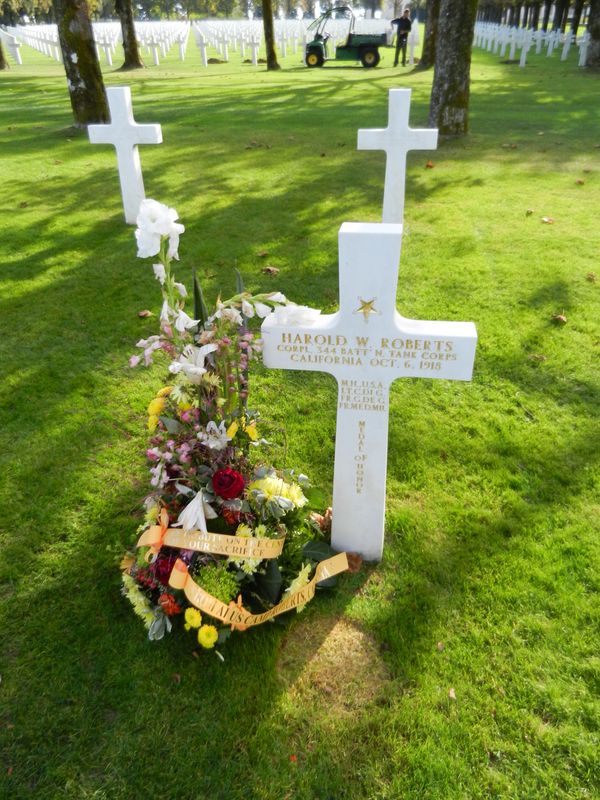 Californian, Corporal Harold Roberts – a World War I Congressional Medal Of Honor Recipient served in the U.S. Army during WWI in the 344th Battalion, Army Tank Corps. In 1918, his unit was engaged in a fierce battle. His citation tells that while trying to protect another tank Cpl. Roberts' tank sank into a deep shell hole filled with water and submerged. Knowing that only one man in the tank could escape, Roberts pushed his companion through the back door of the tank and was himself drowned. Cpl. Roberts was awarded the Medal of Honor, and Camp Nacimiento in California was renamed "Camp Roberts" in his honor.From there, we walked the grave sections, finding the first American woman killed in the war, who entered the service from California, Marion Crandall. We found Benjamin Bowie, from Los Angeles. We found Frank Davis, who was planned to be on the Victory Memorial Grove tablet but his name never ended up on it. We also found an Isaac J. Hoover from Pennsylvania – maybe one of my kin? We then went back up to the Visitor center and briefly talked with some of the staff members, thanking them for taking care of the cemetery, before leaving.
About a mile away in the town of Romagne-sous-Montfaucon is a private collection of WWI artifacts, turned into a Museum by its owner, Jean Paul de Vries.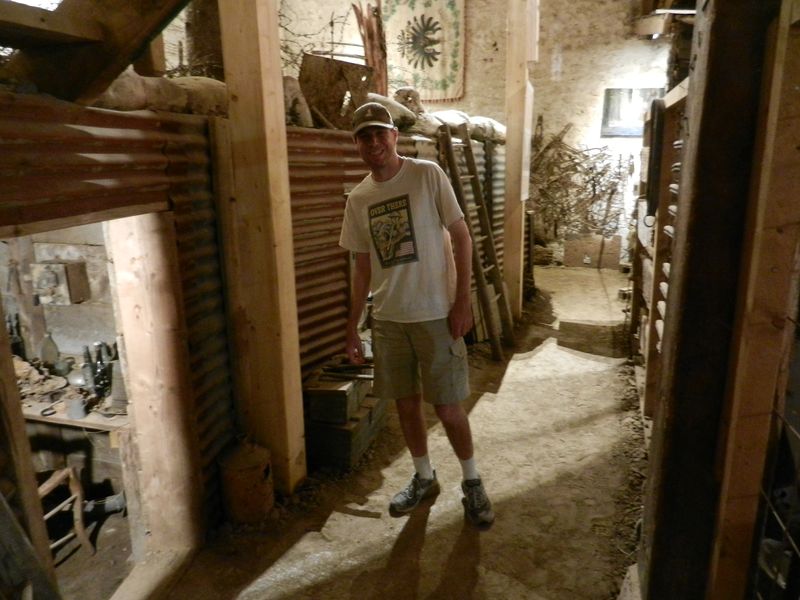 They said he'd found 95% of the collection within a three-km radius of the museum. It was nestled to the side of a lunch café, and very impressive. Hundreds of shovel heads cascaded down a wall, along with collections of guns, swords, bayonets, barbed wire, horseshoes, helmets, canteens, bottles, canisters, medicines, ceramic pieces used to string wires, dog tags, ammo, buttons, clothes, mess kits, and thousands of other pieces of war relics they'd found. He'd built stairs into two or three levels of displays, as well as "bunkers" you could go into to see how crammed they lived during the war, if one was lucky enough to be crammed into some sort of structure. Outside of his museum, he had things for sale such as "trench art," which are large ammunition casings carved into designs of plants and other objects.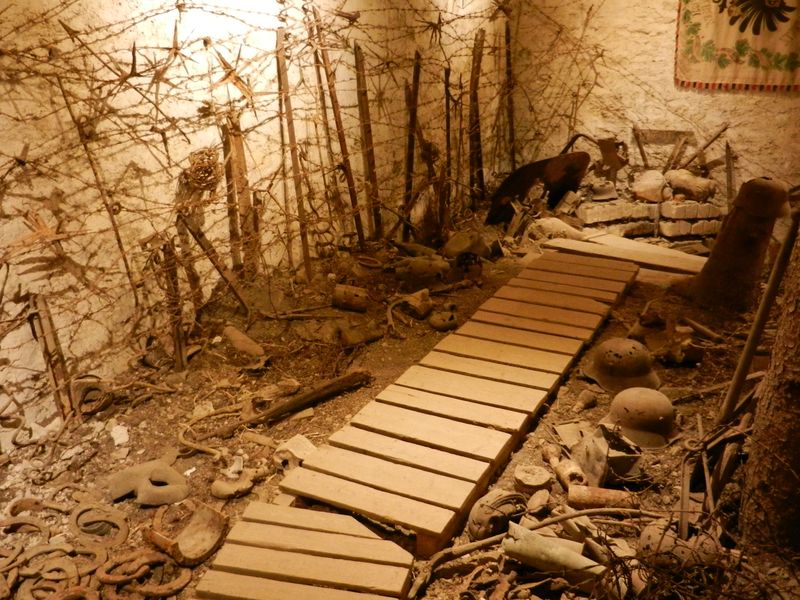
After leaving there, we tried to get to the monument to the Lost Battalion, which features Cher Ami, the heroic homing pigeon who carried a desperate message from the battalion, which was trapped for days and getting fired upon by both the enemy and their own American units, to the American units to have them stop shooting at them. She got her leg and one of her eyes blown off completing the task, which was better than the previous two birds' fate before her, but she did it and is credited with helping to save the Lost Battalion survivors. Unfortunately, we got about 2 km away and the road was closed for logging, we think, so we had to turn around without seeing the monument
We went to the Montfaucon Monument, which we saw last night in the dark, to climb it. Kind of like ascending the leaning tower of Pisa, many, many stairs circle to the top from within the tower, over 200 feet tall.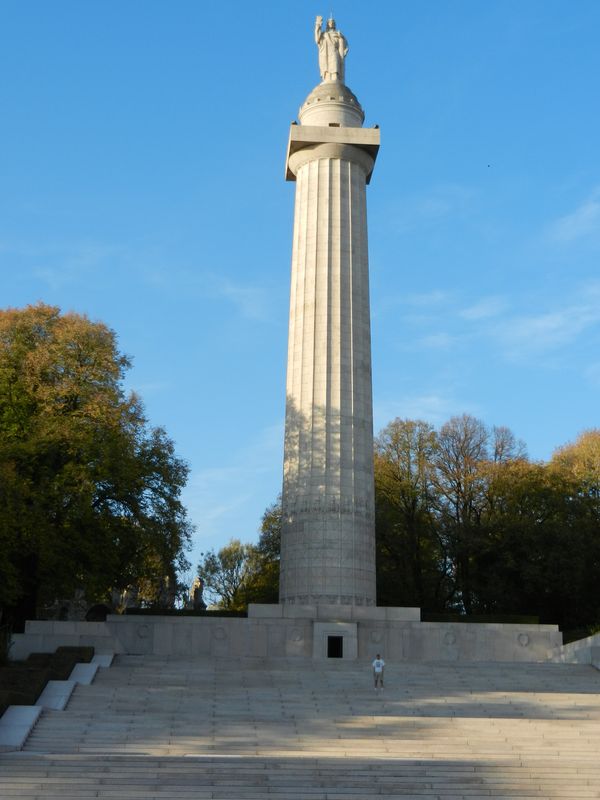 At the top, there are four doors leading out to four sections for viewing 360 degrees around the tower. We spent some time up there, looking out from each vantage point, before climbing back down.
We then walked around the ruins of the town around the tower. It was demolished during WWI, and the ghostly remains of the town are being reclaimed by time and the forest. The best remains still standing are from the massive church that once stood there. They've since rebuilt the town to the west of the monument. There were also the remains of German bunkers and trenches in the area. We watched several tour groups and buses come by the monument, but most didn't even stop there and let people out, they just saw it from the windows and left. Made us grateful that we are doing our own touring!
We ended the day with dinner in Verdun. Tomorrow will be our last full day in the Verdun area.
Tuesday, October 16th
After lazing about and breakfast, we set out just before noon on our adventures for the day.
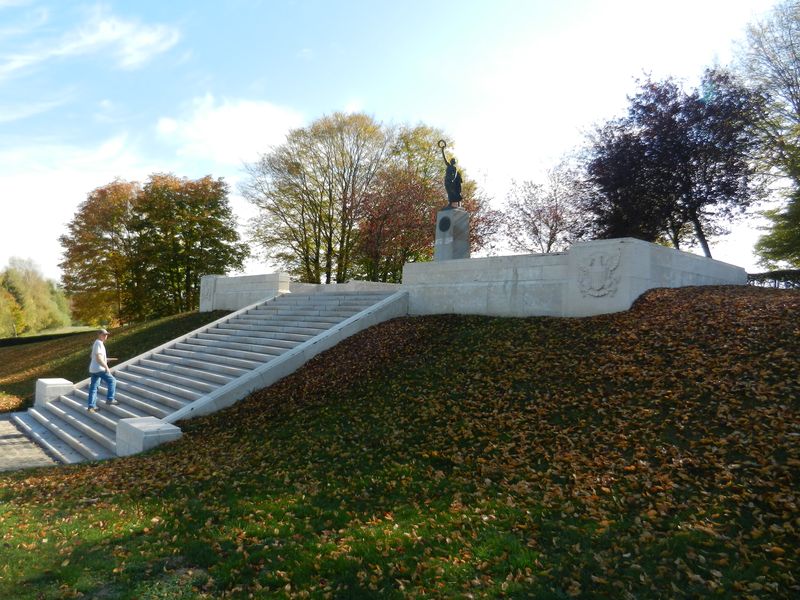 We began at the State of Missouri monument, erected by the state to honor those from Missouri who had died during the war in the area. Particularly, the 35th Division suffered the greatest losses, as the Meuse-Argonne offensive was their first combat experience. Initially they did well, but gradually they were decimated by the Germans. It was a moderately sized monument, at the top of stairs, at the top of which had a lady in bronze holding a wreath up to the sky.
Next, we drove to the Pennsylvania monument. This one was on par with the size of the bigger monuments we'd seen on the trip. Dedicated in 1927, it honors the Pennsylvania soldiers, particularly the 78th Division,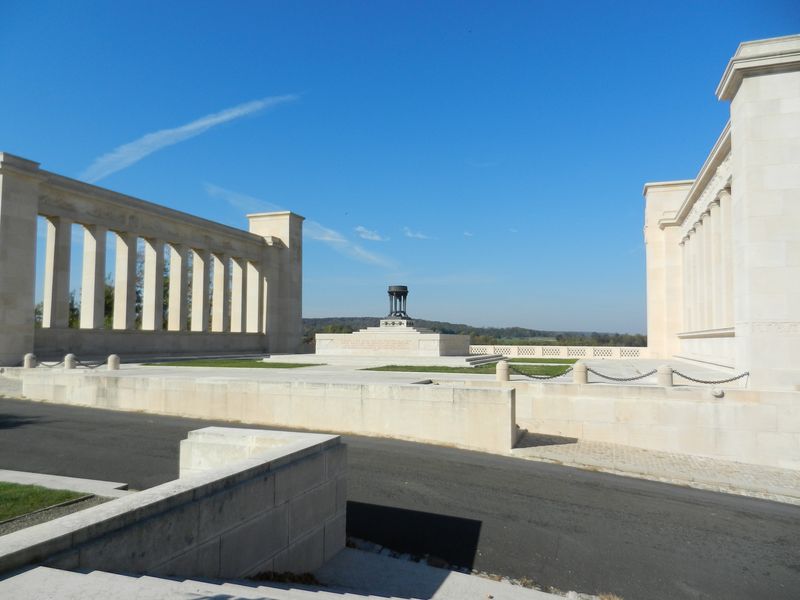 and they liberated the town of Varennes, where the monument sits atop a hill. Its centerpiece is a large bronze eternal flame (which sadly wasn't lit, but we weren't about to try to light it). Upon the eternal flame is inscribed, "The right is more precious than peace."
From there, we drove to see the Cher Ami, the brave pigeon, and Lost Batallion (77th Division) memorial. We laid our hands on the bird, which sits upon several doughboy helmets. 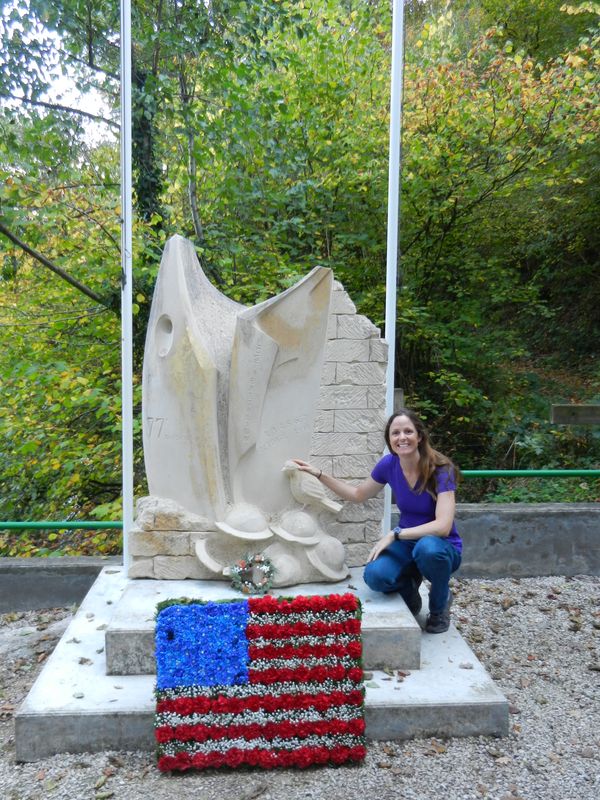 We tried to see the marker depicting a location of the Lost Battalion, which is supposed to be half a km away, but the road was closed for logging and we eventually chickened out walking it that we might get in trouble, so we went back!
From there, we drove to the Sgt. Alvin York memorial in Chatel-Chehery. There is a bronze plaque set in a polished black granite stone describing his role in the war. We drove a short distance away and parked to walk a 40-minute trail depicting the sites of his famous battle. Essentially, in that area, he was part of a unit that was charged with clearing the Germans from the forest. The Germans had fortified the area with trenches and machine gun nests and were difficult to eradicate from the thick forest. His unit worked its way through the area, capturing Germans along the way. His commander was killed and he became the acting leader of the platoon. 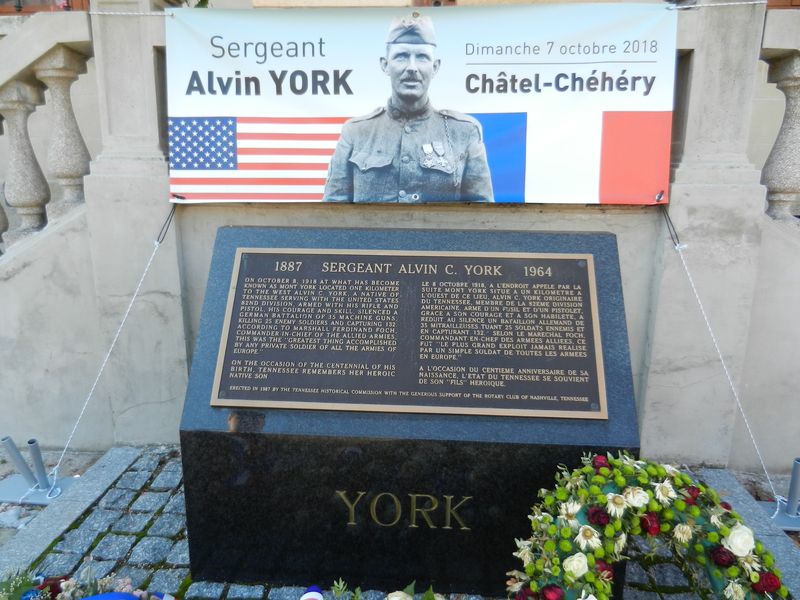 At one point, he single-handedly fought off a bayonet attack, and picked off enemy soldiers one at a time, capturing a machine gun nest at a critical moment of the battle. The enemy was so astonished at their ferocity, one of the German majors looked at him and after York told him they were Americans, the major immediately offered to surrender his unit if York would just stop. He and his fellow soldiers were able to capture 132 Germans, which impressed his commanding officer Brigadier General Lindsey, who told him, "Well York, I hear you've captured the whole damned German army." He told him no, that he "only had 132." His bravery led him to be promoted to Sergeant.
Finally, and fittingly, we went to a small monument at the top of a hill behind surrounded by fields honoring the official last doughboy to be killed in WWI combat, at 10:59am on the day of the Armistice. 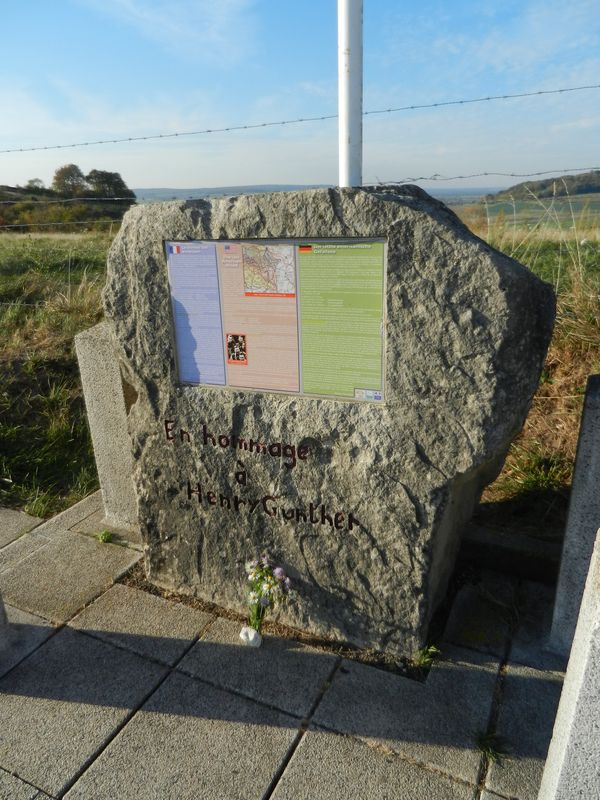 We picked wildflowers along the gravel road on the way to make a small bouquet to lay at the monument. As we walked back, the sun was starting to lower in the sky and the shadows were beginning to set on this peaceful place, though every place around here is peaceful and beautiful! Henry Gunther, perhaps with a chip on his shoulder after being demoted for writing a letter home that was read by the censors in which he was critical of the army and war effort, and for being of German ancestry, might have felt a deep need to prove himself. Thus, knowing the armistice would occur at 11am, in the final minutes beforehand, he and one of his commanding officers advanced on a German position on that hill. The Germans were incredulous, but began shooting at them anyway. His commander got down on the ground and ordered Gunther to stop, but Gunther kept advancing and was shot in the temple and killed.
Afterward we took our last walk in town and gazed up at the night sky. Tomorrow will be our last night here, staying right by the airport, and we are sad to say goodbye to France.
Wednesday, October 17th, 2018
We tried our best not to be too sad today, as it was our last full day in France, and a travel day. 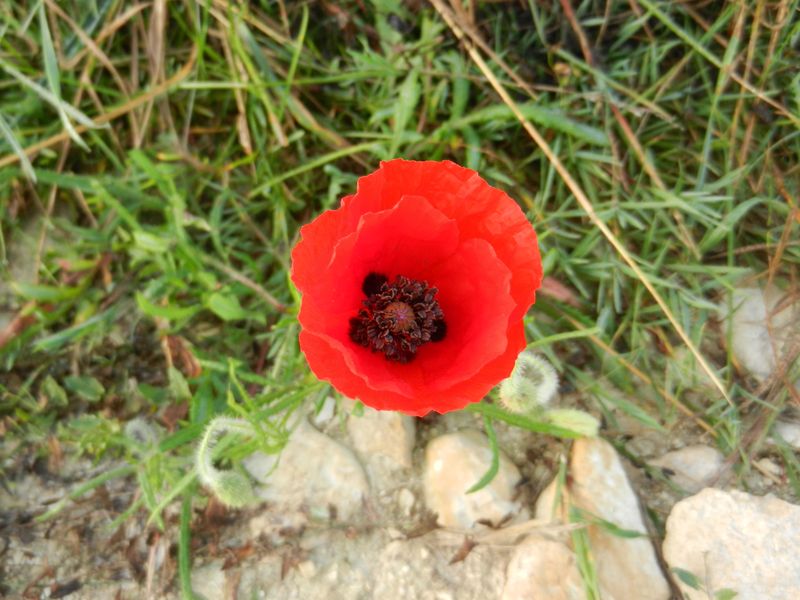 We ran through town, snapping pictures along the way, including the poppies we had seen growing along a dirt road heading up one of the hills of farmers' fields. After breakfast and checking out at the hotel, we drove into Verdun. We had found a walking tour map at our hotel that we'd been meaning to try if we had time, and since we did, we decided to walk it.
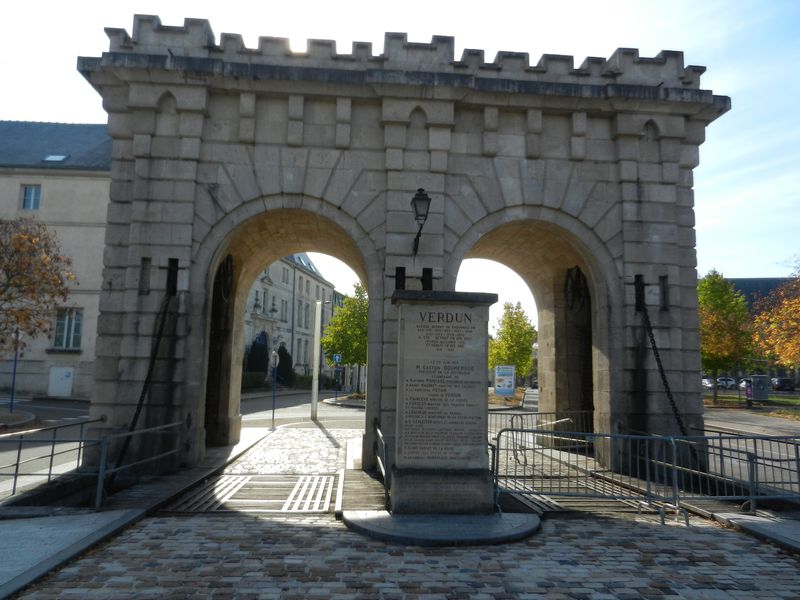 Verdun, whose name comes from the words "strong fort," has a lot of history, mostly of being attacked and destroyed time and time again, since at least the 4th century. We saw a War Memorial, which was originally for WWI and then WWII was added, for the citizens of Verdun who died
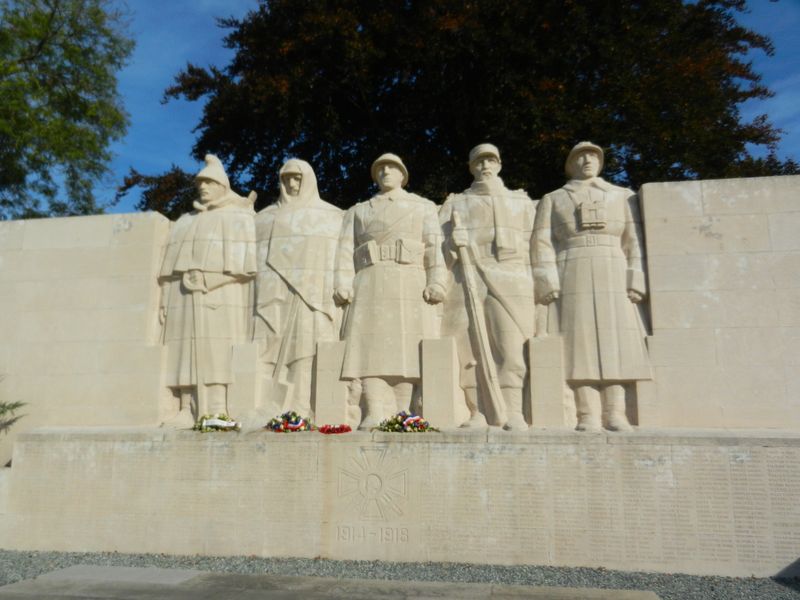 in both world wars. It is comprised of five statues – a cavalryman, an engineer, an infantryman ("poilu"), an artilleryman, and a reservist. They form a human wall symbolizing the motto of the city – "They will not pass." We also saw a war memorial dedicated to the women of Verdun during WWI, who not only bore the burdens of raising children, taking care of the elderly, and working/farming while their male family
 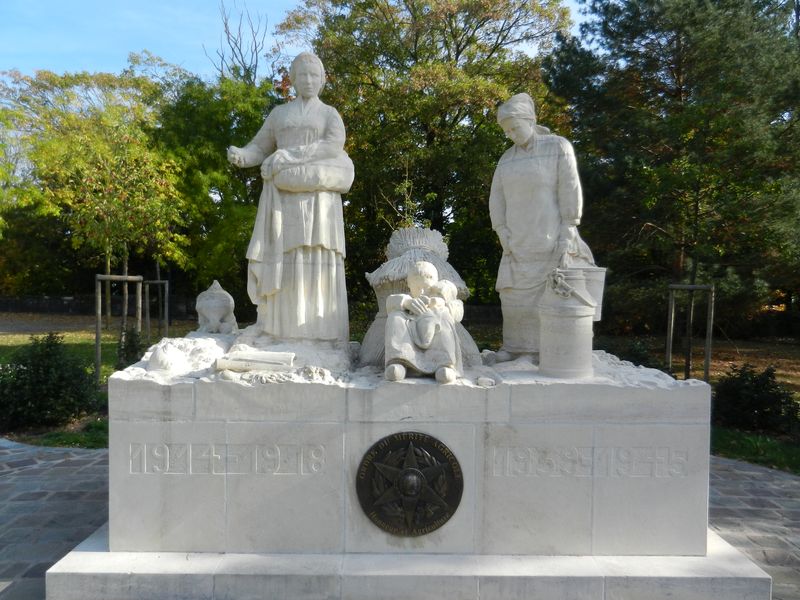 members were off fighting and dying in war, but the burdens of dealing with the aftermath and with injured and emotionally scarred men who returned. There was also a monument to victory and to the citizens of Verdun at the top of a long set of stairs overlooking
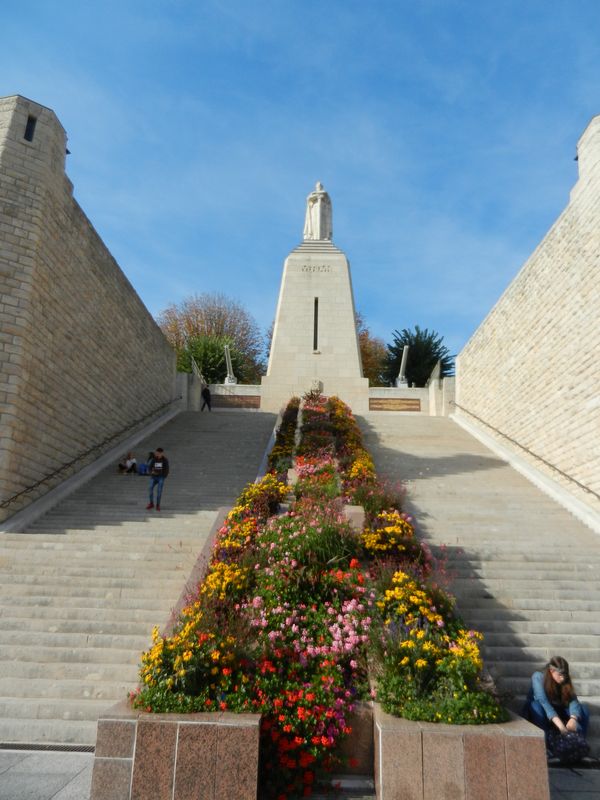 the city center. A warrior faces the Eastern front, and the monument symbolizes the victories of the Battle of Verdun in 1916 and the signing of the armistice in 1918. 85% of Verdun was destroyed during the war, so it also symbolized the rebuilding of the city.
Among other landmarks, we passed the Notre Dame Cathedral, which has stood since the 10th century, and has been rebuilt in the Middle Ages and the modern period. They were working on part of it as we walked by. We also stopped at a tower dating back to the 14th century, which sits on a stream running into the Meuse River. There, we reluctantly returned our WWI bullets we'd been given at the cave near Chateau-Thierry to the ground, as we don't think we're allowed to take them home.
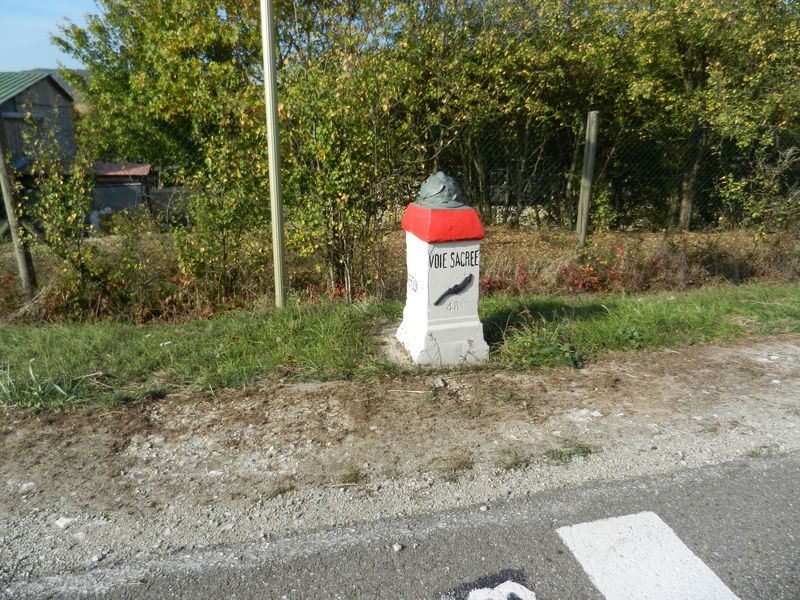 After our walking tour, and filling up the tank with gas, we drove along the Voie Sacree briefly (the "Sacred Way" – the only road that was able to supply men and materials for the French during the siege at Verdun in WWI) and then the A4 autoroute back to Paris. We tried to get to bed early, since we plan on rising early for our 10:20am flight tomorrow back to Los Angeles.
Epilogue by Courtland Jindra
As the months have passed obviously things aren't quite as crystal clear, but experience of traveling the AEF sites in France was unforgettable. While Melissa and I did not see everything we could have, our nearly two weeks there was an amazing time that I cannot properly put into words. William Faulkner famously wrote "The past isn't dead. It isn't even past." Being in rural France you feel the weight of those words - Frenchmen still live with the war in a way that is hard to explain.
No disrespect to the Greatest Generation, but the American sites to the Great War are just as worthy to visit as those for WWII. Normandy gets over a million visitors a year - I would guess all of the American cemeteries put together don't get half that many. If there is one thing I would hope for in the future, it's that more of our countrymen would stop by these places of memory. I can't wait to return someday. Perhaps I will see some of you "Over there" with me.
October 13, 2018 - WW1 conference at CSU Bakersfield
America in the Trenches - A Centennial Exploration of America’s Involvement in the Great War
 An event endorsed and approved by the California WW1 Centennial Task Force to commemorate, honor, and educate the citizens of the Great State of California.
California State University Bakersfield
Sponsored by The Public History Institute at CSUB
The Walter Stiern Library
The Historical Research Center at CSUB
The Department of History at CSUB
The Instructionally Related Activities Fund
The California State University Bakersfield Department of History demonstrated the ability to provide a thought provoking conference when they opened their doors to participants and audience members at their History Forum and Public History Institute's America in the Trenches - A Centennial Exploration of America’s Involvement in the Great War conference.
Dr. Miriam Vivian had invited the the California WW1 Centennial Task Force to present a World War One display which Co-Director Bill Betten and his wife Joni Betten were happy to supply.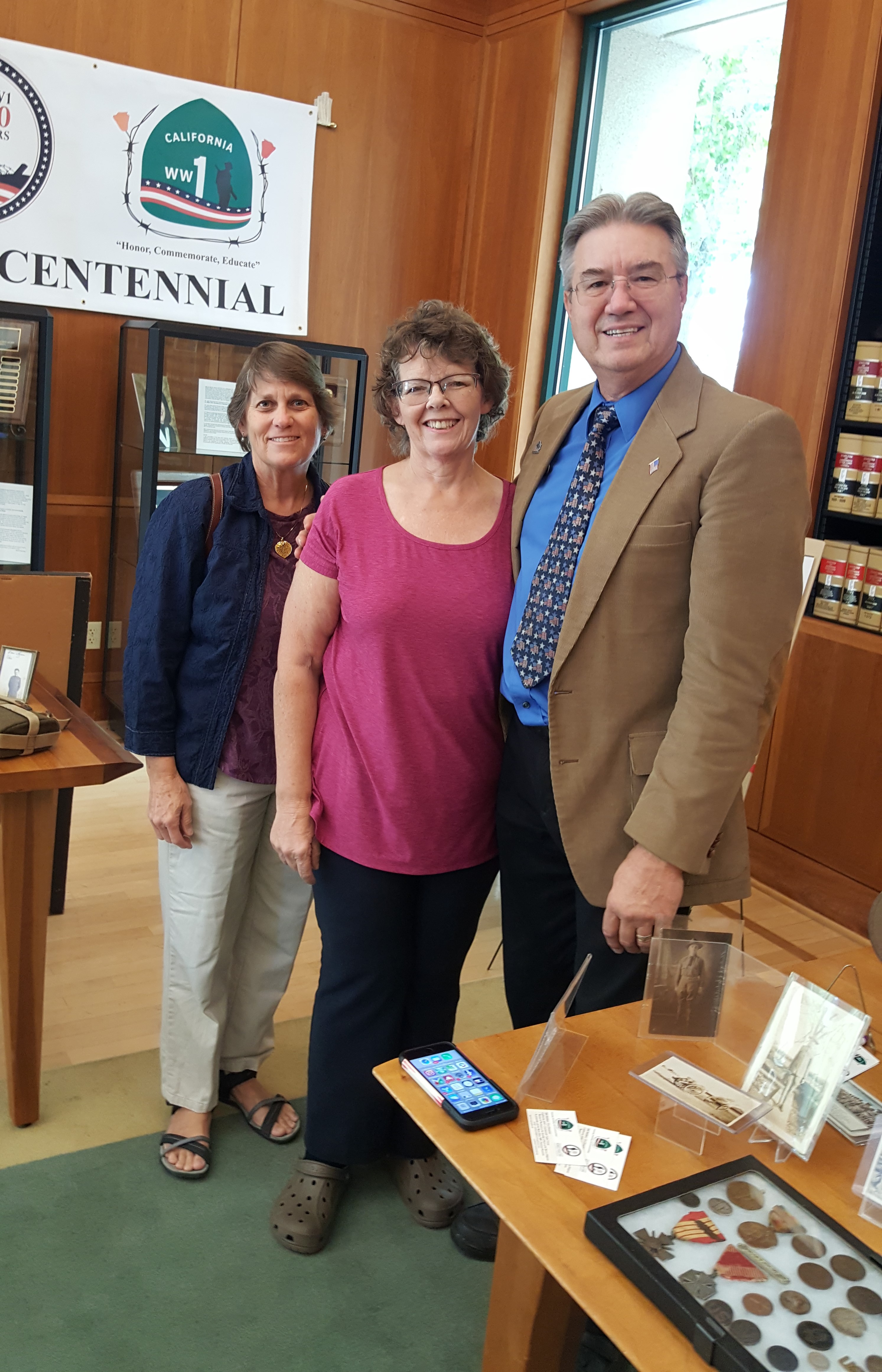 Dr. Miriam Vivian of the UCSB History Department expressed many thanks to Mrs. Joni Bettten and her husband, Co-Director Bill Betten for making the trip and all the effort.
Beginning at 7:45 a.m. the conference check-in in the Humanities Office Bldg. offered attendees coffee, fruit, and bagels to awaken interests and fuel their groggy stomachs before starting The four sets of panel each containing multiple presentations.
Session I, ran from 8:20 to 9:30, with the option of attending two different, but simultaneous panels. 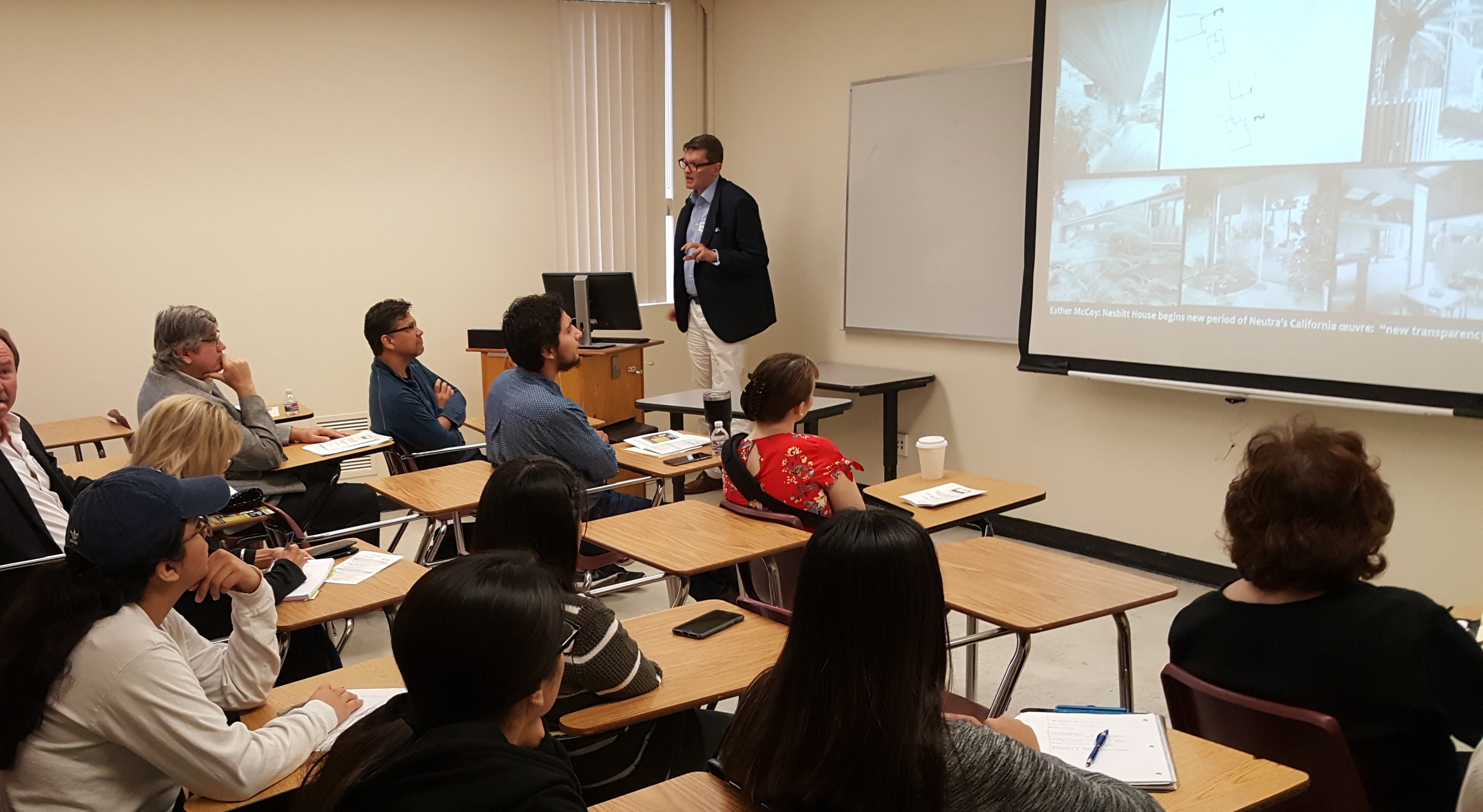 Professor Volker Welter of UC Santa Barbara speaks at the CSUB WW1 conference on how WW1 effected domestic architecture.Panel A, entitled: The Effects of World War I on Southern California, was chaired by Dr. Douglas Dodd, and included three presentations.
First was “The Great War as Civic Development: Long Beach, 1916-1925” by Craig Hendricks, of the Historical Society of Long Beach. Second was “Echoes from the Great War: Richard Neutra’s Domestic Architecture in 1940s Southern California” presented by Volker M. Welter, Professor of History of Art and Architecture, UC Santa Barbara. And the third was titled “Plague in the Boomtowns: The Spanish Influenza in Bakersfield and Kern County, 1918-1920” which Garth Milam, MA, CSU Bakersfield presented.
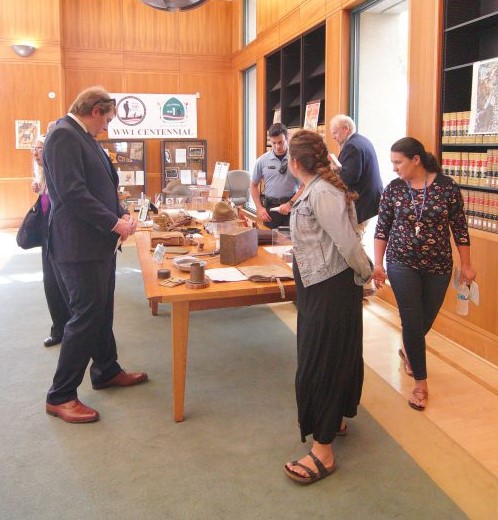 Conference attendees examine the WW1 display next to the California WW1 Centennial Task Force table. (Photo courtesy of the Public History Institute)At the same time Panel B, entitled, Archives, Women, and Art in World War 1 gathered in a room across the hall chaired by Dr. Marie Stango where Archives of the Great War, Women’s Experiences in the War, and the War’s Effects on Art was offered by Chris Livingston, Archivist, Historical Research Center and Lori Wear, Curator, Kern County Museum. At that, a CSU Bakersfield student, senior Judith Carrillo, spoke
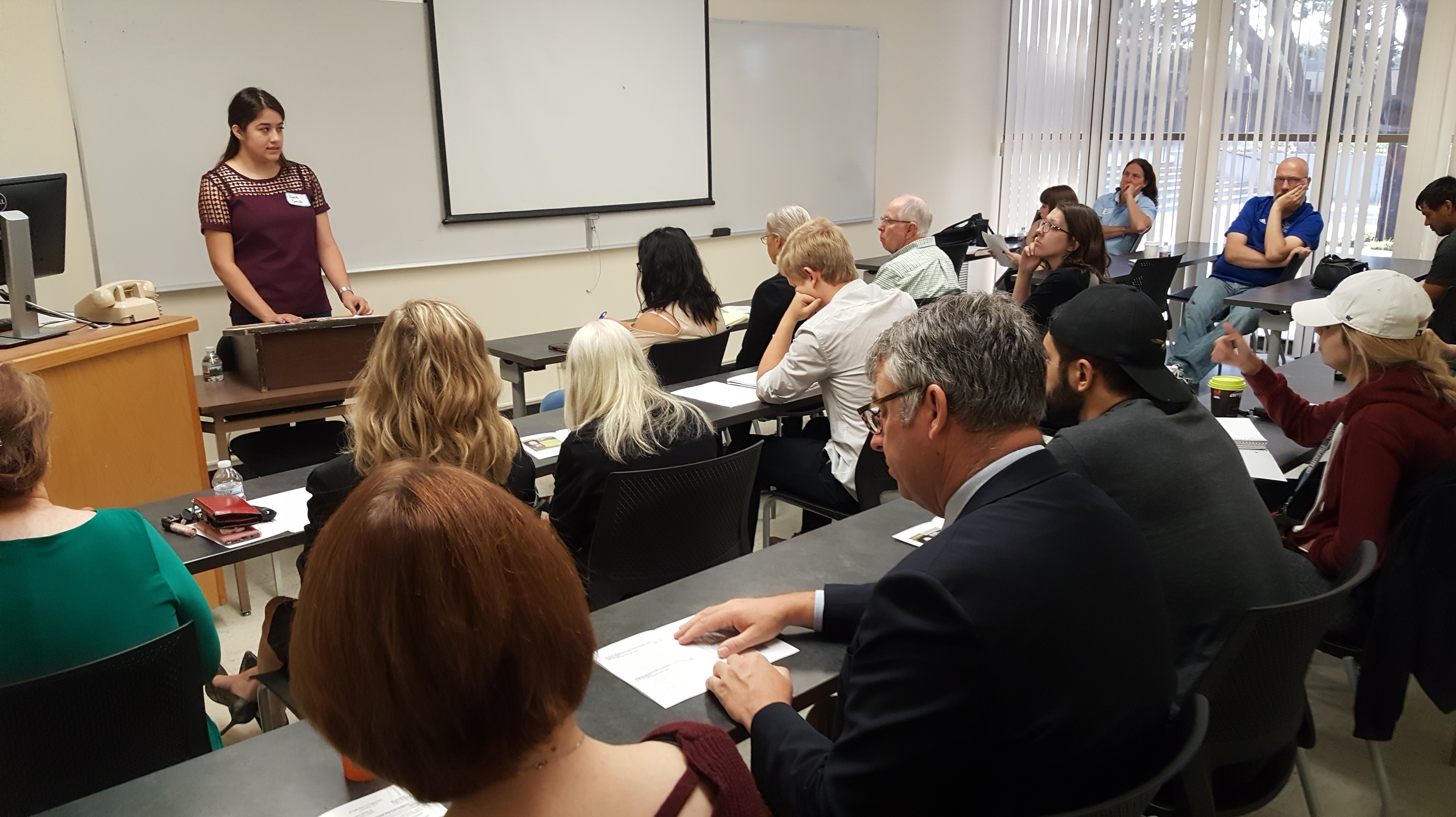 CSU Bakersfield senior Judith Carrillo speaks to an interested group during Panel B. on “World War I and its Effects on Vera Brittain’s Life” followed by “The Effects of World War I on Art: Living History and Emotion through the Lens of Child and Adult Art” by Dianne Turner, Professor of Art Education and
Jennifer Arthington, PhD, Lecturer in Art Education and Psychology, CSU Bakersfield.
In Session II from 9:35 to 10:45 a.m. Panel C, called Historical Insights from Wartime Letters and Memoirs
chaired by Dr. Sean Wempe, ran in Rm 103. This panel topics were “The Spanish Flu at UC Berkeley”
offered by CSU Bakersfield senior, Americo Prado, “'On the Sacred Soil’: Remembering June 1918 and the U.S. Marines who Fought in France” by Darin D. Lenz, Assoc. Prof. of History, Fresno Pacific University, and “1918 War Letters: Deception to Protect the Family, A World War I Case Study” presented by Ava F. Kahn, PhD in History, UC Santa Barbara,listed as an independent scholar.
Concurrently, Panel D engaged the heading of American Politics and Policies: Connections to World War I in Rm. 104 chaired by Dr. Steve Allen. Robert Wells, a senior at CSU Bakersfield spoke on “For Country or Homeland: The Challenge for German Americans during World War I” While another CSU Bakersfield senior, James White, submitted “World War I and The United States’ Occupation of Haiti.” Mark Martinez, Professor and Chair of Political Science, CSU Bakersfield presented “Is History Whispering in our Ear?”
 The audience settled in after viewing the California WW1 Centennial Task Force display. A portion of the cww1ctf display can be seen in the rear.
Task Force Co-Director Bill Betten and his wife had been asked to exhibit Bill's impressive collection of WW1 artifacts, original photos, and centennial certificates and proclamations. Bill answered general questions about the display while Joni oversaw a table specifically to answer questions about the Task Force and fundraising for the new WW1 Memorial in Washington DC. The California WW1 Centennial Task Force display due a lot of attention as the conference participants shifted into the main lecture hall of the facility. The display included actual artifacts that the American Doughboys carried, as well as some from allied and enemy soldiers. At one side of the room stood many of the state and local proclamations from throughout California commemorating those who served and recognizing the California WW1 Centennial Task Force as the state's official centennial commemoration organization. Here a complete original uniform from the US Army Air Corp stood proudly.
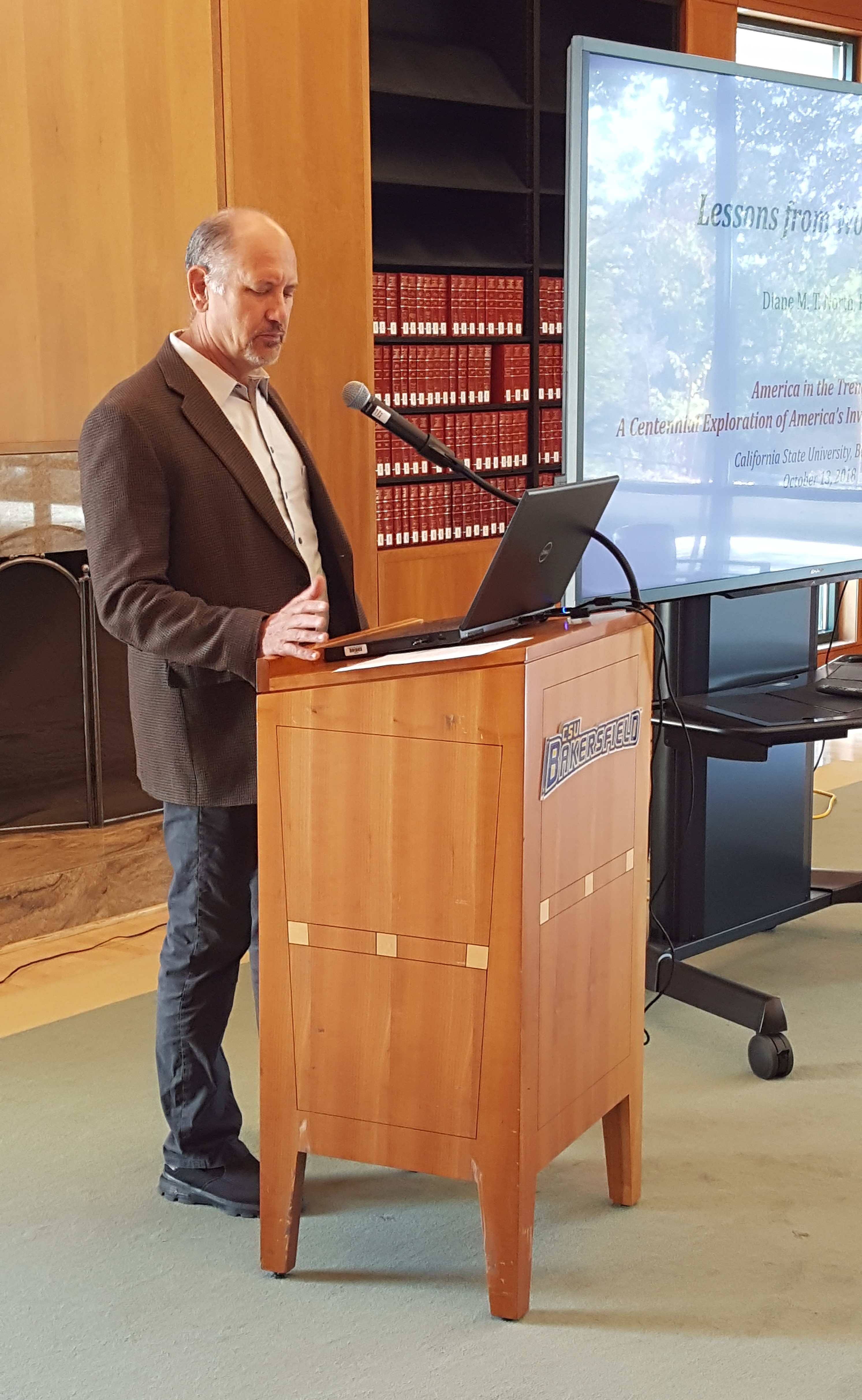 CSUB Dean, Curt Asher greets the audience and kicks off the second half of the conference.At 11:00 a.m., the keynote address
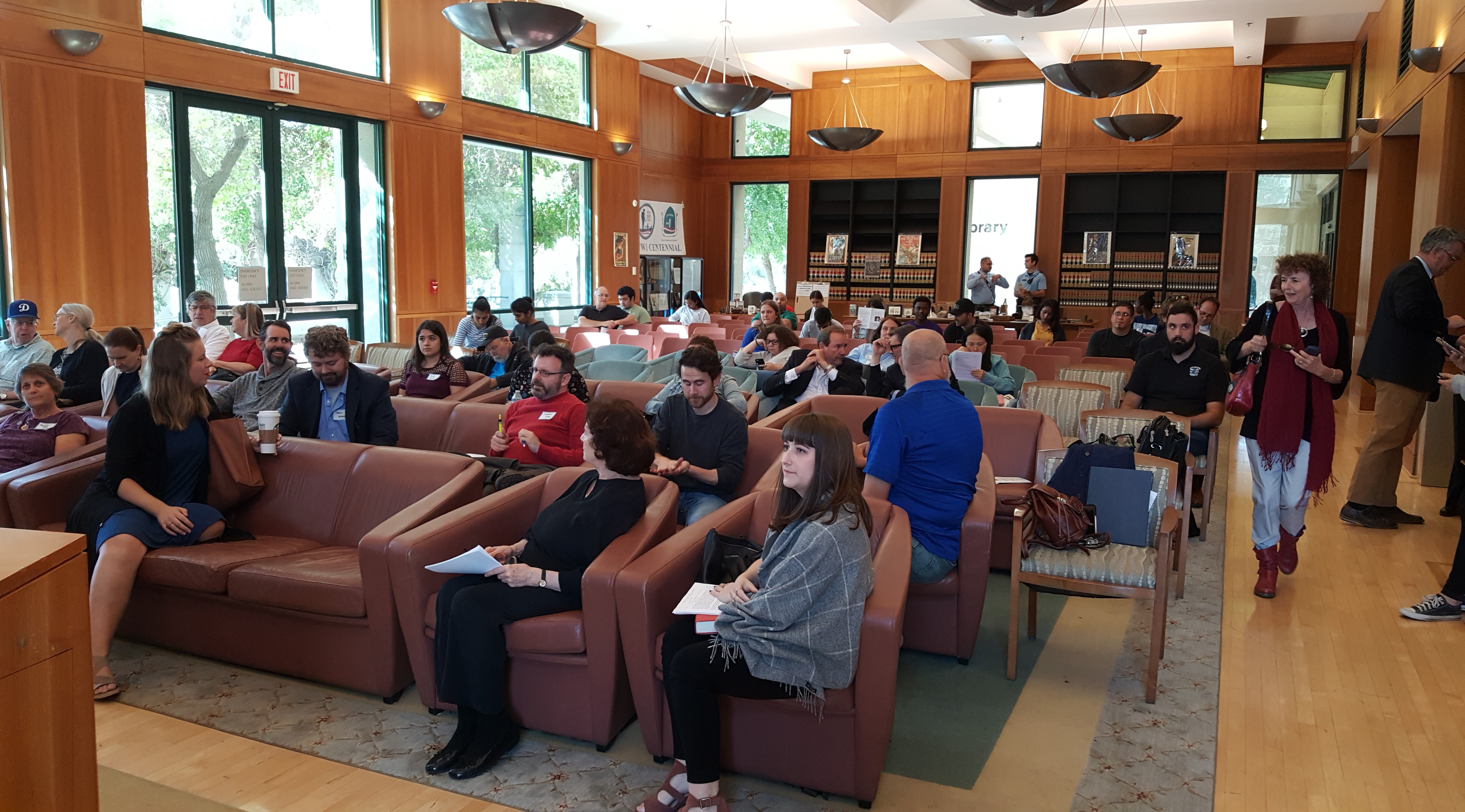 The CSUB WW1 Conference Participants await the second portion of the day which included the keynote speaker. was presented in the Dezember Reading Room in the Walter Stiern Library. As participants settled into thier seats for the keynote presentation, many continued taking notes on the California WW1 Centennial Task Force World War One display until CSUB Dean, Dr. Curt Asher began opening remarks and introduced Dr. Miriam Vivian, organizer for the event.
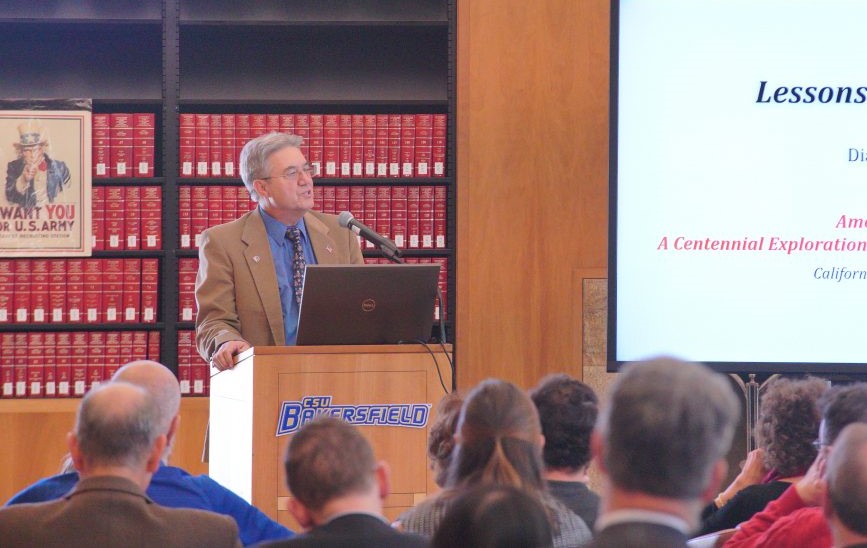 Co-Director Bill Betten talks about the "Bells of Peace" and the efforts to place a World War One monument on the National Mall in Washington DC. (Photo Courtesy of the Public History Institute.)Before continuing, Dr. Vivian introduced Bill Betten whom she had asked to tell about the Task Force and the United States World War One Centennial Commission's "Bells of Peace" bell tolling initiative. She also asked him to explain the commission's mission and plans to place a WW1 Monument on the National Mall in Washington DC and the fundraising efforts to that end.
 Dr. Miriam Vivian addresses the conference audience in the Walter Stiern Library in the Dezember Reading Room.
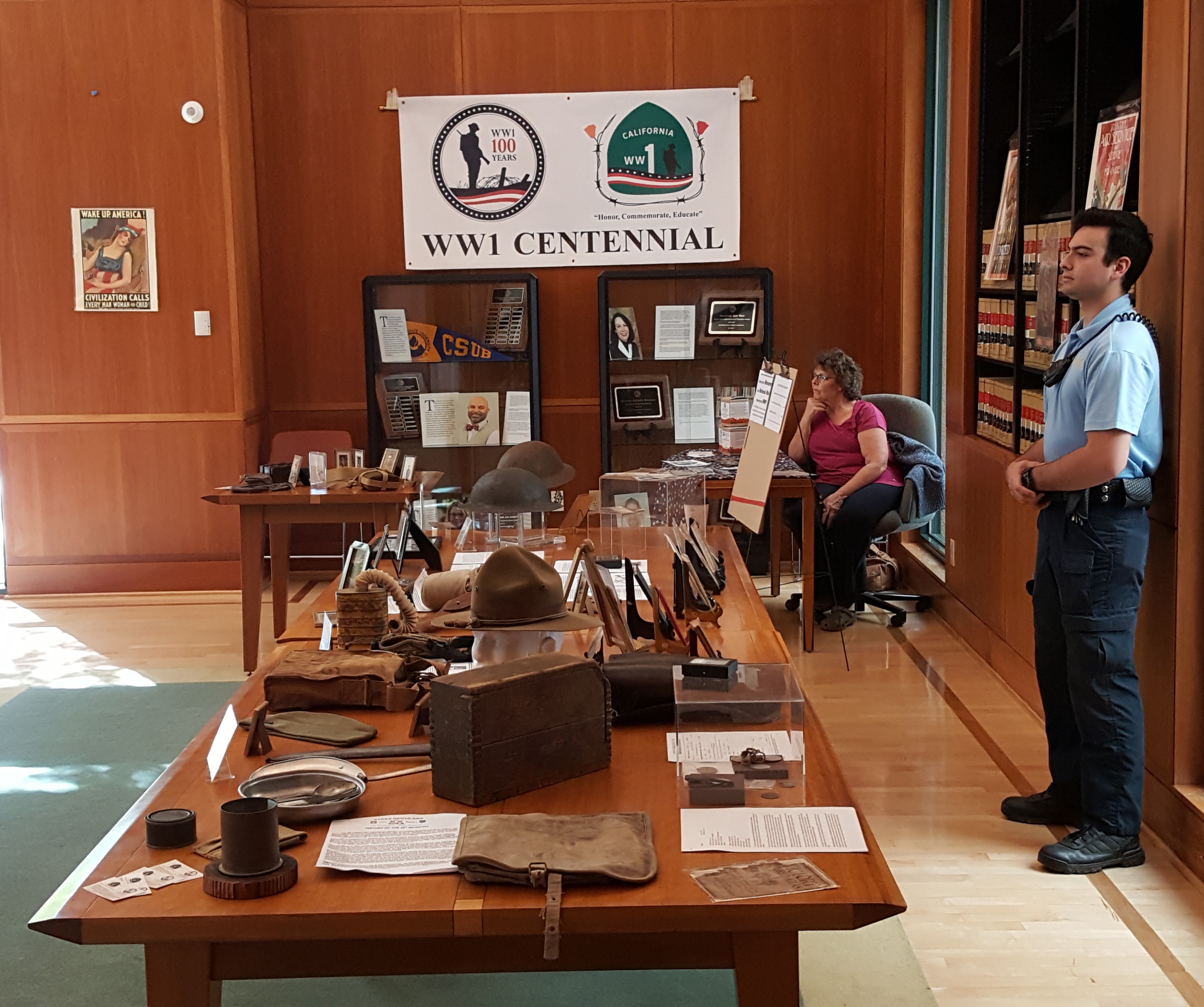 Joni Betten sits at the California WW1 Centennial Task Force table intently listening to the speakers at CSUB as a security person who slipped in to listen also took great interest in the topic.
The History Forum's keynote speaker Dr. M.T. North of the University of Maryland University College addressed the topic, "Lessons from World War I." The History Forum is created and sustained by the faculty of CSUB's Department of History. Since 1999, the History Forum has invited, local, national, and international speakers to discuss their research or address some topic relevant to the study of history.
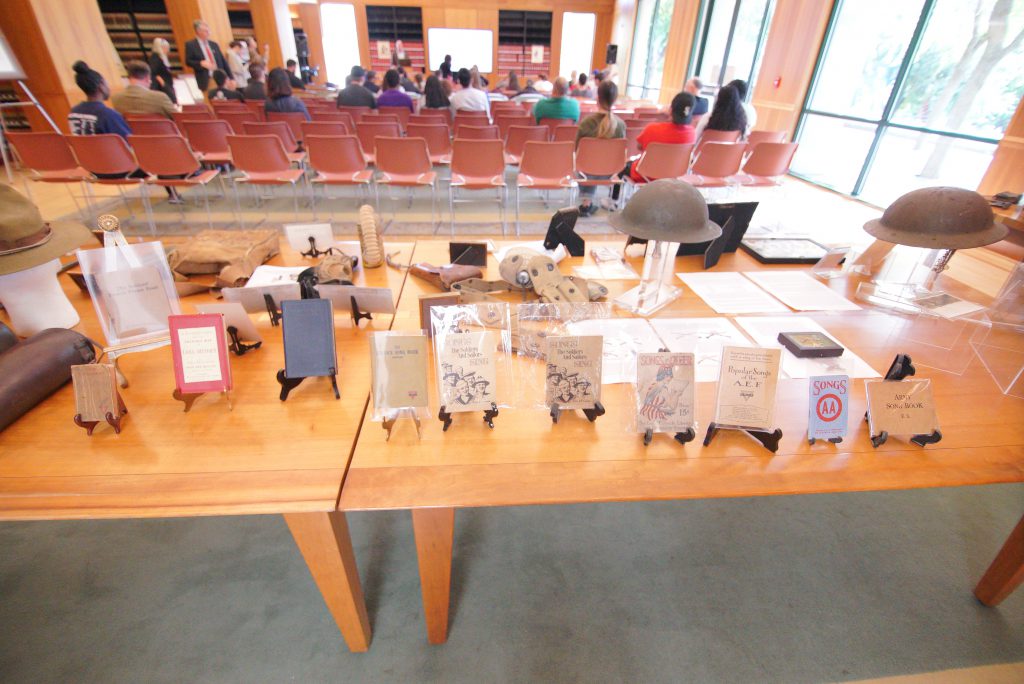
A portion of Bill Betten's WW1 display at the back of the lecture hall (Photo courtesy of the Public History Institute)
For more information about the CSUB History Forum visit http://www.csub.edu/history/index.html
October 18, 2018 - America's Great War Romance: Love and Death, 1917-1919
Chapman University - Wilkinson College of Arts, Humanities, and Social Sciences - Leatherby Libraries B03
By Bill Betten, Co-Director of the California WW1 Centennial Task Force

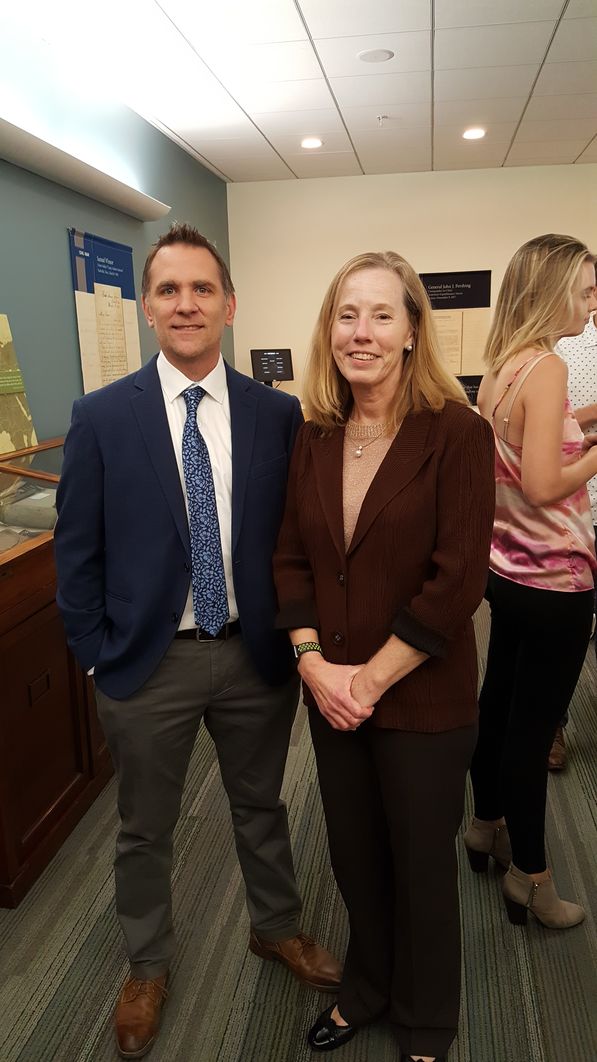 Dr. Huebner and Dr. Keene greet guests at the reception.The California WW1 Centennial Task Force had been invited to attend Chapman University’s America’s Great War Romance: Love and Death, 1917-1919. The event at Wilkinson College of Arts, Humanities, and Social Sciences presentation at the Center for American War Letters included displays and speakers featuring a special lecture by Dr. Andrew J. Huebner, Associate Professor of History at the University of Alabama.
After a period of a well-stocked reception, in a room exhibiting a wide variety of letters, artifacts, and posters discussing the writings of those 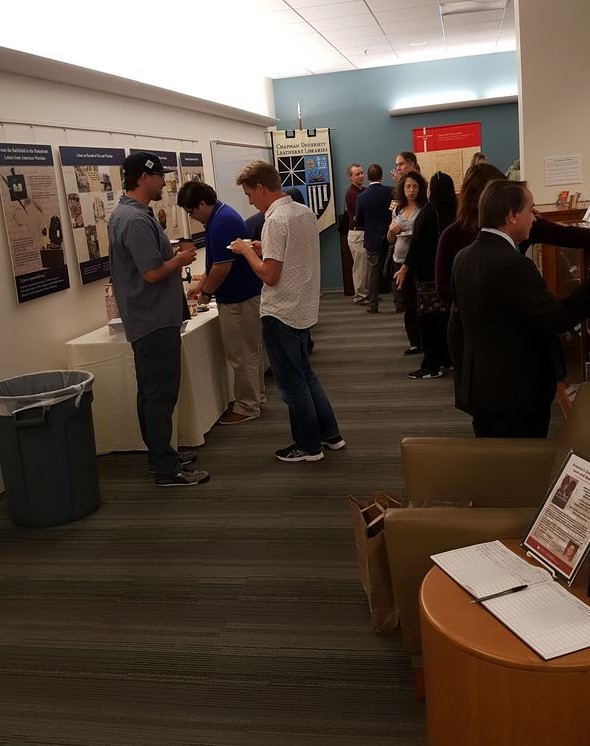 who participated in WW1 at home and over there, Kevin Ross, Acting Dean of the Leatherby Libraries gave his welcome. He made introductory remarks explaining a little about the relationship between the Leatherby Libraries and the Center for American War Letters, and pointed out that the evening was sponsored by the Center for the Study of War and Society, the Department of History, and the Leatherby Libraries. He then introduced Andrew Carroll, Presidential Fellow in American War Letters, and
 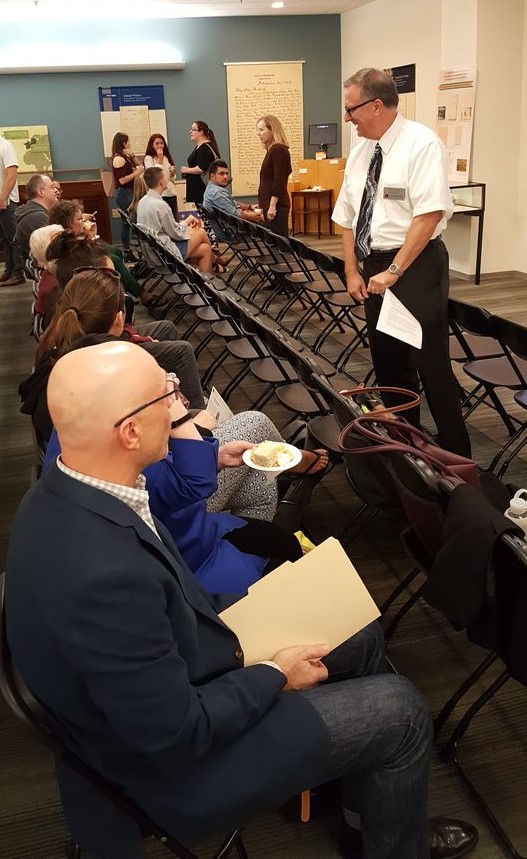 Dr. Keene and Dean Kevin Ross chat with invited guests.Founding Director of the Center for American War Letters. Dean Ross shared that Carroll is a bestselling author, historian, playwright, and currently the director of the Center for American War Letters at Chapman University. Along with the Nobel Laureate Joseph Brodsky, he co-founded the American Poetry & Literacy Project.
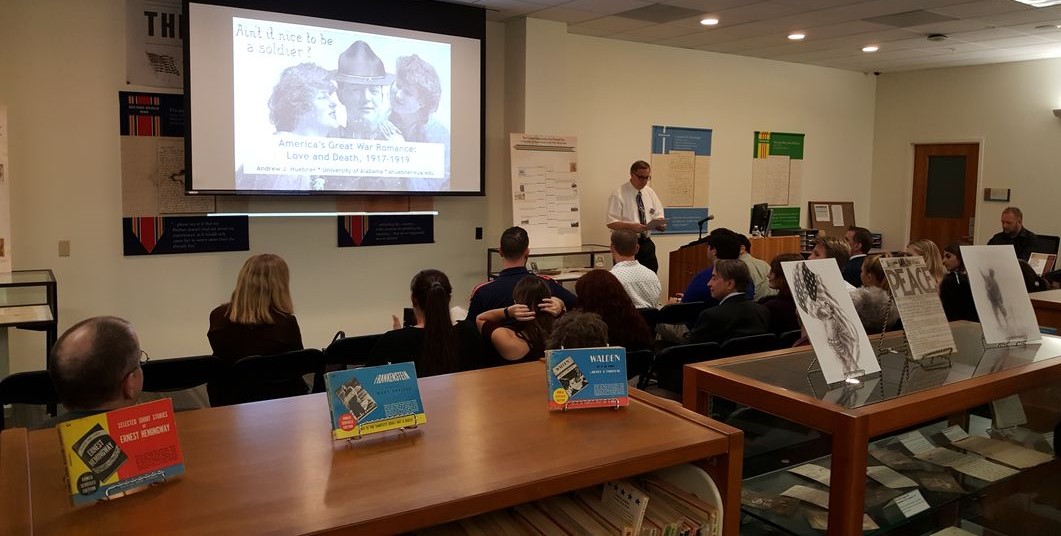 University Dean Kevin Ross speaks. (Only those seated in front of the exhibit are visible.)Mr. Carroll explained that it was his book LETTERS OF A NATION: A Collection of Extraordinary American Letters, a New York Times bestseller, which led him to create the Legacy Project, to preserve wartime correspondences. He had collected an estimated 100,000 letters from every war in U.S. history which he then donated to Chapman University. The Legacy Project has been re-named “The Center for American War Letters,” and is now archived in Leatherby Libraries at Chapman. Through this work with the Center, Carroll continues to uncover and preserve soldier’s letters, and call light to the importance of saving the war-related personal communications.
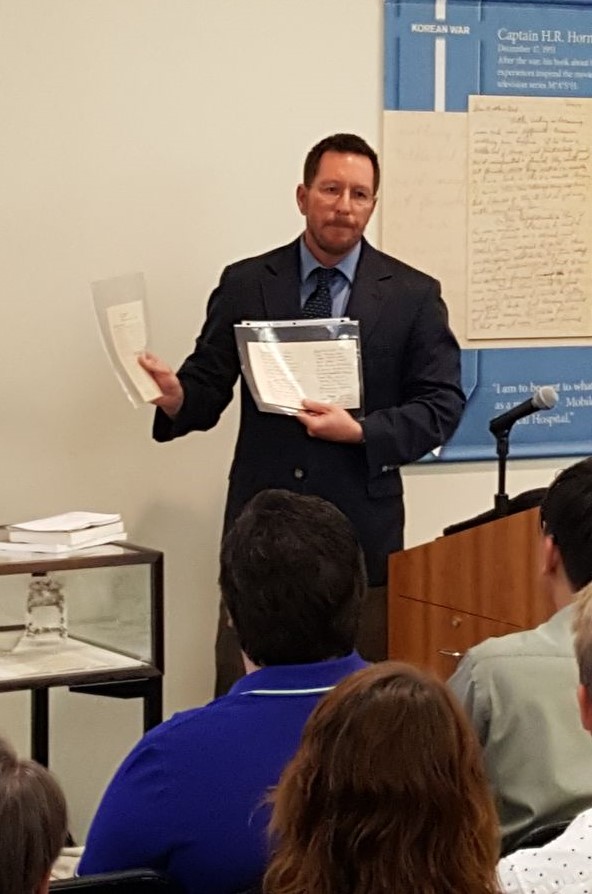 Andrew CarrollAdditionally, Carroll has edited two other New York Times bestselling books on the topic which feature hundreds of previously unpublished correspondences from American conflicts, WAR LETTERS and BEHIND THE LINES. He is also the author of the play If All the Sky Were Paper, which began touring the United States in August 2013 and has been performed coast-to-coast, from the Kirk Douglas Theater in Los Angeles to the Kennedy Center in Washington, DC. All of these performances were directed by John Benitz, the chair of Chapman University’s Theater Department. The play is based on Mr. Carroll's worldwide search for “the most extraordinary war letters ever written.”
Andrew Carroll’s most recent book is MY FELLOW SOLDIERS: General John Pershing and the Americans Who Helped Win the Great War, published in 2017, and that same year Andrew was featured in the PBS documentary, “The Great War,” about World War I.
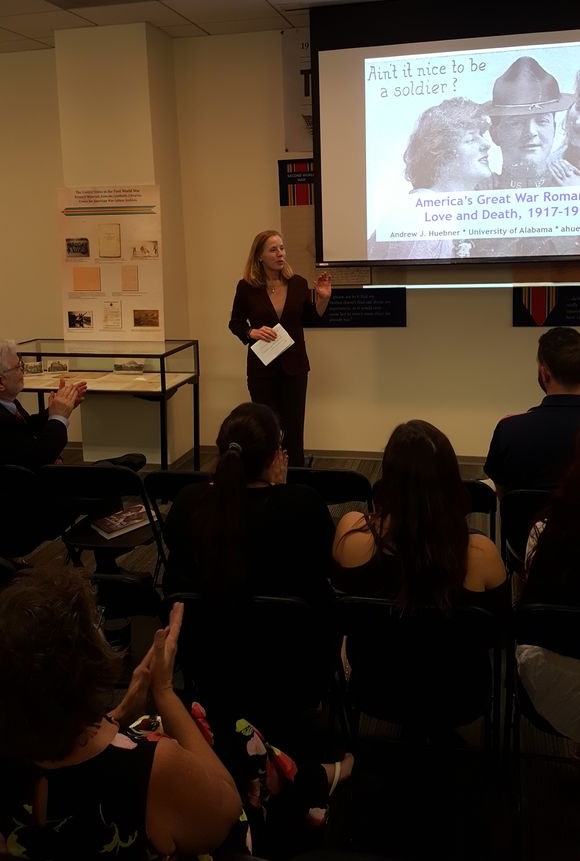 Dr. Jennifer KeeneDr. Jennifer Keene, Professor and Chair History Department Chapman University, then stepped up and shared that the evening’s event was in conjunction with the exhibitions: The World Remembers: Honoring Victory and Loss at the End of the First World War on view from September 12 – December 14, 2018, and the international The World Remembers display on view from September 12 – November 11, 2018 in the Center for American War Letters Archives and invited all to see these exhibits if they had not already.
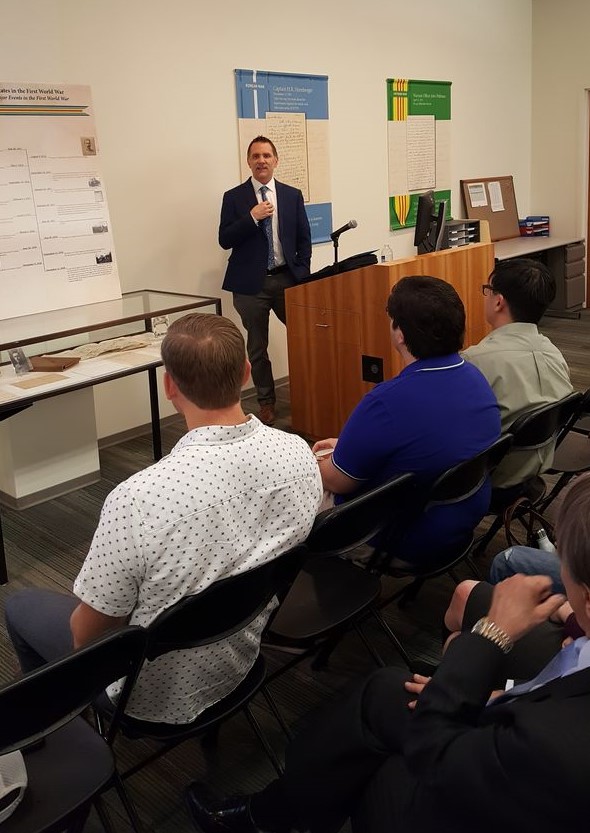 Dr. Andrew Huebner, author of Love and Death in the Great WarDr. Keene then introduced the evening’s guest speaker, Dr. Huebner, and that the Department of History shares a unique interest in the topic of the speaker’s book, and explained that it is an important contribution. She mentioned that Dr. Huebner received his doctorate in history at Brown University, and before writing his current release wrote, The Warrior Image: Soldiers in American Culture from the Second World War to the Vietnam.
Then Dr. Andrew Huebner, the author of Love and Death in the Great War, came up and gave a very interesting presentation. He stated that of the Great War era, Americans often hear the tale of American participation told as a love story. “Fighting offered romance, and not just on the battlefield. It promised to stir “khaki-mad” passions in young women, bolster the romantic credibility of the Doughboy, and cultivate national chivalric virtue.”
Instead the tale soon plummets into the reality of war. He states that, “The daily lives of the Missourians Mae and Eliga Dees—visible through a full set of letters between the two while Eliga was fighting in Europe—suggests a different tale of war, one obscured by the passage of time and the romantic tones of American wartime culture.”
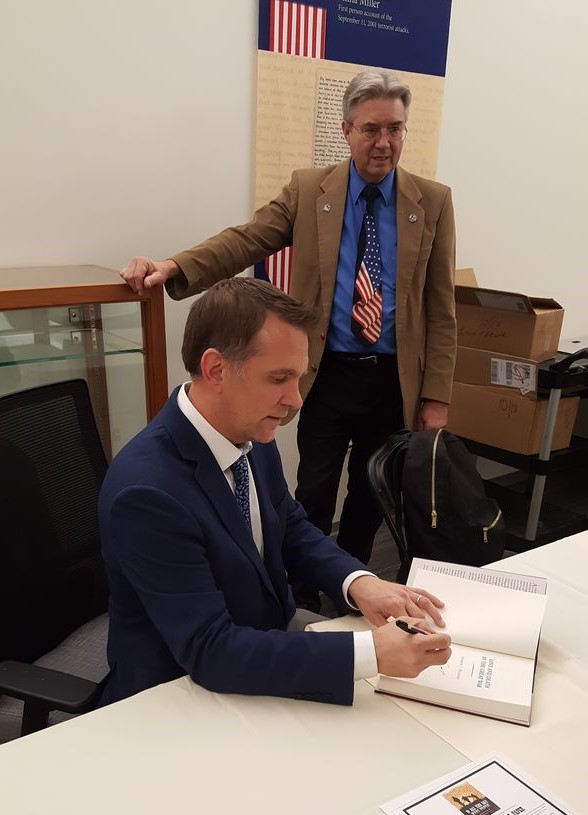 Dr. Huebner signs his book for Task Force Co-Director Bill Betten.
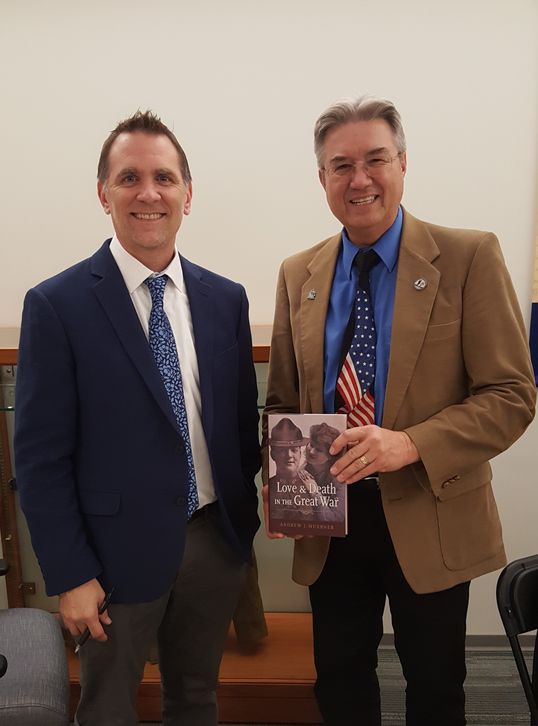 Dr. Andrew Huebner and California WW1 Centennial Task Force Co-Director Bill Betten.
The talk was followed up with a book signing where copies of Dr. Huebner’s book were available for purchase.
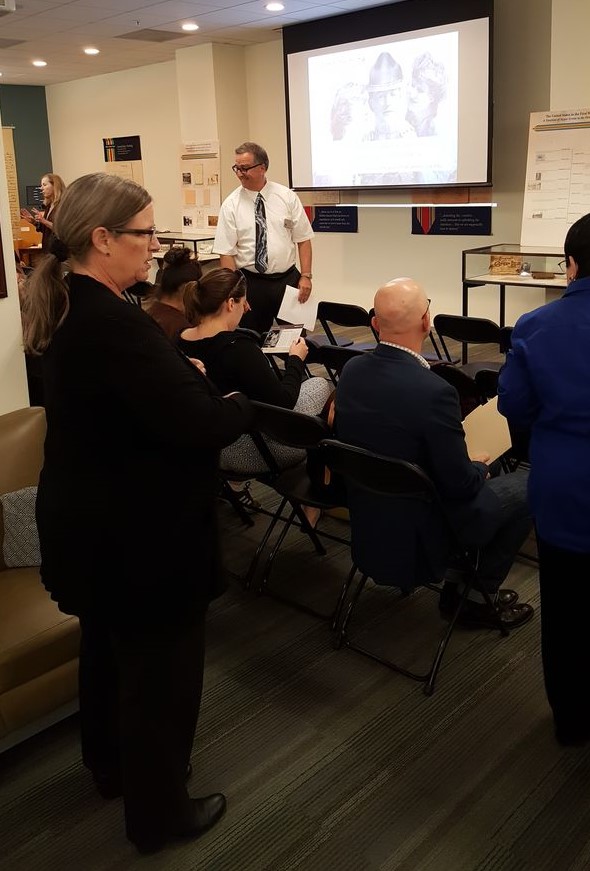
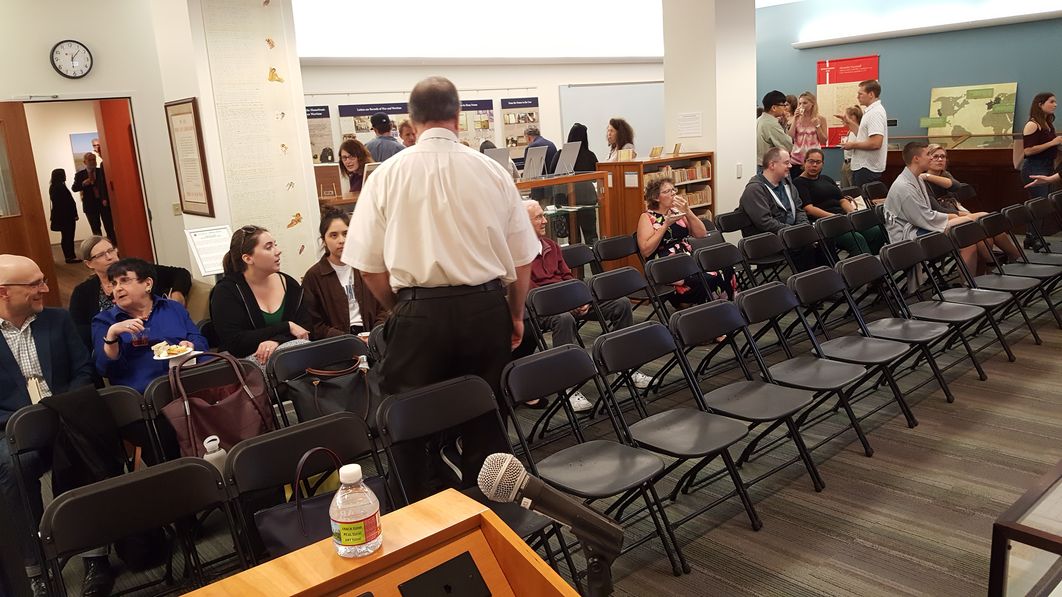
Reception and displays at Chapman University's Leatherby Libraries.
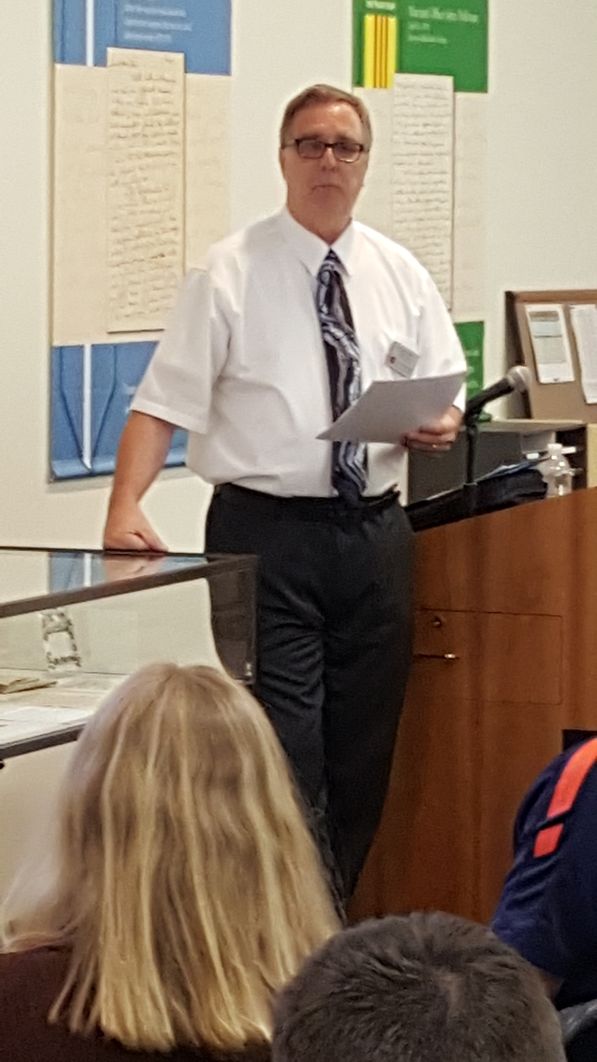 Dean Kevin Ross
 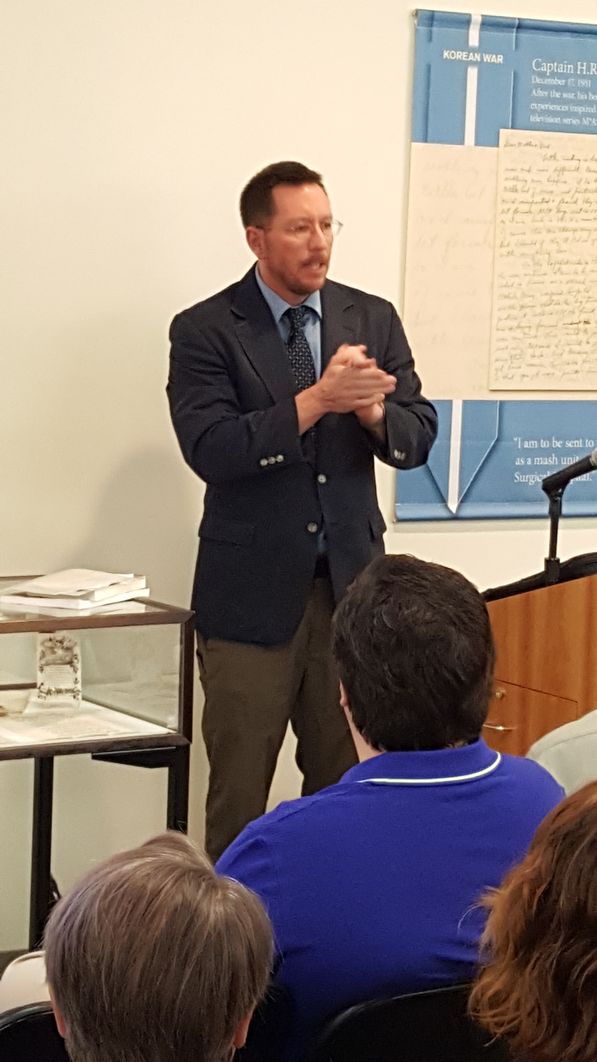 Andrew Carroll
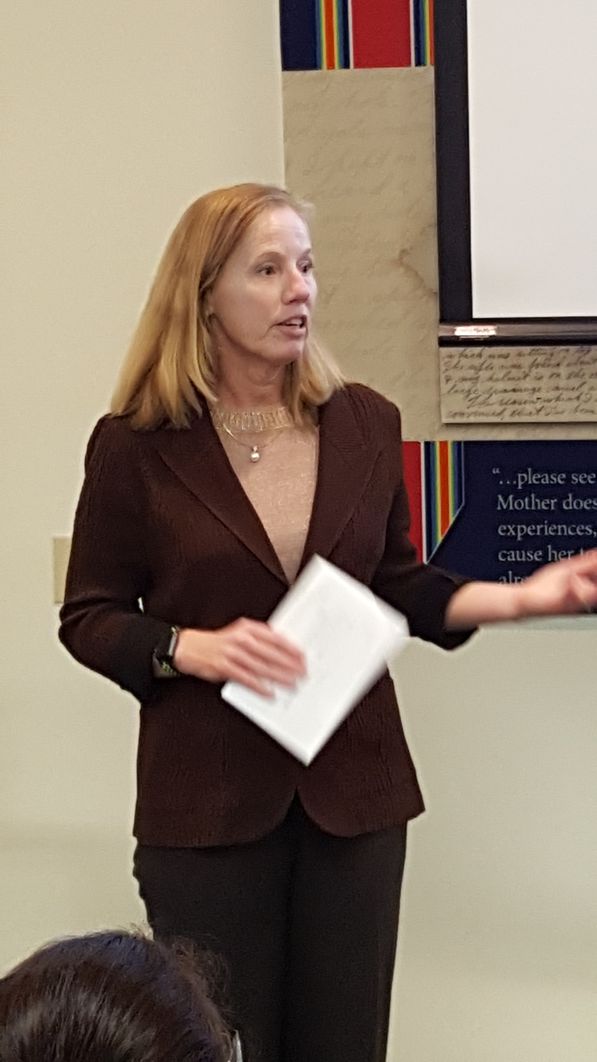 Dr. Jennifer Keene
November 3, 2018 - 2nd Annual Amber Waves of Grain Craft Beer Festival
Fundraiser for Veterans
An event endorsed and approved by the California WW1 Centennial Task Force to commemorate, honor, and educate the citizens of the Great State of California.
By Joni Betten, Member-at-Large of the California WW1 Centennial Task Force
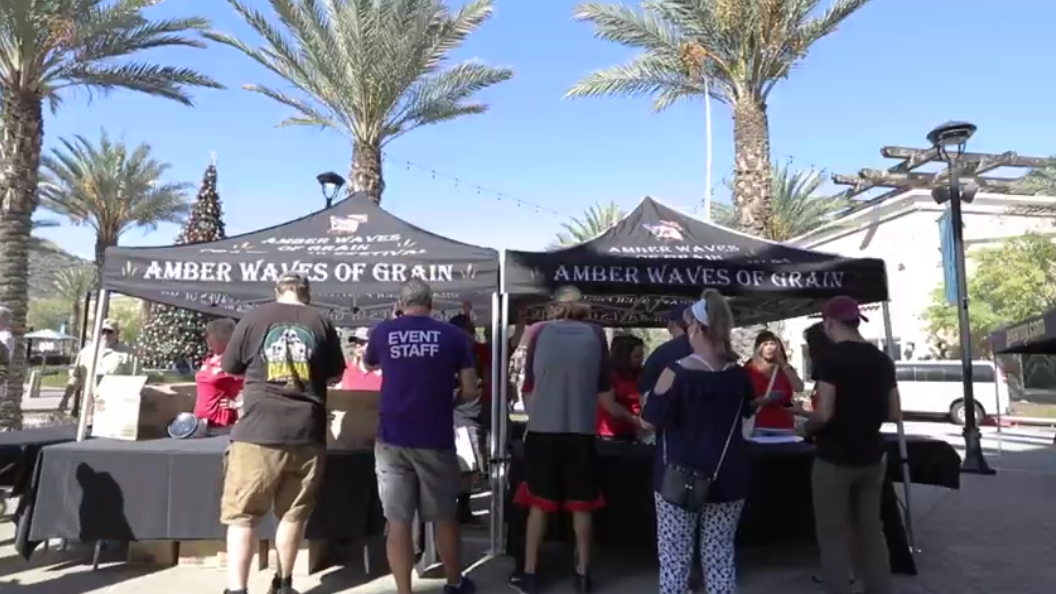 Check-in at the 2018 Amber Waves of Grain Festival.
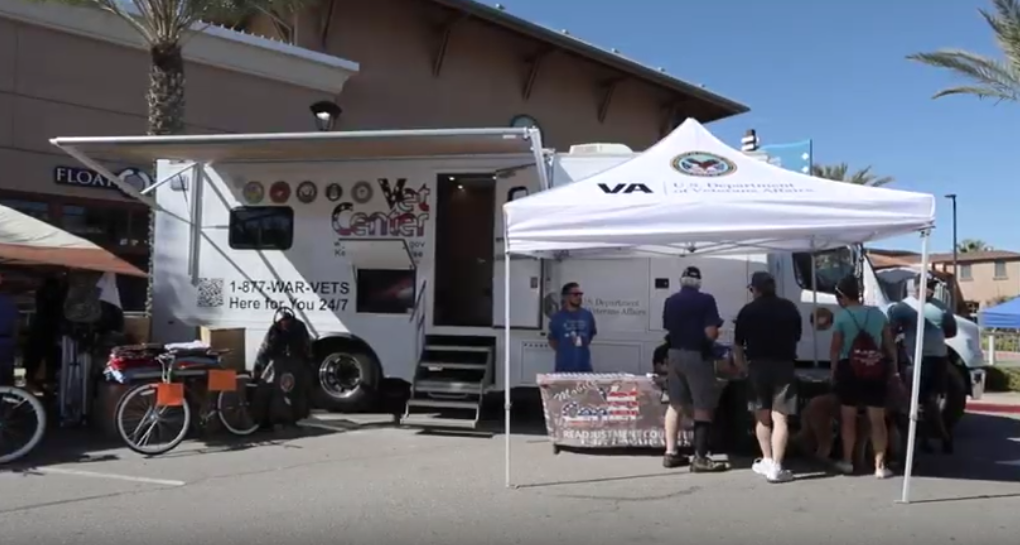
For the second year in a row the Amber Waves of Grains Festival in Corona, California had asked the California WW1 Centennial Task Force to staff a booth and present a WW1 display . The festival, not just known for its offering participants the chance to sample the many craft beers of the Southern California area, is an annual effort to raise funds for Veterans Service Organizations, or VSO’s.
 Arriving at the Shops at Dos Lagos on November 3rd was like attending the set-up of any open market area, everyone is busy trying to get ready for the crowds. This was no different, although there was always someone around who could get you the help you needed. My husband, Bill Betten, Co-Director of the California WW1 Centennial Task Force was as busy as usual setting up the Task Force booth and his extensive WW1 display, and relied upon the helpful Bill Steinkirchner, an event organizer and owner of Stone Church Brewing. Bill, a retired U.S. Army colonel, was able to locate for us some necessary tables.
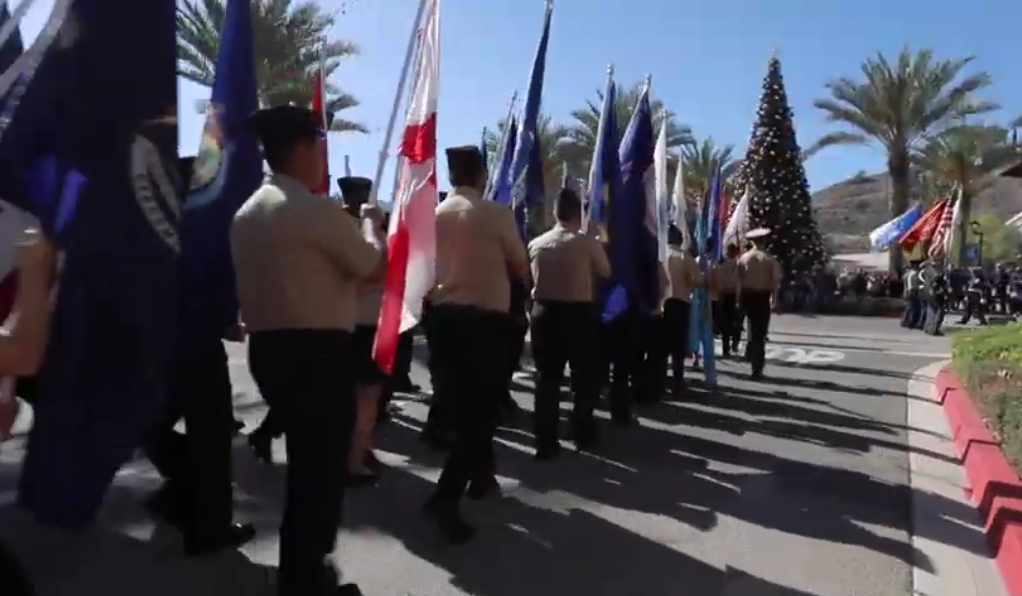
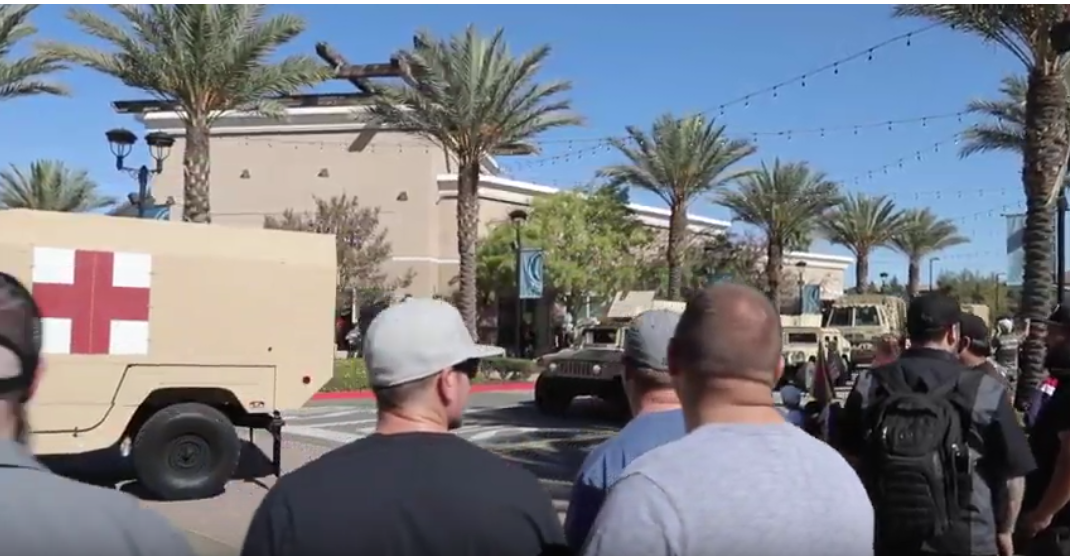
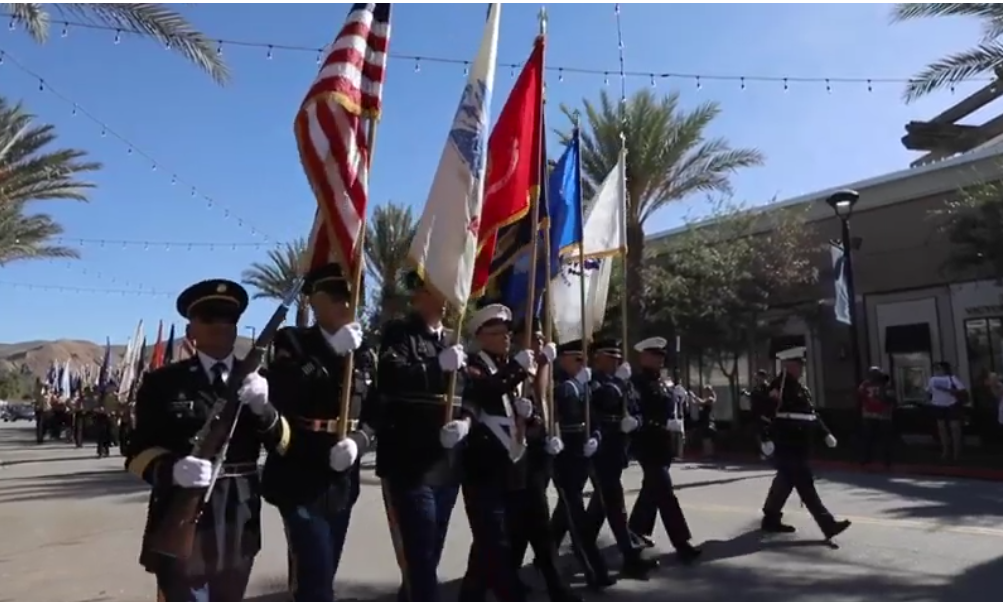 Once we were set up it wasn’t long before the event’s parade got started. As usual for this parade, it wove its way down the middle of the street that divides the shops at Dos Lagos and stood lined with the wide-variety of booths. Local High School bands, military outfits, veterans, veteran motorcycle clubs, vintage military vehicles, classic cars and more made for an exciting and entertaining parade. It seems the crowd gets bigger every year. As we watched, our patriotic spirit was recharged.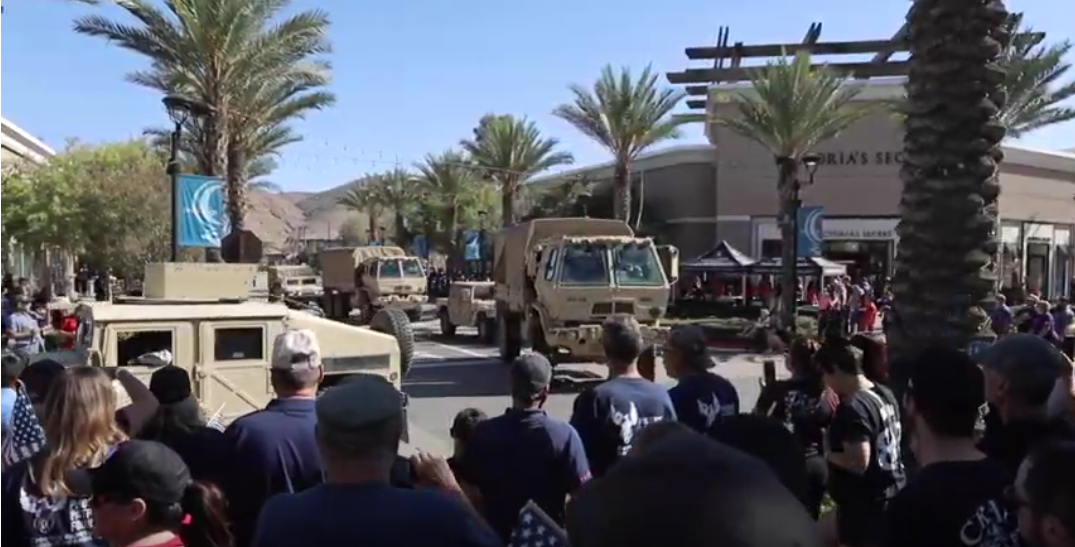
My favorite entry was the old veteran driving the self-propelled gun. It was so unusual that I did not realize that there was a big hairy gun sticking out the back. I thought it was some kind of a pole that he was delivering. I was distracted by the funny-looking ATV cart it sat on, not to mention the vet's ear-to-ear grin.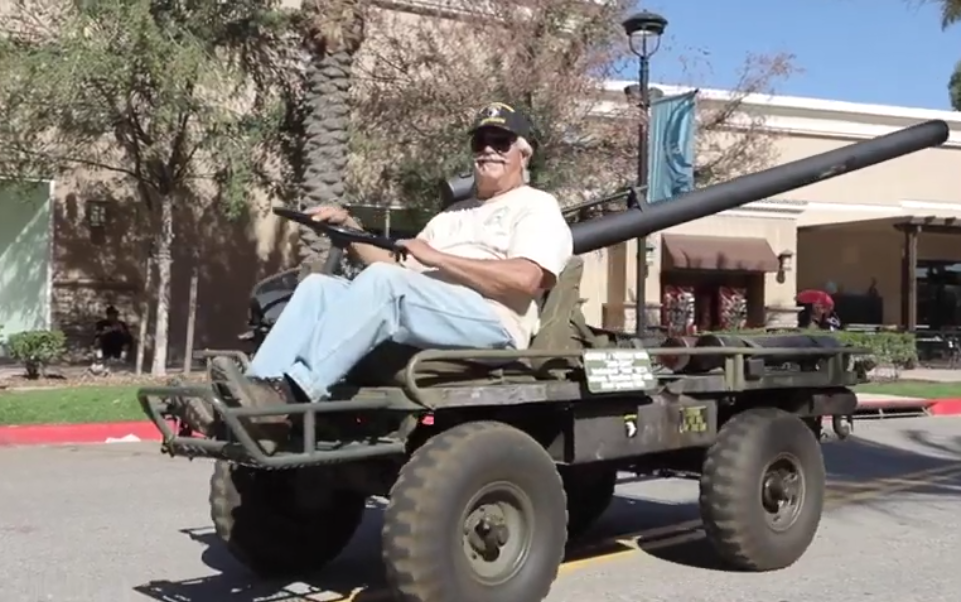
To top off an already exciting parade we were treated to a aircraft fly-over. Two military helicopters came whizzing down the parade route causing the audience to cheer in delight. This was a special 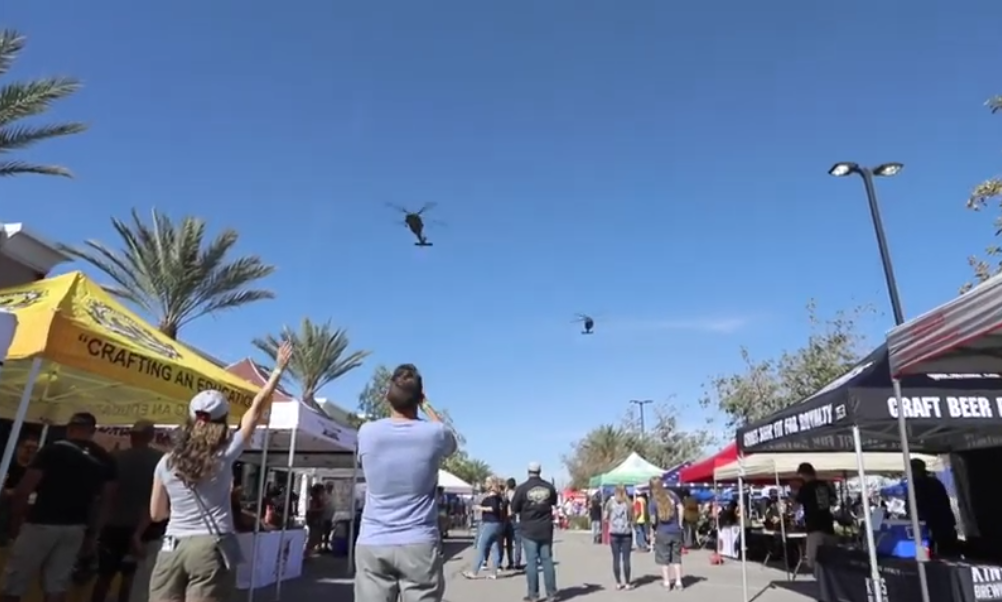 unexpected surprise. These types of bonuses are traditional for the Amber Waves of Grain Festival. Last year they had a functioning World War Two Sherman tank.
As Bill Steinkirchner will tell you, the real purpose of this gathering is to support veteran groups, although the crowds may tell you it is to sell craft beer tasting tickets. 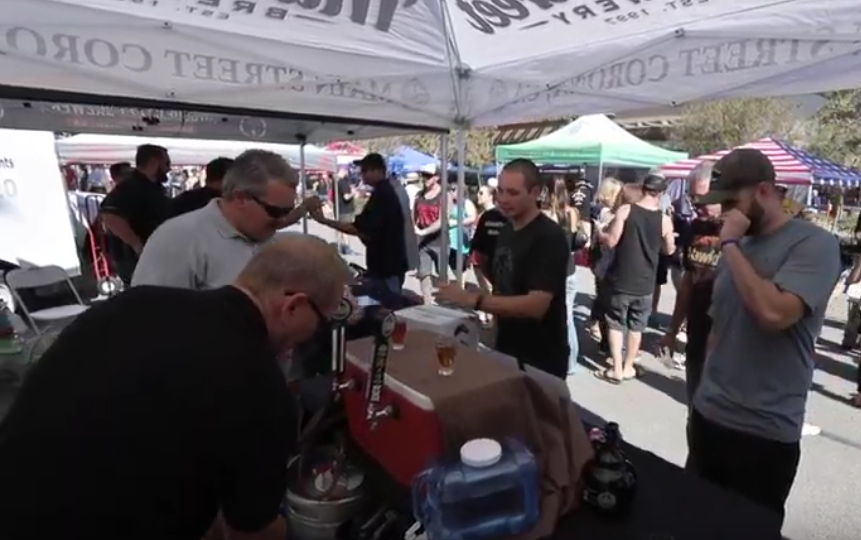 In reality though, it is the beer tasting that raises the money, since all proceeds are donated to the many Veteran's service Organizations. A ticket allows adult participants to sample from all the many microbrewers contributing. And trust me, there are lots of them wanting to show off their special brew. But with the live bands, the military reenactors, the veteran groups, and the many other vendors it’s a fun time for all.
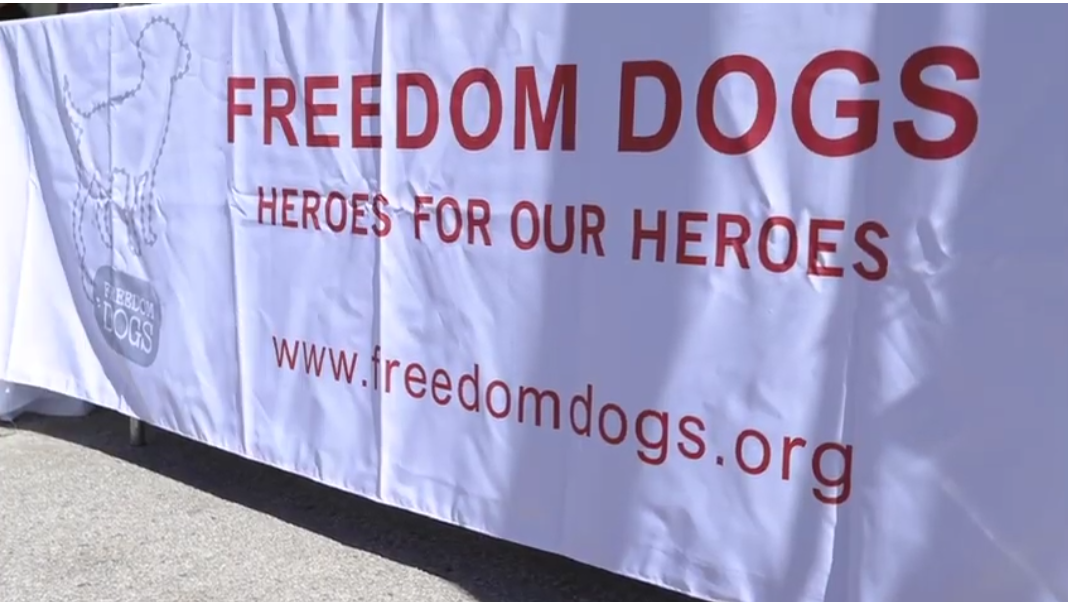 Freedom Dogs is a desperately needed veteran's support organization .
We were there reminding people of the Great War and informing all of the quickly arriving Armistice Centennial Event called the “Bells of Peace” when any American across the land can take part in a ringing of the bells at the centennial of the end of WW1 at the Eleventh Hour of the Eleventh Day of the Eleventh Month. Even though it was already  November, it was still a rather warm California Day there in Corona. We were very busy talking with those who were meandering pass, and rarely were able to leave our booth. We did get to take turns sneaking away and got to visit a little with our friends from the Great War Historical Society, Southern California’s WW1 reenactors.
It turned out to be a very successful day, for us. Many folks had been unaware of the “Bells of Peace” initiative, and had eagerly taken our flier as a reminder, promising to participate in just a few days.
Also, as was later revealed at a party which invited veteran group who participated for the money distribution, many of the local VSO’s were given much needed support to continue their programs. They even gave the California WW1 Centennial Task Force some funds to help defray costs, and support the national effort to fund the building of a WW1 monument on the National Mall in Washington DC. With the centennial of WW1 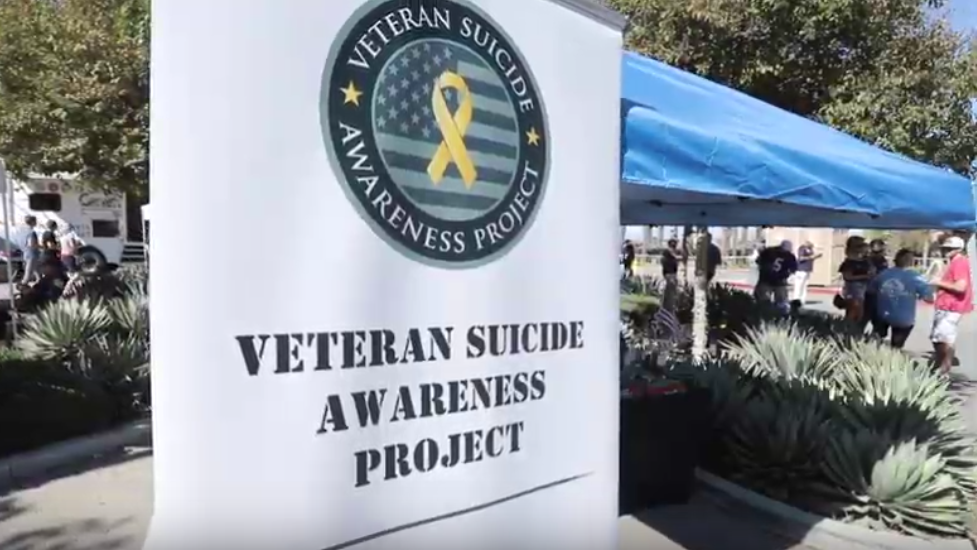 coming to a close, I don’t know if the Task Force will be represented again next year at the Amber Waves of Grain Festival, but we may just show up to enjoy the fun and great company.
November 8-9, 2018 - Imperial Implosions: World War I and its Global Implications
California State University at Channel Islands, Camarillo, California
 An event indorsed and approved by the California WW1 Centennial Task Force to commemorate, honor, and educate the citizens of the Great State of California.
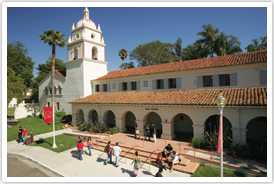 The Famous Bell Tower of California State University at Channel Islands.
Just days prior to the centennial of the ending of World War One, historians and educators gathered on the sun-drenched coast of California for a two day conference to investigate and explore world-wide consequences concerning The Great War. Not unlike the plans made by belligerents one hundred and four years earlier at the beginning of WW1, the conference plans were also to be found unachievable due to unanticipated wildfires in the area that soon raged out of control.
California State University at Channel Islands, Camarillo, California, and the History Department had announce that it would host a conference commemorating the 100th anniversary of the end of World War I on November 8th and 9th, 2018. The focus of the conference became it's title, Imperial Implosions: The Global Implications of World War I.
Featured speakers at the conference were to be  Professor Sean McMeekin of Bard College and the author of The Russian Revolution (2017) and The Ottoman Endgame: War, Revolution and the Making of the Modern Middle East (2015) and
 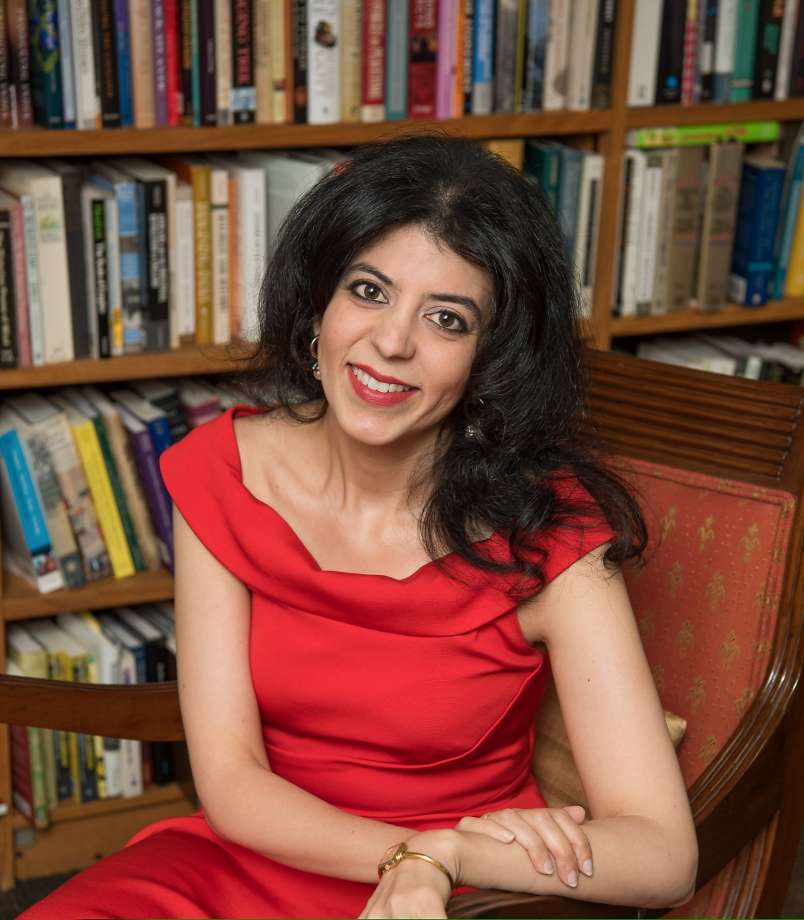 Professor Pria Satia, of Stanford University and the author of Empire of Guns: The Violent Making of the Industrial Revolution (2018) and The Great War and the Cultural Foundations of Britain's Covert Empire in the Middle East (2008.)
 California WW1Centennial Task Force display with sign at CSUCI conferencePresentations were to extend over both days and include other informative talks and educational displays. Speakers and contributions dealing with many aspects of the war, throughout the world, were planned to deal with the significant historical implications and reverberations of World War I. CSUCI Professors P. Scott Corbett, and Michael Powelson had worked hard to prepare, and the morning of the first day of the event promised a fine day ahead with clear blue skies accompanied by warm breezes.
Additionally, two of the Co-Directors of the California WW1Centennial Task Force had been asked to present papers. I being one, had arrived early in the day as I had been asked by Dr. Corbett was to present a paper and address those in attendance. My topic, "James Reese Europe: The Carrier of the Most Virulent Germ of the First World War, and All That Jazz," had been selected from a variety of paper submitted. Likewise, my fellow Co-Director Courtland Jindra was to talk on his submission, "Memorializing the War," of which he is an expert in the Los Angeles area.
 As I spent the morning setting up my enormous displays and hanging posters, maps and images, no evidence presented itself for the disaster that loomed.
As the conference began that morning and the first presenter spoke, the campus's Grand Salon filled with attendees. Collin Wonnacott presented an interesting paper called "War Brides of the AEF in Siberia," a rare, but fascinating topic. Then Micheline Golden was introduced. Her paper, "Pig Kitters and Patriots: Rural American Women and Red Cross Relief Work During the Great War" was nearly complete when, for the first time since the schedule began, the doors opened and the organizers were taken aside. Moments later as Ms. Golden asked for questions from the audience, Dr. Corbett interrupted and apologized explaining that the conference was being terminated, and that the entire university was being evacuated due to a wildfire.
At the outset, the statement struck the crowd as though it were a joke, but clearly someone as serious about the success of the conference would not jest in such a manner. Was this part of the conference in some strange way? I for one could hardly grasp the purpose of such an announcement.
 The smoke had already partially darkened the sky as its acrid odors were everywhere outside.At first, most in the audience as well were stunned by the news, and it took several announcements for all to grasp the urgency of the situation. It was not until after the doors were opened and the smell of smoke cemented the idea in place, did everyone realize the danger. Upon walking outside and seeing that the earlier blue sky was now painted orange and brown, participants audibly groaned to realize the
 campus was being filled with smoke from not one, but two fires that approach from opposite directions. The bright California sun, that had previously warmed the morning, struggled to show even the hazy glow of a sun-setting disk, though still high in the sky.
All presentation equipment as well as my rare and valuable displays had to be abandoned in the rush to leave, though this did not happen as everyone had wished. All had to sit in bumper-to-bumper traffic to escape the area which took several hours to accomplish. Even a smaller college campus such as CSUCI must be populated by thousands in any one particular day, and each it seemed had their own car to take with them.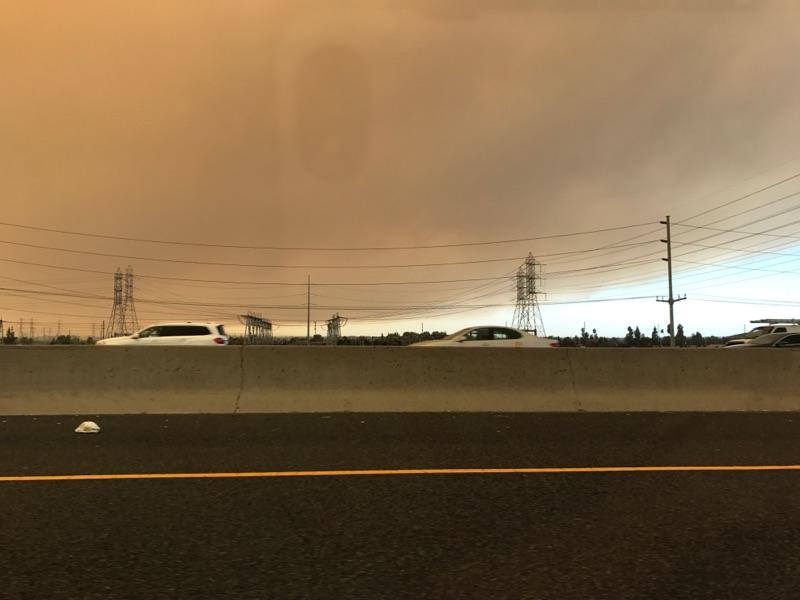
I spent the night in my hotel room but hardly got any sleep. I was so worried that hundreds of unique artifacts would be lost. Rare and hard to find items could easily be destroyed, even by minimal heat. Most had taken me years to collect. The photographs were irreplaceable.  Wildfire of November 11, 2018 as seen from a Camarillo hotel later in the afternoon. At this time it was unsure that even the town of Camarillo would be spared disaster.Some, like my that of my grandfather's photo were copies, but others were singularly exclusive originals. Even my stereographs were by now one-of-a-kinds.
I could only hope, pray, and wait as the news reports came in.
Somehow I did manage to fall asleep for a little while because when I awoke very early, it was to the news saying the fire had started to shift away. I made a call to see if there were any way to return to the campus to collect my displays. Dr. Corbett said he would see what he could do.
That morning, the campus was still closed as the threat of fire still loomed, yet not as close. At times, it seems as though my request would be denied as at each checkpoint a new, and even more unyielding officer needed convincing. Through a miracle I was given entrance and permission to retrieve my stuff, but was instructed to, "act fast as no one was sure that the winds would not shift."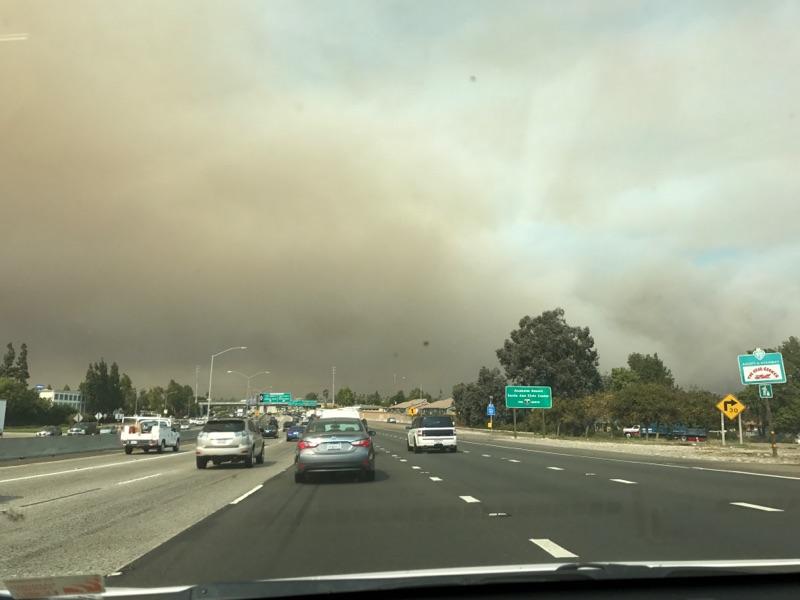
My packing was not as meticulous as usual and I still faced a long and arduous drive home past the fires now burning toward the highways I must travel on, but eventually I, and my precious cargo made it safely home.
Days later by phone, I was informed that Dr. Corbet and Dr. Powelson still planned on publishing all of the papers that were to be presented at the conference, and that more details are pending. Needless to say, I can safely admit that it was a conference unlike any I had ever attended before.
- A Golden Cross to Bear - A Calif WW1 Centennial Task Force Supported Film
- November 10, 2018 - Armistice Centennial Event - Fleming Park - Colton
- November 11, 2018 - The Bells of Peace Toll Again Throughout California
- November 11, 2018 - Armistice Centennial Event - Los Angeles High School Alumni Veterans Day Commemorations
- November 11, 2018 - Armistice Centennial Event - Victory Memorial Grove
- November 11, 2018 to December 31, 2019 - A WW1 Armistice Centennial Exhibit at the San Francisco War Memorial Veterans Building 2018-2019
- November 12, 2018 - The Great War - The Oneonta Club - South Pasadena
- Nov. 12, 2018 - Armistice Centennial Event - Hollywood American Legion Post 43