





































 John Simon Hilgenhold
Submitted by: John Levi Hilgenhold {Great-Grandson}
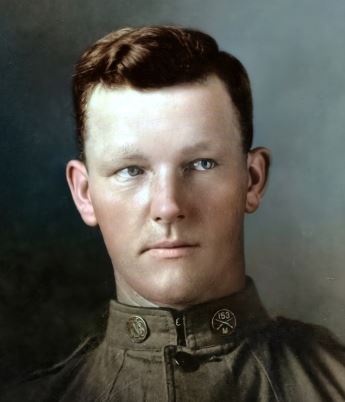
John Simon Hilgenhold was born in 1892. John Hilgenhold served in World War 1 with the United States Army. The enlistment was in 1918 and the service was completed in 1919.
Story of Service
My great-grandfather, John Simon Hilgenhold, was born on March 24, 1892 in a rural community, known as St. Marks, in Perry County Indiana. The grandson of Dutch-German immigrants, he was the seventh of eleven children. As a young man he completed his education after the eighth grade, as was customary for the time, and worked on the family farm with his father and three brothers.
John registered for the draft on June 5, 1917 at the age of 25. Just under a year later, on May 28, 1918 he was drafted into service of the U.S. National Army and reported to Camp Zachary Taylor in Louisville, Kentucky along with forty-eight other Perry County men. One of whom, Carl Goelzer, would eventually become his brother-in-law. He trained as an infantryman with the 44th Company, 11th Battalion, 159th Depot Brigade and completed basic training on June 16th.
He was then transferred to Company M, 153rd Infantry Regiment, 39th National Guard Division that was stationed at Camp Beauregard near Alexandria, Louisiana. This influx of new recruits brought the division up to full strength and they set sail from Newport News, Virginia a little over a month later on August 6th aboard the S.S. Kursk, a converted British troop transport. Upon arrival in Brest, France, the 153rd traveled to the St. Florent region, southwest of Bourges, until it was dismantled and its personnel sent to replace battlefield losses in existing combat divisions.
John F. Tronsor
Submitted by: Joseph McElroy {Nephew}

John F. Tronsor born around 1898. John Tronsor served in World War 1 with the United States Army . The enlistment was in 1917 and the service was completed in 1919.
Story of Service
All I know of Uncle Frank was he was gassed three times and was eventually medically discharged.
In Memory of his service and inspired by the "Blood Swept Land and Seas of Red" exhibit in London 2014, I conceived of a community project that would reinvigorate the reason why our town's high school is Memorial High School. It has morphed into HMHS, Haddonfield Memorial High School, in Haddonfield, NJ.
I and Lisa Quanci designed a aluminum poppy to be installed on Memorial Day 2020. We sold kits of 10 to be assembled and brought back to us. Every club as well as many individuals participated. Covid interrupted our planned installation in 2020 and the poppies were stored in my garage.
Clarence Marine Johnson
Submitted by: David Johnson {son}
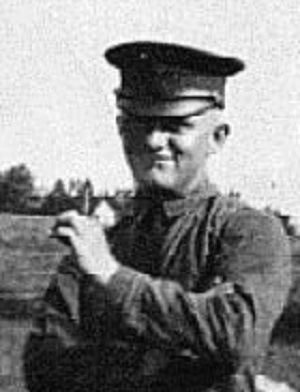
Clarence Marine Johnson born around 1897. Clarence Johnson served in World War 1 with the United States Army. The enlistment was in 1916 and the service was completed in 1919.
Story of Service
Clarence Marine Johnson served in the 32nd Division, Signal Corps.
Service Record
May 22, 1916
Enlisted at age 19 in Milwaukee, Wisconsin, Serial Number - 252,094
The National Guard was created by the National Defense Act which went into effect June 1, 1916 and on June 19, 1916 was called to the Mexican border for duty by President Wilson. This was in response to the revolutionist Poncho Villa crossing the border to attack a village at Columbus, New Mexico. It is interesting to note that at this time in history the U. S. had only about 137,000 regular army and 181,000 National Guardsmen in uniform in the entire United States. General Pershing used the regular army near the border to follow Poncho Villa into Mexico. The National Guard was called up to position themselves all along the border to discourage any more infringements 0n U. S. territory.
Michele Francalangia
Submitted by: Maria Pietrantuono {great grand-niece}
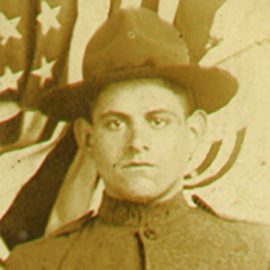
Michele Francalangia born around January 28, 1898 . Michele Francalangia served in World War 1 with the United States Army. The enlistment was in 1917 and the service was completed in 1917.
Story of Service
Michele Francalangia was born on January 28, 1898 in Campodipietra in the province of Campobasso to Carlo Francalangia and Beatrice Paventi. He spent his childhood in Molise until he was sixteen when, on boarding from Naples in 1914, he joined his brother Giovanni in Cleveland in the state of Ohio where he had settled for a few years working for a steel mill. S
hortly after his arrival, he joined another brother, Antonio, in the mining communities of West Virginia where, in June 28, 1917, he volunteered for the American army, enlisted in Columbus, Franklin, Ohio. Michele (Franch as reported on the service documents) initially became part of the C battery of the 17th field artillery regiment organized at Camp Robinson in Wisconsin and then of the 2nd battery of the 7th field artillery regiment.
The recruits crossed the ocean on October 31, 1917 aboard the Mount Vernon transport and once in France Michele was transferred to the F Battery of the 5th Artillery Regiment. After an initial garrison of the Sommerville and Ansauville sector, the 5th supported the operations of the first AEF division and the 60th French division in the Montdidier sector from April to July 1918.
During those weeks, the regiment fired between 5,000 and 15,000 bullets a day, contributing significantly to the interruption of German communications and the capture of the village of Cantigny.
A few weeks after the alternation at the front, the regiment set off again towards Soisson, in support of the great allied counter-offensive of the Aisne-Marne unleashed at dawn on 18 July, distinguishing itself particularly in the bombing of the German positions in Missy, Ploisy and Berzy -le-Sec in addition to the constant work of counter-barrage decisive for the protection of the advance of the infantry.
John Henry Allison
Submitted by: Jim Allison {grandson}
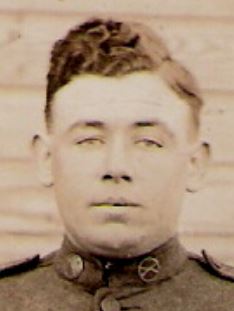
John Henry Allison born around 1894. John Allison served in World War 1 with the United States Army . The enlistment was in 1917 and the service was completed in 1919.
Story of Service
My Grandfather, John Henry Allison had moved from Adair County Kentucky to Pontiac, IL and was a farm hand for his future father-in-law John B. Scott in 1916. At the beginning of his courtship with Louise Scott, what is now known as World War 1 disrupts the plans of many a young man including Grandpa who was inducted in Pontiac, IL September 19, 1917 and sent to Camp Dodge, Iowa. From there he went to Camp Pike Arkansas. Then he sailed from Hoboken, New Jersey on June 19, 1918 on the ship “Delta” arriving in Liverpool, England on July 15, 1918, and on to Le Harve, France on July 20, 1918.
Grandpa was in the following engagements: Chateau Thierry July 20-August 5. 1918; St. Mihiel Sept. 14-20, 1918; Verdun Sept. 21-28, 1918. He was wounded in the left arm at Chateau Thierry and in his right foot at Verdun. He was in overseas hospitals at Tauris and Vichy France. He sailed back from Brest, France on September 29, 1918 and arrived at Hoboken, New Jersey Christmas Day 1918. He was discharged January 19, 1919.
In her high school days my sister Janet interviewed grandpa concerning his World War days. When grandpa told her about diving into a fox hole and having a bullet hit his foot, she asked him why he dove in head first? Grandpa said something to the effect with a touch of humor, “Would you rather I had got shot in the head?” Janet could probably fine tune this part of my memory a bit!
Here are a few memories grandpa shared about his war experiences. While on leave, he and a small group of soldiers were in town somewhere in France. They were trying to find some thing and one of the fellow soldiers convinced grandpa to ask a lady how to find it. They told grandpa how to say it in French. He did so and was promptly slapped in the face. They “got” grandpa on that one.
Marcus Juul Hanson
Submitted by: Per G. Melberg {Distant relative}
.PNG)
Marcus Juul Hanson was born around 1890. Marcus Hanson served in World War 1 with the United States Army . The enlistment was in 1918 and the service was completed in 1918.
Story of Service
Markus Juul Hansen / Marcus J Hanson (1890-1918)
Tombstone of Markus Juul Hansen (Hørby Cemetery, Denmark)
Memory of
Markus Juul Hansen
Born in Lunden 24 June 1890
Killed in France
9 November 1918
___
He died for his Country
Introduction
What journey in life led to a young man from a rural parish in Northern Jutland, Denmark dying on a battlefield in France, whilst serving in the U.S. Army? And this just a few days before the Armistice put an end to World War I. This is the story of Markus Juul Hansen.
Markus' childhood and youth in Denmark
Markus Juul Hansen was born on 24th June 1890 in "Lunden", a small farmhouse on Tranekær Mark in the northernmost part of the parish of Hørby, Northern Jutland, Denmark. He was the son of Hans Christian Hansen (1861-1934) and Mathilde Jensen (1855-1913), who had married in 1884 and had seven children together. Markus was the third sibling.
Markus was confirmed in Hørby Church in 1904, and still included in the census for Hørby Parish as being resident in "Lunden" in 1906. Being part of a large family living on a small farm, Markus soon had to make his own way of living, commencing as a worker on a larger farm in the neighboring Karup Parish.
Theodore E. Fournier
Submitted by: Brian A. Huseland {great-nephew}
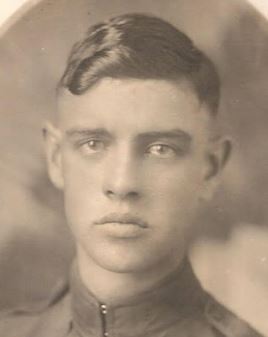
Theodore E Fournier was born around 1899. Theodore Fournier served in World War 1 with the United States Army. The enlistment was in 1917 and the service was completed in 1918.
Story of Service
My great-uncle Theodore Everett Fournier served in the 103rd Infantry, Company C. After his parents told Teddy in his teen years that he was adopted, he left home and enlisted in the Minnesota National Guard, 2nd Infantry, finding comfort in serving his country.
In 1916, they patrolled the U.S.-Mexico border because of Pancho Villa’s raids. In 1917, the boys were drafted into the American Expeditionary Forces, and trained at Camp Cody, NM, as part of the 34th “Sandstorm” Division. However, as some American regiments had encountered heavy losses in Europe, the 34th became a replacement division, and was broken up.
Teddy was shipped out from New York City on June 29th, 1918 on the ship Demosthenes. He carried with him standard issue uniform and equipment, and a precious item: an enlisted men’s prayer book. He arrived in mid-July and was assigned to the 103rd about the time of the Meuse-Argonne offensive. After resting and training the new recruits, the regiment boarded trains for Verdun, France. Teddy’s regiment prepared for the St. Mihiel Offensive as part of the 26th Division, encountering occasional gas and gunfire.
Fred H. Becker
Submitted by: Michael Jon Chapman {No relation...but I have kept his story alive through my writings.}
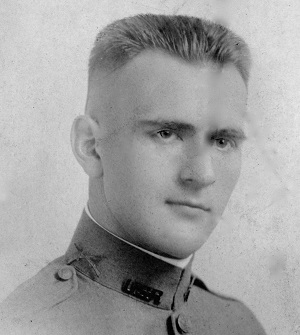
Fred H. Becker born around 1895. Fred Becker served in World War 1 with the United States Marine Corps. The enlistment was in 1916 and the service was completed in 1918.
Story of Service
On a warm spring day, May 14, 1921, over 5,000 people attended a funeral in Waterloo, Iowa. The mourners filled the church to the bursting point, with the overflow covering the parking lot. Later that afternoon, they packed the local cemetery as well.
They had come from all over the state to honor Fred Becker, who had given his life fighting in France during World War I. It was said to be the largest crowd ever assembled in the city nestled in the heart of the Midwest. The story behind the turnout remains one of the most inspirational in Iowa sports and military history.
Fred H. Becker was born on November 6, 1895. The Becker family lived in a modest, one-story house on the east side of the river, just two blocks from where the five Sullivan brothers – who all perished on the same ship during World War II – were raised in the 1930s.
He first gained attention in sandlot football games on dusty, makeshift fields. It was in those rough-and-tumble games that he carved out a reputation that would serve him well in the years to come. He was known all over town for his “fighting spirit”!
Becker had a highly successful high school career. Handsome and popular, he was involved in a variety of activities, ranging from football, basketball and track to several after-school clubs. He was elected vice president of the junior class, and was also a member of the German Club. Little could he have imagined that he would one day lose his life fighting against Germany, the country where his mother had been born, and where his father’s side of the family had originated.
Clayton Final Wheeler
Submitted by: Brian McCutcheon {Grandson}
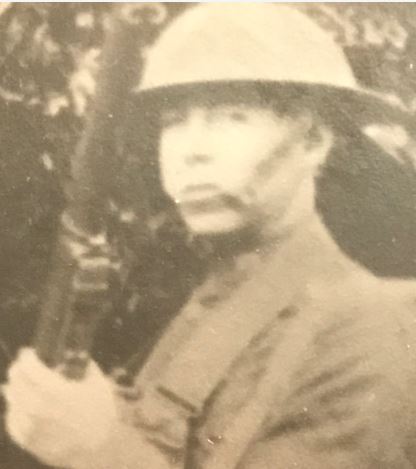
Clayton Final Wheeler was born around 1890. Clayton Wheeler served in World War 1 with the United States Army. The enlistment was in 1917 and the service was completed in 1918.
Story of Service
My grandfather was a member of the Michigan National Guard and served in B Company, 16th Engineers (Railroad). His unit was one of the first units to enter France and one of the last to depart. He left Michigan from the Michigan Central Terminal in Detroit. From there the unit went to New York awaiting transport to France. His unit entered France at Bordeaux.
During his time in France he served in multiple regions. At one time early in his deployment, his unit was attached to and under the command of the British, at a location near the English Channel. The Service Bars on his WW1 Victory Medal, which is in my possession show he served in the Lys Campaign, the Meuse Argonne and the Defensive Sector.
The majority of his time in France was spent in Camp Williams. Camp Williams which was located just outside of the village of Is Sur Tille, which is a short drive from Dijon. Camp Williams was the largest US Army Logistics Base in France during WW1. His uniform is now on display in the town museum.
Fortunately, my Grandfather returned home safely in 1919. However, when he returned, he learned that his Mother had died during the Influenza Pandemic of 1919. HIs Mother came from a French family and he had hoped to demonstrate to her that he had learned how to speak some French.