



































Emmett George Hoyt
Submitted by: Joe Davis {Nephew}
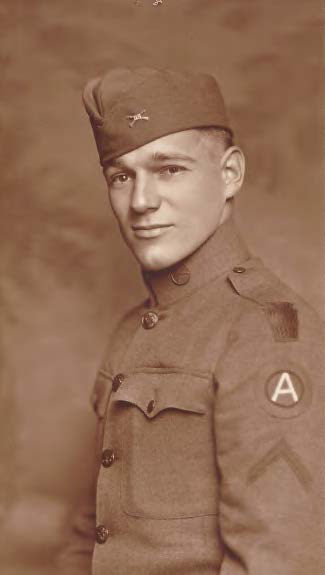
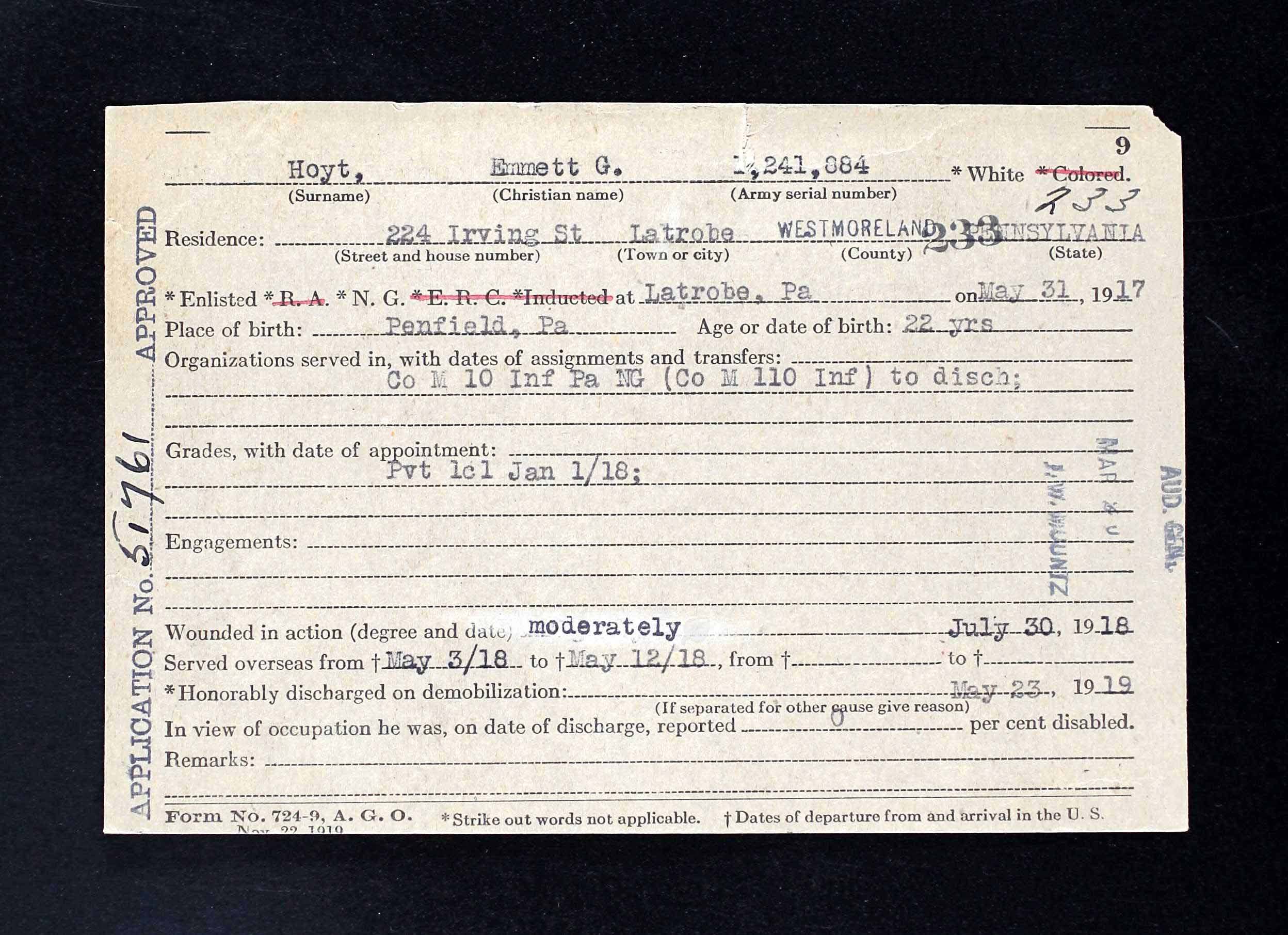
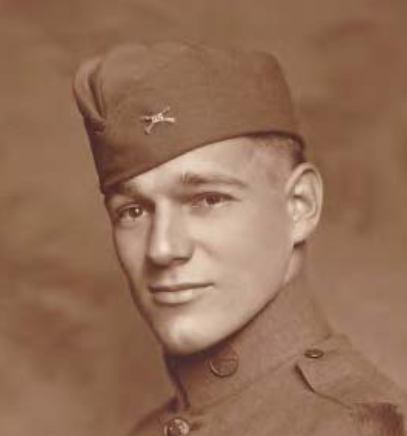 Emmett George Hoyt was born around 1895. Emmett Hoyt served in World War 1 with the United States Army. The enlistment was in 1917 and the service was completed in 1919.
Story of Service
Emmett George Hoyt was inducted into the army on May 31, 1917 and was a Private in Company M, 110th Infantry, 28th Division, Pennsylvania National Guard. His company sailed to France on the transport ship Ansonia on May 3, 1918. He saw action in France at Cierges hill 212 and two major offensives.
He spent 57 days in the Argonne, and on June 30, he was sent to Aisne Marne, where, on July 30, he was “moderately” wounded when he was peppered with shrapnel. mostly in his legs. He was carrying a tin of tobacco in his breast pocket over his heart and credited "Prince Albert" with saving his life.
Six months after being wounded, Emmett was assigned to a Military Police unit in Cologne, Germany, for a short time before returning to France. He departed St. Nazaire, on 29 April 1919 on the transport ship Santa Olivia with the remaining members of Company M.
He was honorably discharged upon demobilization on May 23, 1919.
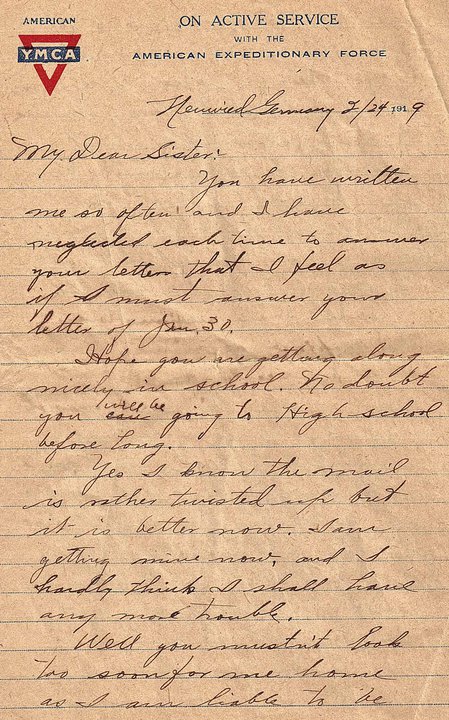
From Germany, on stationary with the letterhead, "American YMCA" insignia and "ON ACTIVE SERVICE WITH THE AMERICAN EXPEDITIONARY FORCE," Emmett wrote to his 13-year-old sister, Mary. In part, it reads:
2/24/1919
My Dear Sister,
. . . Well, you mustn't look too soon for me home as I am liable to be over here for six months yet . . . .
It's a regular spring day here today, but the Dutchmen say that march is the worst month over here. . . . Things weren't, it's true, what everyone desired while hostilities raged, but right now we are seeing things and getting along very nicely. I wouldn't sell my experience for any money. On the other hand, I wouldn't take any amount and go through it again. So, you can see that there are a lot of things one can learn in the army.
After his discharge, Emmett worked as a postal clerk in Ridgway, Pennsylvania. About the war, he said, I' won't carry a gun in the next one." Although he could not have known how prophetic that statement was, he prepared himself. He took advanced military courses and received a commission in the Army reserve. During his tours of reserve duty, he commanded CCC (Civilian Conservation Corps) camps in Western Pennsylvania.
Called up in WWII, he participated in the Sicily, Rome Arno, and Northern Apennines Campaigns. He served in Sicily as Assistant Adjutant General in Palermo. By war's end, he was a Lt. Colonel. He was promoted to full Colonel in 1946 and at that rank retired from the Army Reserve in November 1953.
He retired from the Post Office in 1955, having devoted his entire adult life to serving his country.