




























James Milo Miller
Submitted by: Myron M. Miller {Son}
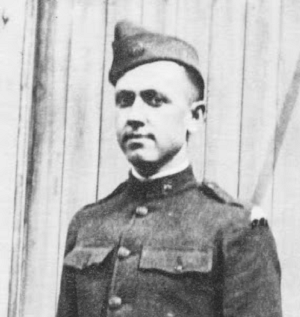
James Milo Miller was born around 1893. Jamse Miller served in World War 1 with the United States Army. The enlistment was in 1918 and the service was completed in 1919.
Story of Service
The Service in World War I of James Milo Miller, 314th Field Artillery Regiment
February 1918 – March 1919
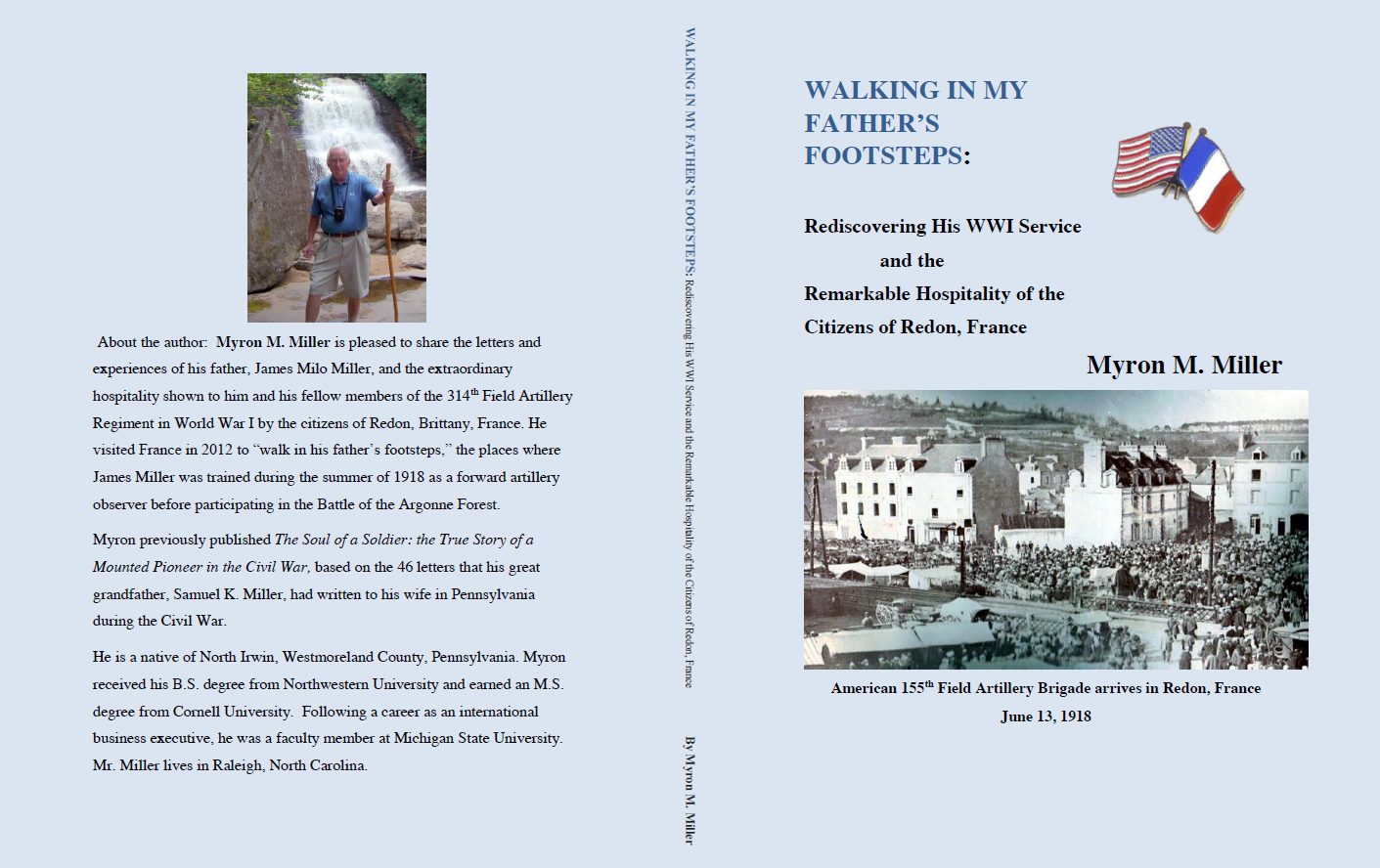
First, I would like to say that I have written a book about the experience of my father, James Milo Miller, in World War I based on all the letters he wrote to various members of his extended family during his time in that war, from the time of his being drafted in 1918 until he was discharged in March 1919. The book also describes the remarkable hospitality extended to the three regiments of the 155th Field Artillery Brigade (the 313rd, the 314th and 315th Field Artillery Regiments) during their two months of training on the French 75 in and near the city of Redon, Brittany, France.
The men of the 155th Field Artillery Brigade made such a favorable impact on the citizens of that city that there was a 100th year commemoration of the arrival of that brigade in Redon on June 9, 2018! The brigade entered Redon for their two months of training in the wee hours of June 13, 1918.
James Milo MillerBy an amazing coincidence, I was able to make a connection with a man in Redon, France, who is the grandson of a couple who entertained four officers of Dad’s 314th Field Artillery Regiment during that summer of 1918. This Frenchman, Jean Yves de Trogoff, knowing about the contact his grandparents had had with the American officers in 1918, became very interested in Dad’s regiment and got a lot of information about the period of time when the 314th and the other two regiments in 1918. Jean Yves found on the Internet a 35 page summary of my dad’s unit in France in 1918, and by a miracle – which I’ll describe later – he connected with me and invited me to “walk in my father’s footsteps.”
I made the trip to Redon in April 2012 and was able to visit all the places where my dad had been billeted and trained. I was invited to the city hall in Redon to give a presentation of my dad’s several months in Redon in 1918, with an audience of local teachers and local leaders. An unforgettable experience, to be where dad had prepared to fight in WWI and to get to know personally the current citizens of that wonderful city of Redon. More about the miracle of discovery later.
My father, James Milo Miller, was drafted into the U.S. Army on February 12, 1918 at the Old City Hall, Smithfield Street, Pittsburgh, Pennsylvania. He was assigned to the supply company of the 314th Field Artillery Regiment, which was then in training at Camp Lee, Virginia, located between Petersburg and Hopewell, Virginia. His regiment had been formed in September 1917.
Before his regiment left the U.S. for France, his regiment moved to Camp McLaughlin, at Dutch Gap, Virginia, where they were able to begin firing practice. On May 24, 1918, the regiment entrained for Lamberts Point near Norfolk, Virginia where they were to embark for overseas.
His unit boarded the SS America at 8:10 on the morning of May 26, 1918. According to my dad, the trip across the Atlantic took a bit longer than usual because the ship needed to zigzag to avoid German submarines.
Their ship arrived in Brest on June 8, 1918. After several days of rest, the brigade took the 12 hour train ride and arrived in the city of Redon, Brittany arrived in the wee hours of June 13. While the local citizens knew the American were coming, they were not prepared for an arrival late at night, so on the morning of June 13, the citizens awoke to see hundreds and hundreds of American troops sleeping on their streets.
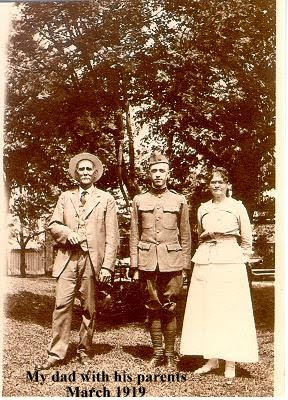 James Milo Miller (center) with his parents.Although the American officers who chose Redon as a place for the training of that brigade wanted the troops to be housed in several very large buildings, none were available so he arranged to have the citizens of the city house various elements of that brigade, including providing for the “housing” of 1,100 horses, which were soon acquired in Northern France.
During the early period of the training of those units, James Miller was in the supply company, bringing supplies from the Supply Base at St. Nazaire and other parts of Brittany. Those trips gave dad a great introduction to the beauty of that part of France. Unfortunately, when unloading a large bag of oats, it fell on his back, so his shoulder was sprained, which was later to affect him when he was at the front. Nevertheless, after a couple of days, he was back in duty.
Fortunately for dad, on July 13, 1918, Colonel Robert S. Welsh transferred dad into a small unit of forward artillery observers. Dad had had five years of night school at Carnegie Tech (now Carnegie Mellon University), so he had the necessary math skills to work in metrics with the French 75. With that assignment, he moved from where he was billeted with the Supply Company to the location of the Headquarters Company of the 314th Field Artillery Regiment at the Bel Air Chateau in Redon. Dad’s home was in the carriage house directly behind Bel Air.
His unit was in training in Redon until August 7, 1918, when they left Redon to train at Meucon Camp where they could practice their firing. Their time in Redon, apart from the many hours of training, was quite enjoyable. Every evening, the band of one of the three regiments played in the city center, attracting all the soldiers of the three regiments, along with all the citizens of Redon. Dad was able to get the assistance of a 15 year old local boy to help him learn a reasonable amount of French. Some of the soldiers taught English to the local lads, including some words that the young fellows should not have used!
Eventually, dad’s unit arrived at the city of Vannes, France and from there took a train past the cities of Rennes, Chartres, St. Florentine and Bar-le-Duc to Longville, where they left the train and were finally at the front and ready by September 24, 1918. As we know, the major offensive began on the morning of September 26, 1918. As Dad described it to me, it was as if hell had opened up! He said that 25 miles of cannon, wheel to wheel, all opened at once!
 In his role as a forward artillery observer, he was involved in that initial barrage, and in the combat over the following weeks. He had some harrowing experiences, including having shrapnel bounce off his helmet. Dangerous duty, that of a forward artillery observer. Unfortunately, after four weeks of combat, in the rain and dampness of late September and October of 1918, his sprain morphed into a paralysis of his left arm and he had to be taken off the line and to various hospitals until he ended up at a hospital in Orleans, where he was located on Armistice Day, November 11, 1918.
Dad was hospitalized in Orleans, where a special cast was placed on his arm until he began to recover the use of his left arm. He stayed at that hospital in Orleans until late December, when he was transferred from France to the American Base Hospital in Lakewood, New Jersey until he recovered sufficiently to be discharged at the end of March 1919.
How was I able to write the story of Dad’s time in WWI and about the city of Redon and what they did to prepare for the arrival of the 155th Field Artillery Brigade in June 1918? First, my great uncle managed to collect all the letters Dad had written to his parents (Myron and Sarah Miller) back in his home town of Hartstown, Crawford County, Pennsylvania, to his brother, to his sister-in-law, to a lady cousin and to his uncle, Milo H. Miller. Milo collected all those letters Dad had written and gave them to my Dad. Those original letters are now in my possession.
After taking a course on WWI at Duke’s lifelong learning program early in 2010, I decided to prepare a short 35 page summary of his experience in WWI for my three children and my grandchildren. In that process, I was able to find some information about the 314th Field Artillery on the Internet, and was provided some very interesting material from a lady whose grandfather was in Dad’s unit. When I finished those 35 pages, the lady suggested that we put it on the Internet, which we did. I thought that would be the end of it; all I wanted to do.
However, in June 2010, I had an email message from Paris, from Jacques de Trentinian, who said that there was a man in Brittany, Jean Yves de Trogoff, who would like to meet me. How did that happen?? Well, as it turns out, Jacques and Jean Yves were in the Society of the Cincinnati, which is how they became friends. Jean Yves had found on the Internet my 35 page summary of Dad’s experience, but there was no contact information on that summary. So, Jean Yves contacted his friend Jacques de Trentinian, and asked whether Jacques might be able to locate this Myron M. Miller. Now it turns out that Jacques de Trentinian was the Vice President of the SAR (Sons of the American Revolution) for all of Europe!!
So Jacques thought (I learned later) that because I was so interested in history that I might be a member of the SAR. Jacques check his directory of members of the SAR, found me –for I joined the SAR in 2008 – and then sent the message to me! What were the odds of anyone in France being able to locate me, let alone the head of the SAR for all of Europe.
That was a wonderful miracle, the best ever example of synchronicity! Be Jacques introducing me to Jean Yves de Trogoff, I was able to visit the city of Redon, where Dad was trained, as well as the places where he went after leaving Redon before he left the train from the lovely city of Vannes for the front.
When I visited Redon in April 2012, I not only had a wonderful reception by Jean Yves de Trogoff, his wife Veronique and many leading citizens of Redon, but also had time with Jacques de Trentinian and his wife. In fact, when I gave my presentation at City Hall in Redon, my new friend Jacques de Trentinian translated for me.
And so, here is the story of my Dad in France during WWI, as well as the remarkable story about my time “walking in my father’s footsteps” in France. After having written about my Dad’s letters and then visiting Redon, I decided to write about Dad’s story as well as about the remarkable preparation that the citizens of Redon prepared for the arrival of the 155th Field Artillery Brigade (which included Dad’s 314th Field Artillery Regiment) and the marvelous hospitality of the citizen of that lovely city of Redon in 1918 –and then for me in 2012!