





























World War I Centennial News
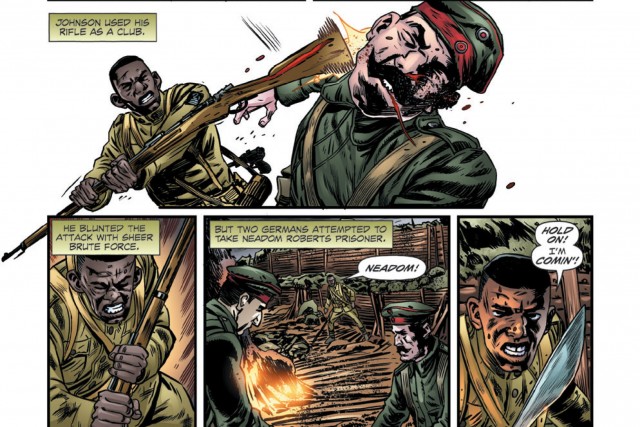 Sgt. Henry Johnson a New York National Guard Soldier who was awarded the Medal of Honor Posthumously for his actions during World War I attacks a German Soldier in these panels from a "digital graphic novel" about Johnson released by the Association of the United States Army. Johnson, who worked as railroad porter in Albany, N.Y. was a member of the New York National Guard's 369th Infantry. He was awarded a heroism medal by the French Army, which the 369th fought with, but did not receive the United State's highest honor until 2015. (Photo Credit: Courtesy Association of the United States Army)
Heroic Soldier's WWI story told in digital comic
By Eric Durr, New York National Guard
via the army.mil web site
LATHAM, N.Y. – Sgt. Henry Johnson, the Albany resident whose World War I service in the New York National Guard’s 369th Infantry Regiment was recognized with the Medal of Honor almost a century later, is now the subject of a digital comic.
The 11-page comic tells the story of Johnson’s actions on May 14, 1918.
Johnson and Pvt. Needham Roberts were on outpost duty when a German raiding party attacked their position out in front of the trenches. The two Americans fought back with grenades and rifle fire, and when Roberts was knocked unconscious and the Germans tried to carry him away, Johnson attacked them with his bolo knife.
The 369th had been fighting with the French Army and Johnson was the first American to receive the French Croix de Guerre with a golden palm, France’s highest award for bravery. But the Medal of Honor eluded him until 2015 when it was presented posthumously by President Barack Obama.
The 369th Infantry was an African-American regiment in a segregated Army. The unit fought under French command because no American commander wanted them.
They went on to become one of the most decorated units in World War I.
The Henry Johnson digital comic is the sixth produced by the Association of the United States Army, known as AUSA for short, which focus on recipients of the Medal of Honor.
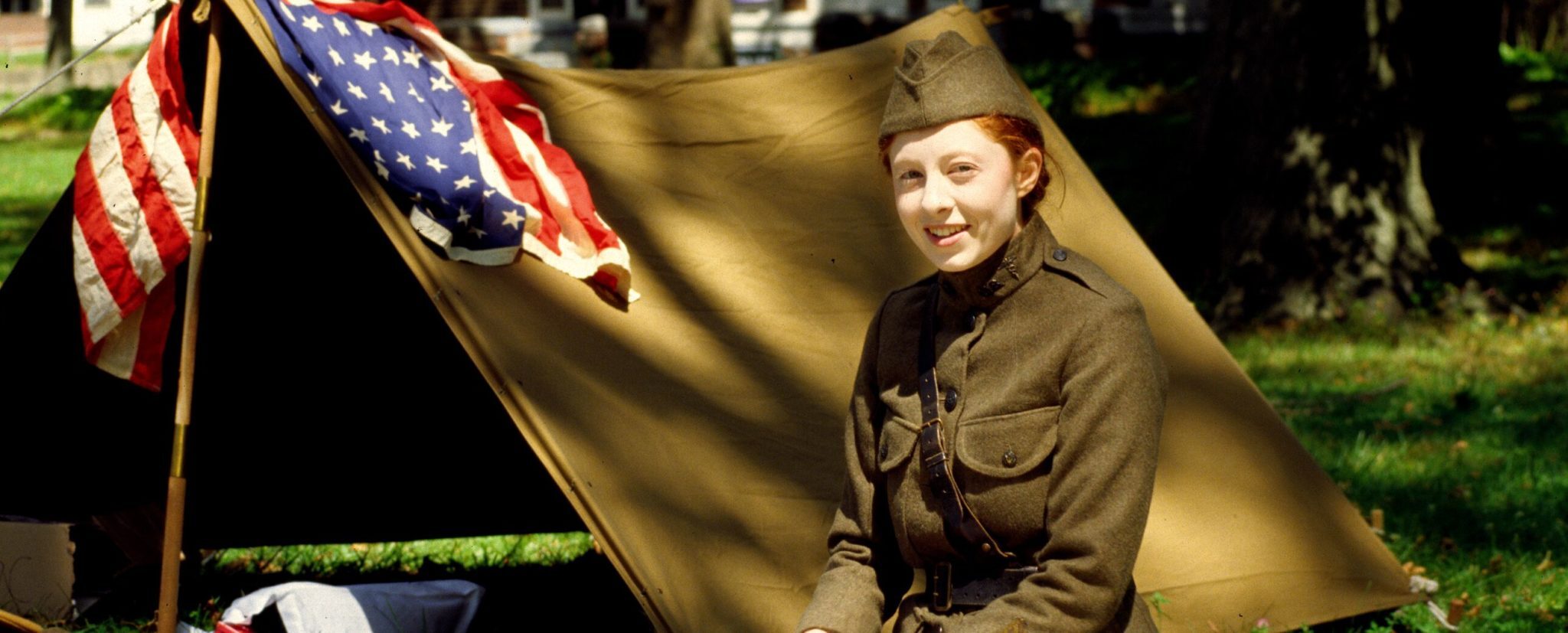 World War I reenactor Lillian Fehler pictured at the 1919 Camp Doughboy event on Staten Island, New York. The three-day camp-out for World War I living historians also welcomed more than 3,000 curious visitors into its midst each day. Camp Doughboy was sponsored by the United States World War I Centennial Commission.
This Millennial’s Alter Ego is a Forgotten Female Surgeon From World War I
By Rachel Veroff
on the Narratively.com web site via the getpocket.com web site
On a sunny morning last September in the grassy hills of Governors Island, New York City, 27-year-old Lillian Fehler woke to the bright, warbling call of a military bugle. She sat up inside her camping tent (an authentic green cloth tent that soldiers actually used during World War I), and laced up her boots. The boots were authentic, too — impeccably restored to mint marching condition by Fehler herself, who studied at the Fashion Institute of Technology. Next, she brushed her striking red hair into a bun, snapped up the highest button on her stiff collar, and ducked out into the light of day, where she was greeted with a historically accurate breakfast, prepared on historically accurate cookware.
The event was Camp Doughboy — a three-day campout for living historians that also welcomed more than 3,000 curious visitors into its midst each day. Even the location had historical resonance: Governors Island (a 15-minute ferry ride from the lower tip of Manhattan) served as an active military base during WWI. Today, the site is cared for by the Trust for Governors Island, and Camp Doughboy is the result of a collaboration between this trust, the National Parks Service, and the WWI Centennial Commission — which was created by Congress in 2013 to “honor, commemorate and educate.” Thirty or so dedicated historical reenactors like Fehler were in attendance, and they had brought an astonishing array of items from their personal museum collections (rusty bicycles! bayonets! binoculars!) to show off to each other over the weekend. Since its start in 2016, Camp Doughboy has grown to be one of the largest historical gatherings in New York City.
“Where did you get this uniform?” a curious woman asked Fehler, while testing the fabric of Fehler’s sleeve between her fingers.
“Hoo boy,” Fehler smiled impishly before launching into a scarily precise explanation. She had stitched her WWI uniform herself using a 1916 dressmaker’s diagram as a guide, and she’d raided antique fairs and obscure corners of the internet to find the original hat and leather belts. She also had a lot of critiques to share about various vendors of rare dyes and chemicals, stemming from her rigorous training as a textile conservationist and theatrical costumer. The results of Fehler’s intense nerdery and hours of labor showed: She was quite arguably the most photogenic living historian to show up at Camp Doughboy. Not only was she a singularly pretty model for her own clothes, but she also stood out for being one of the youngest participants — and one of the only women.
Read more: This Millennial’s Alter Ego is a Forgotten Female Surgeon From WWI
National WWI Memorial Virtual Explorer App Available July 3
WASHINGTON, DC – The Doughboy Foundation has announced the release of the WWI Memorial "Virtual Explorer" App on July 3, 2020, in cooperation with the United States World War One Centennial Commission.
The free, innovative Augmented Reality Smartphone App for iOS and Android mobile devices, allows users to take a virtual field trip to the National WWI Memorial being built in Washington DC.
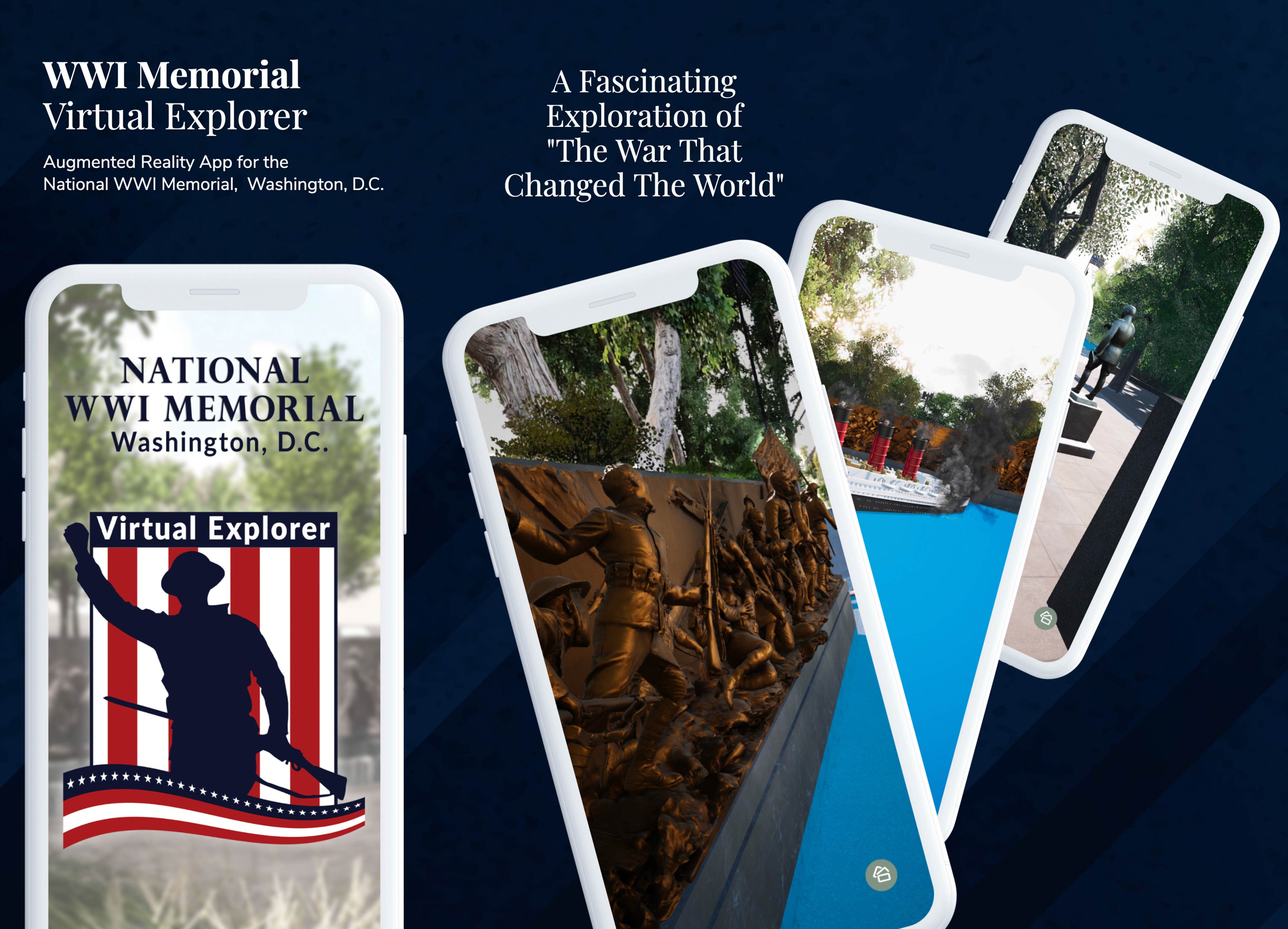
The App provides an ability to explore the past using the tools of the future.
Developed by the Doughboy Foundation, a 501c(3) nonprofit foundation, under an education grant from Walmart, the mobile device App places a scaled version of the entire 1.8-acre WWI Memorial anywhere including backyards, driveways, living rooms, and more.
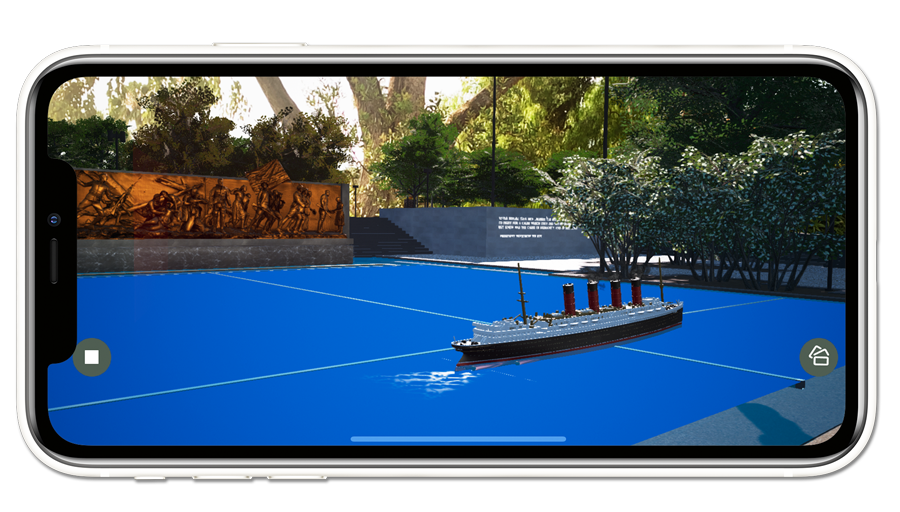
The virtual Memorial is filled with WWI explorations and discoveries including video game style 3D stories and over 50 videos integrated into the 3D space. Together they present various aspects of WWI, “The War that Changed the World”.
Read more: WWI Memorial Virtual Explorer Press Release: Launch
Public-private partnerships developed during World War I had a profound impact on American civilian society after the war
By Mark Hauser
Special to the United States World War One Centennial Commission web site
Although I do not think of myself as a military historian and did not start out as a business historian, my recently completed dissertation arguing that World War I changed Americans’ relationship to mass culture is both a history of the military and a business history. How did I get here?
I knew very little about the First World War before I began graduate school, but I was always vaguely aware it was important. As a fan of sketch and improv, I entered graduate school wanting to explore the roots of comedy in America and wrote a masters’ thesis about vaudeville at the turn of the twentieth century. When I began generating ideas for a doctoral dissertation, I thought I would mine the same vein – I wanted to study how audiences’ reacted to performances they saw, but where could I find letters and diaries from “ordinary” people describing these relatively minor events in their daily lives?
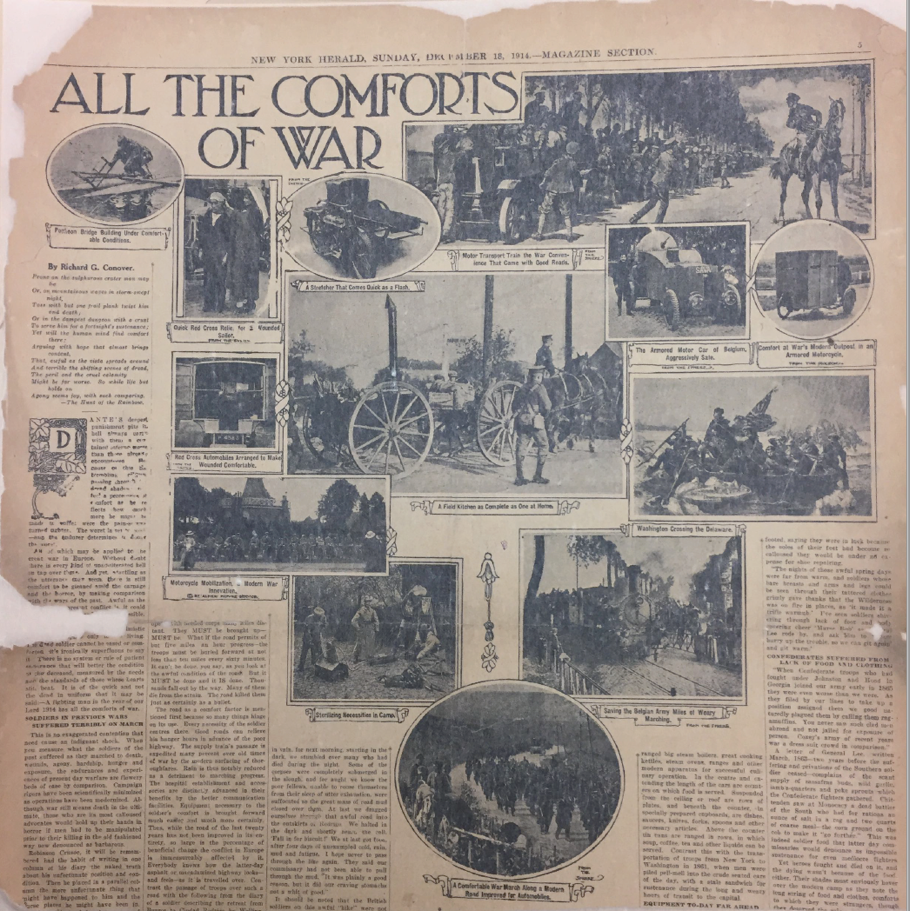 Even before America entered the war, there were many indications it would be important to provide for the daily care and comfort of servicemen in new ways. The New York Herald, December 13, 1914, 5.
Wartime seemed like a good opportunity, since archivists recognize such exceptional moments and collect material documenting men and women’s reactions to a range of experiences during unprecedented times. World War I seemed like a great option – vaudeville was a thriving industry during the era and I assumed entertainers would want to support the war effort. Since the USO formed shortly before the United States entered the Second World War, I also thought I could learn new details about the origins of entertainment for servicemen. It was settled – I would study the history of entertainment in the First World War.
 National World War I Museum and Memorial Guest Services Associate Joe Saviano working on transcription of a World War I letter home from an American soldier. When the Museum closed due to the COVID-19 pandemic from mid-March through May, the organization reallocated its staff so that a team of 17 employees – largely consisting of those working in guest services capacities – could instead shift their responsibilities to working on transcription.
National WWI Museum and Memorial Announces $125,000 Gift from National Endowment for the Humanities for Digitization/Transcription of WWI Letters
By Mike Vietti
Director of Marketing, Communications and Guest Services, National World War I Museum and Memorial
KANSAS CITY, Mo. – The National WWI Museum and Memorial announced a grant for $125,000 from the National Endowment for the Humanities (NEH) to digitize and transcribe letters, diaries and journals from soldiers and family members originated from World War I.
“This gift is essential as it allows the organization to take a major step forward in our efforts to digitize and transcribe our entire collection of letters, diaries and journal entries from the Great War, “said National WWI Museum and Memorial President and CEO Dr. Matthew Naylor. “Making the content from these incredible first-person accounts available is important because it allows people to connect with those who experienced the 20th century’s founding catastrophe.”
Following an application process, NEH grants totaling $40.3 million were issued to more than 300 cultural institutions in all 50 states and the District of Columbia. NEH received more than 2,300 eligible applications from cultural organizations requesting more than $370 million in funding for projects between June and December 2020. Approximately 14 percent of the applicants were funded. Along with the Missouri Historical Society, the Museum and Memorial is one of only two organizations in Missouri to receive a grant through the NEH CARES program.
“Over the past few months we have witnessed tremendous financial distress at cultural organizations across the country, which have been compelled to furlough staff, cancel programs, and reduce operations to make up for revenue shortfalls caused by the pandemic,” said NEH Chairman Jon Parrish Peede. “NEH is pleased to provide $40 million to preserve thousands of jobs at museums, archives, historic sites, and colleges and universities that are vital to our nation’s cultural life and economy.”
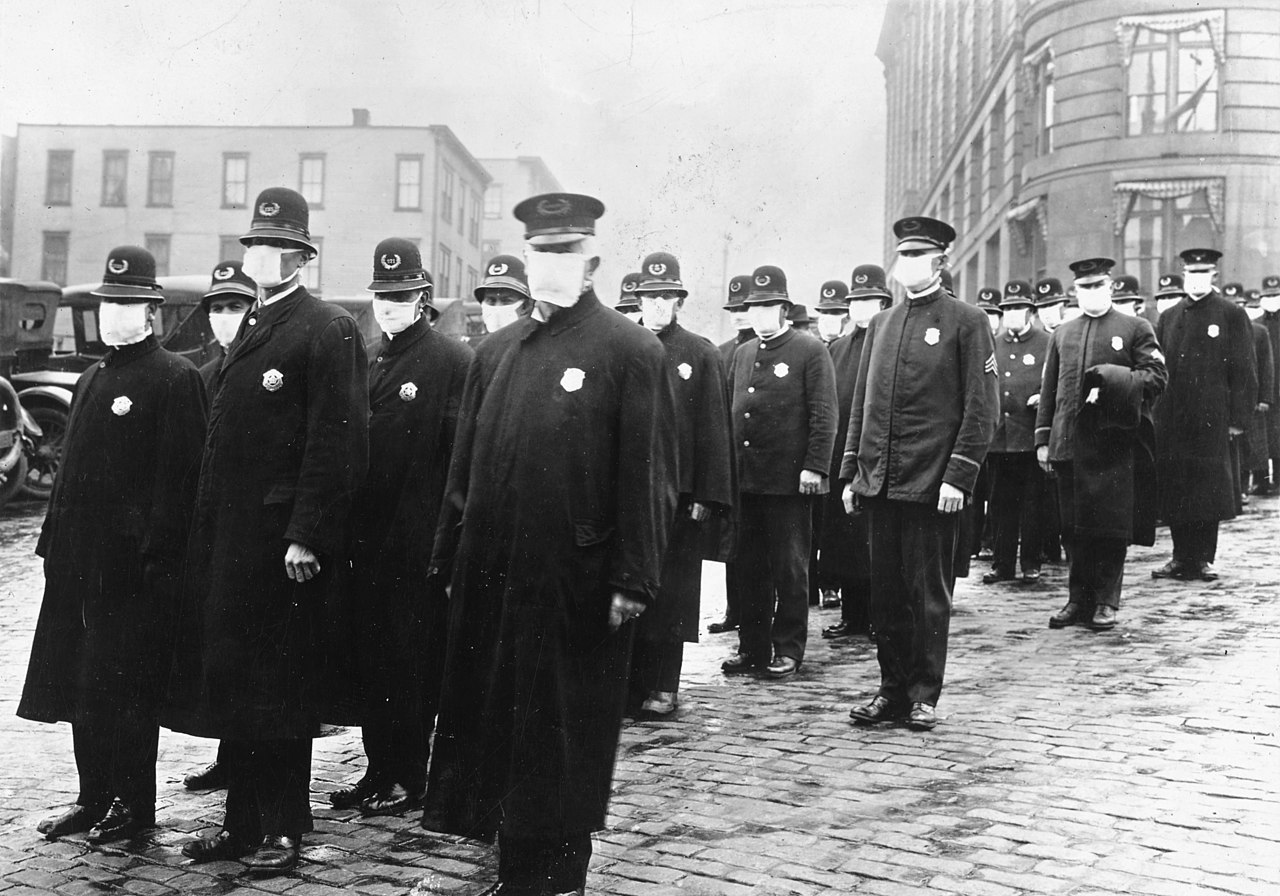 Policemen wearing masks provided by the American Red Cross in Seattle, 1918. From a worldwide perspective, the 1918 influenza “killed more people in a year than the Black Death of the Middle Ages killed in a century; it killed more people in twenty-four weeks than AIDS has killed in twenty-four years,” according to author John Barry.
1918: A Study in How Disease Can Shape Public Policy
By Doug French
via the Mises Institute web site
I suppose the first I read of the Great Influenza was in the first few pages of the Charles Portis masterpiece True Grit. The book’s heroine, Mattie Ross, tells readers about Yarnell Poindexter, whom Mattie’s papa left at the farm to look after her mama and the family while he went to Fort Smith. Mattie and Yarnell “exchanged letters every Christmas until he passed away in the flu epidemic of 1918.”
Most people hadn’t heard a thing about the 1918 pandemic until 2020’s version of, if not the same thing, something similar.
But two new books in recent years offer some much-needed context. One is Laura Spinney’s 2018 book Pale Rider: The Spanish Flu of 1918 and How It Changed the World. The other is John Barry’s 2005 book The Great Influenza: The Story of the Deadliest Plague in History.
One thing that quickly becomes apparent from reading these books is that the numbers from the 1918 flu are startling.
Spinney writes, “The Spanish flu infected one in three people on earth, or 500 million human beings.” That’s an astounding number; however, as we are finding out, precise pandemic information is hard to come by.
The 1918–20 pandemic killed between 35 million and 100 million people worldwide and 675,000 in the United States. The current version has claimed over four hundred thousand souls worldwide. “Most of the death” in 1918, writes Ms. Spinney, “occurred in the thirteen weeks between mid-September and mid-December.” By the way, that thirteen-week period was the second wave.
The misnamed “war to end all wars,” World War I, was ending with 22 million deaths as its direct result. In Spinney’s view, the pandemic “influenced the course of the First World War,” and “ushered in universal healthcare.” Is it possible that the 2019–20 pandemic will push America to adopt the same?
Read more: 1918: A Study in How Disease Can Shape Public Policy
 Poole Brothers, Military map of the United States of America: showing location of all forces in training, 1917. Since the influenza virus broke out in military camps before spreading into civilian communities and cities, Army records offer important data points in studying the virus. Click map to enlarge. (Geography and Maps Division, Library of Congress)
The Pandemic to End All Pandemics?: WWI, the 1918 Influenza Epidemic, and Urban America
via The Metropole Blog web site of the Urban History Association
In a recent fivethirtyeight podcast, political scientist Dan Chen noted that in China the population largely distrusts local authorities’ response to the COVID19 pandemic, while placing faith in the large central government. Host Galen Druke then noted that in the United States, at least over the past few months, the reverse is true: support for local governments’ COVID responses is quite high while many judge the federal government’s response dimly.
One hundred years ago, the federal government largely abdicated its responsibility and placed much of the burden of fighting the influenza pandemic—which took 675,000 lives between January 1918 and April of 1919—on states and municipalities. Some of today’s governors and mayors have thus far demonstrated competence and leadership, and others have not. The same was true in 1918, and the list of the dead demonstrates that a nation on wartime footing battles pandemics very poorly, particularly at the federal level. The total war of “the war to end all wars” differed greatly from the conflicts we fight today with an all volunteer army; during the former all policies and institutions focused on its prosecution at the expense of everything else and measures established to facilitate mobilization and troop shipment overseas greatly exacerbated influenza’s spread. If not for the efforts of the American Red Cross along with Progressive-era volunteer social welfare organizations, the death toll would have been even worse.
The War and The Federal Government
Urban America was largely left to fend for itself in 1918. The federal government focused intensely on fighting in World War I and willfully ignored the pandemic. With a handful of exceptions, like Army Surgeon General William C. Gorgas, who sounded numerous alarms regarding the pandemic’s spread, officials purposely downplayed and ignored the illness.[1]
Cowed by the Espionage Act of 1917, the Sedition Act of 1918, and the overheated nationalism of the war, newspapers self-censored and avoided reporting on the illness, lest it reflect poorly on the mobilization of U.S. armed forces. Though as historian Alex J. Navarro pointed out in a recent interview, to say newspapers ignored the pandemic would be misleading: “Newspapers featured daily articles on the epidemic, often with front-page and above-the-fold coverage.” When they did address health, newspapers frequently offered little more than popular bromides: “Remember the three C’s, clean mouth, clean skin, and clean clothes … Keep the bowels open. Food will win the war … Help by choosing and chewing your food well.”[2] According to Navarro this was not intentional, but rather “a result of the knowledge gap that existed about influenza at the time.” Public officials frequently downplayed the virus unaware of its novel origins.
The agency also failed to designate influenza a reportable disease, which partially explains why so few records from the pandemic exist. General chaos brought on by the flu pandemic also hampered record keeping. Only large cities and 24 states maintained statistics adequate enough for federal databases, and even in those places officially documenting the event “held low priority,” writes historian John M. Barry.
Read more: The Pandemic to End All Pandemics?: WWI, the 1918 Influenza Epidemic, and Urban America
United in the Great Cause: Allied and American military relations during the First World War
By Tyler Bamford
via the Army History Magazine web site
On 28 May 1917, less than two months after the United States entered World War I on the side of the Allies, 191 U.S. Army officers and men led by Maj. Gen. John J. Pershing boarded the British ocean liner RMSBaltic and sailed for Europe.1 President Woodrow Wilson had dispatched this group as the nucleus of the American Expeditionary Forces (AEF), an army that eventually comprised over one million American soldiers in Europe. Faced with the task of building and leading the largest field army yet in American history, these handpicked officers did not pass their voyage in leisure. Also traveling on the Baltic were a number of high-ranking British Army officers with extensive experience fighting in France. Taking advantage of this opportunity, Pershing and his staff spent countless hours with their British hosts, absorbing as many of their lessons as possible. Pershing later wrote that these British colleagues “kindly consented to answer questions on the subjects of organization, training, and fighting.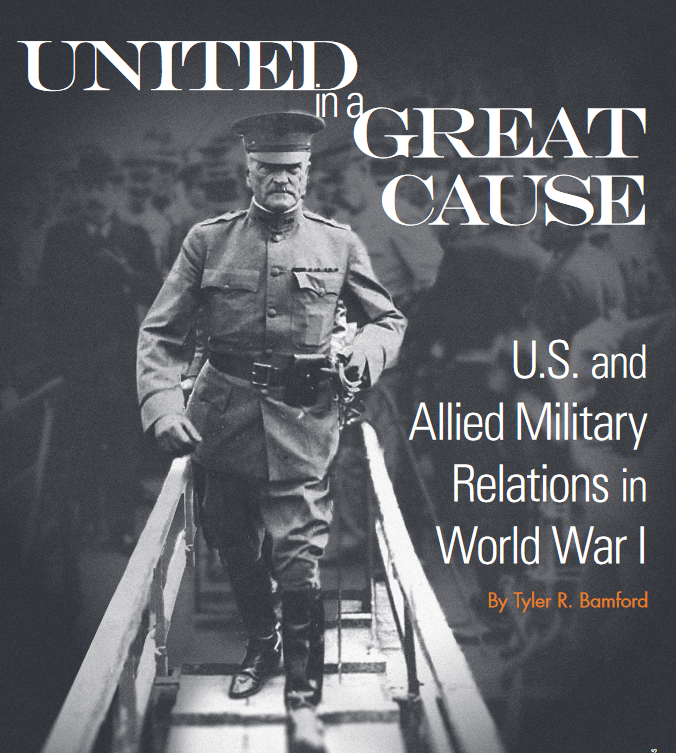 The conferences thus held and a study of confidential reports from the British and French helped to put us more closely in touch with many details which could not have been learned otherwise except through experience.”2
Pershing understood he faced an enormous task for which the U.S. Army possessed little institutional experience. Naturally, he and his subordinates wanted to hear the lessons that the British had learned at an enormous cost in three years of fighting. More than just technical instruction, however, these discussions revealed the culture, customs, and attitudes of the British Army to the American officers.For many in Pershing’s entourage, this was their first introduction to the British Army, and the officers impressed them favorably. American Lt. Col. (later Maj. Gen.) James G. Harbord found lectures by British Lt. Col. Frederick K. Puckle particularly instructive. A former supply officer in France, Puckle spoke on logistics organizations and the British Army. Harbord also recorded Puckle’s characterization of the typical British officer. “He is never demonstrative,” Puckle cautioned, “He does not show his feelings. He does not wear his heart on his sleeve.” Puckle said the American officers “must not misunderstand his attitude for hostility, for it is not.”3 Puckle and many of the officers on both sides realized that with increasing contact between the two armies, social and cultural differences had just as much potential to sour the partnership as disagreements over policies.
For nearly all active U.S. Army personnel, World War I marked the first time they came into contact with their British counterparts. It was also the first time the U.S. Army had ever deployed to Europe. Only once in the two armies’ histories, during the brief Boxer Rebellion of 1900–1901, had they fought side by side. Yet between April 1917 and November 1918, hundreds of thousands of American officers and men would train and fight with their British comrades. American and British officers’ encounters with each other during the twenty months their countries functioned as associate powers created predominantly positive impressions that shaped their personal views and professional judgments, and set the tone for the two armies’ interactions in the interwar period. Many officers in both armies published their experiences and opinions in postwar memoirs, which circulated among fellow officers for years after the authors’ retirement. In this way, these contacts became embedded in the armies’ institutional memories. Often, these memoirs downplayed disagreements, thereby presenting an even stronger image of wartime camaraderie. Yet in contrast to officers’ positive interactions, their soldiers’ attitudes toward one another showed that fighting as allies did not automatically produce goodwill between the two armies. Disagreements over tactics, strategy, and the command of American soldiers all threatened to sour interarmy relations. Even though many American soldiers chafed under the British guidance during their training, the majority of American and British officers developed an affinity and mutual respect that carried over into the postwar era. Therefore, the armies’ cooperation during World War I laid the foundations for the unique, informal Anglo-American military relationship in the interwar period.
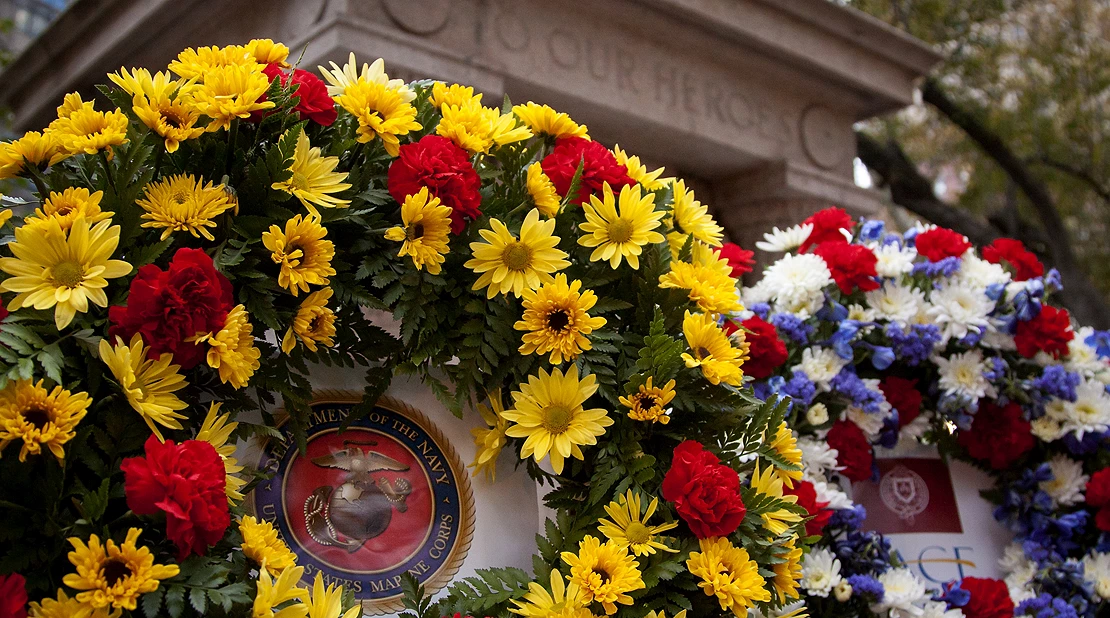 The Eternal Light Flagstaff in New York City's Madison Square Park honors those victorious forces of the United States Army and Navy who were officially received at this site following the armistice and the conclusion of World War I. The New York Life Insurance Company is marking its 175th Anniversary on 2020 with a series of articles about the company's history. The associations and clubs formed in the crucible of World War I laid the foundation of New York Life’s ongoing humanitarian outreach.
WWI marked the birth of New York Life’s volunteerism and commitment to humanity
via the New York Life Insurance Company web site
When the United States entered World War I in April of 1917, New York Life shared the nation’s fighting spirit and rallied to help mobilize America’s troops. The company offered its deep financial and human resources to support the war effort. And the volunteerism born then—from fundraising to moral support to military service—would live on as an abiding value for decades to come.
Throughout the conflict, the company’s financial contributions were easy to quantify: New York Life bought nearly $90 million in low-yield war bonds throughout the war, amounting to more than $1.8 billion in inflation-adjusted dollars. And company leaders encouraged policy owners to do the same.
The human contribution was enormous, too. A total of 192 men from the home office, 170 field employees, and 340 agents—702 men in all—left the company for military service. With so many New York Life staffers in uniform, the company earned its own chapter within the newly formed American Legion: NYLIC Post no. 503. To offset the burden of their sacrifice, the company initially paid those entering the armed forces the difference between their military and company salaries.
Evidence of New York Life’s deep moral commitment showed up in lots of everyday ways. The steward of the Home Office cafeteria insisted on keeping the names of all the “boys” serving in the military on his list. “Just a bit of sentiment,” The Nylic News explained. But the gesture really meant, “Your place is ready for you when you come back, and God grant that it may be soon...” The Nylic News also regularly featured letters “From the Boys ‘Over There’” to maintain strong ties with their New York Life family back home.
Read more: WWI marked the birth of New York Life’s volunteerism and commitment to humanity
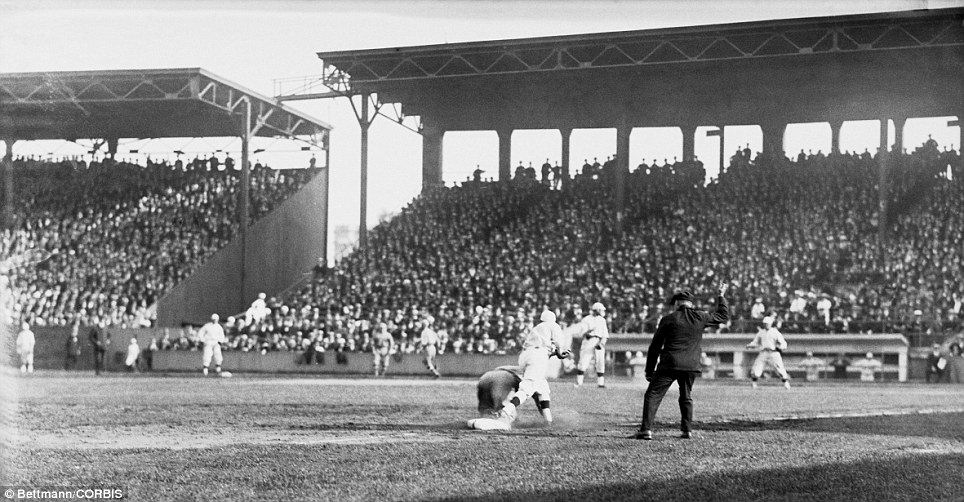 Opening game of the 1918 World Series in Comiskey Park, Chicago. The U.S. involvement in World War I prompted the playing of The Star-Spangled Banner during the seventh-inning stretch of Game 1. The Star-Spangled Banner would become a fixture of important baseball occasions — opening days and World Series — moving forward.
Before the 1918 influenza outbreak hit Camp Sherman during World War I, baseball was in action
By Tim Vollet
via the chillicothegazette.com (OH) newspaper web site
It was late afternoon on Thursday, Sept. 5, and there were two outs in the bottom of the ninth inning of the first game of the 1918 World Series. The visiting American League champion Boston Red Sox were clinging to a narrow 1-0 lead over the National League champion Chicago Cubs.
The sun was out at the Chicago ballpark, but the chilly winds off Lake Michigan had many fans wearing coats, including the numerous uniformed soldiers scattered throughout the bleachers. By the final inning of the pitchers’ duel, many fans had already headed home and the top tier of seats were nearly deserted.
The first two hitters in the Cub’s final at bat had been quickly retired, but the next batter managed to beat out a slow roller to third base, keeping the hopes of the hometown fans alive. Now, the on deck hitter stepped into the batter’s box, kicked up a small cloud of dirt and dug in at the plate.
The Red Sox southpaw pitcher stared into the catcher’s mitt and went into his stretch. He paid little attention to the runner taking a comfortable lead off first base. And just as the big lefty began his motion toward the plate, the Cub runner broke for second base. The hit and run was on!
The Cub’s slugger connected and launched the ball high into the bright blue sky in right field. The hopeful fans rose to their feet, but cheers instantly turned to moans after the Red Sox right fielder settled under the fly ball and squeezed it into his glove for the final out. Game one of the 1918 World Series: Red Sox 1, Cubs 0. The winning pitcher? Twenty-three-year-old Babe Ruth.
Read more: Before 1918 influenza outbreak hit Camp Sherman, baseball was in action
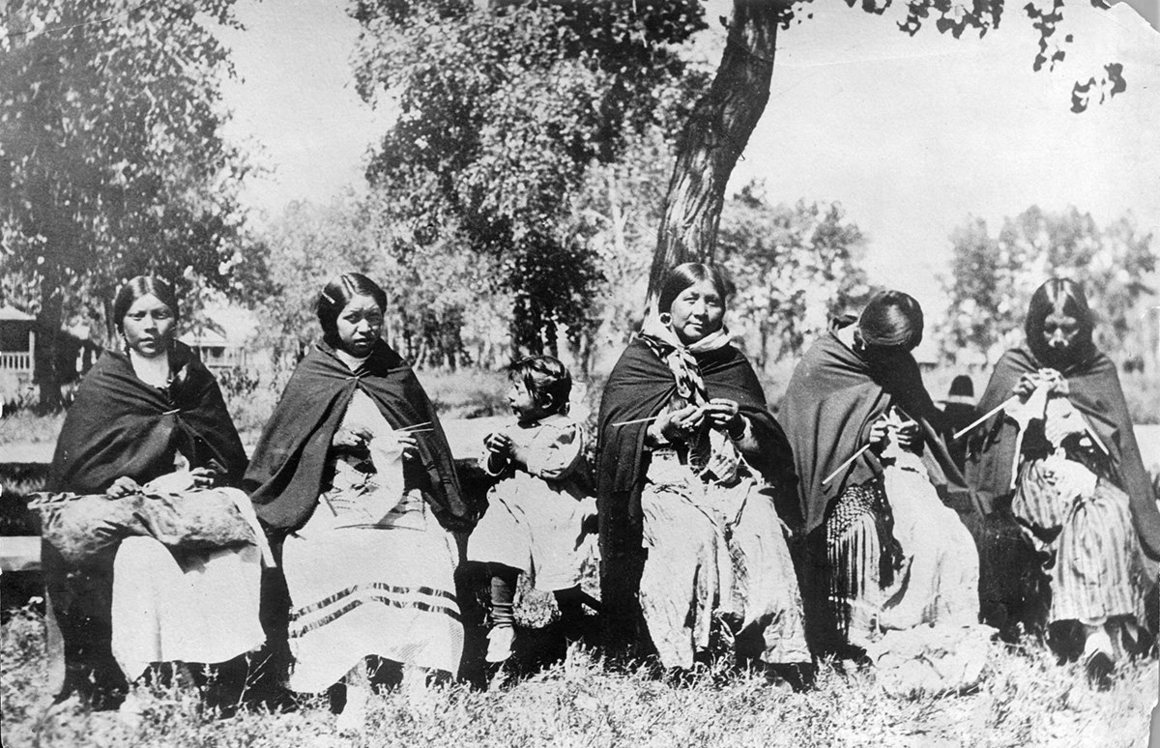 Knitters from the Uintah and Ouray Indian Red Cross Auxiliary Division in Fort Duchesne, Utah in 1918, making warm articles of clothing for American soldiers fighting in World War I. An estimated 35,000 Native American adults and children knitted for the U.S. war effort.
Review: "First Americans: U.S. Patriotism in Indian Country after World War I"
By Matthew Villeneuve
via the H-Net: Humanities & Social Sciences Online web site of the University of Michigan
Thomas Grillot's First Americans is a study of Indigenous patriotism in the aftermath of World War I. While the historiography on American Indian participation in the First World War often focuses on the battlefield experience of Indigenous people, Grillot's study examines the ways Indigenous veterans, along with their Euro-American comrades, made meaning out of Indigenous participation in the War to End All Wars after the armistice.
This is welcome analysis that acknowledges the presence of Indigenous people on the battlefield while favoring a closer study of the memory, discourse, and politics wrought in the commemorations, memorials, and holidays that came in the wake of the conflict. In so doing, Grillot sheds light on the process by which the symbolic repertoire for the expression of Indigenous pride came to include such icons as the American flag, citizenship, and the figure of the GI.
Grillot defines Indian patriotism as "the mix of gestures, ceremonies, and utterances demonstrating love of the country and military loyalty," which constituted Indigenous responses to an American "political ideology linking rights and military participation and a series of teachings, symbols, and ceremonies [which] centered on collective belonging" (p. 11). While military service generated political capital for Indigenous people and their communities, Grillot spends the first portion of the book examining the early twentieth-century period when patriotism was a double-edged sword. On the one hand, military service of American Indian men demonstrated the autonomy and capability that offered a means to resist the paternalism of the Office of Indian Affairs (OIA). On the other hand, celebrating that service and casting citizenship as a "reward" for battlefield sacrifice was just as often yet another front in a larger campaign by whites to impose citizenship on Indigenous people as a vehicle for their assimilation.
Grillot's history tracks how Indigenous veterans and the reservation communities of which they were a part consequently navigated "the intersection of universalistic soldier-citizenship and the particularistic condition of being Indians in the United States" (p. 162). In so doing, these veterans inaugurated a seemingly irrevocable shift from earlier Indigenous participation in armed conflicts alongside the United States as allies, to becoming American soldiers themselves.
Grillot's book contains many examples of Indigenous displays of patriotism that helped to cement this transition. For example, in 1925 the Five Civilized Tribes of Oklahoma purchased one of E. M. Visqueney's now-iconic sculptures depicting an American soldier running with rifle in hand titled "the Spirit of the American Doughboy." Though the statue was identical to hundreds of others purchased by towns across the country, when it was installed in Muskogee, the tribes listed not only the names of their warriors who fell in battle in France but also a longer list of their nation's esteemed leaders and former war chiefs, some of whom had fought against the United States. Grillot argues that for the tribes, their longer martial tradition was not incompatible with their nation's service in the United States' military during World War I.
Read more: Review: 'First Americans: U.S. Patriotism in Indian Country after World War I'
These were the Mercy Dogs of World War I
By Blake Stilwell
via the We Are The Mighty web site
Man's best friend has also been man's battle buddy for as long as dogs have been domesticated. The mechanical, industrialized slaughter in the trenches of World War I didn't change that one bit. All the belligerents let slip the dogs of war, some 30,000 in all. They were used to hunt rats, guard posts as sentries, scout ahead, and even comfort the dying.
The last were the mercy dogs of the Great War.
Our canine companions can do much more than just fight alongside us in times of war. Modern-day uses of dogs include bomb-sniffing and locating the bodies of the fallen. World War I saw some uses of dogs unique to that war, especially in terms of hunting the rats that spread disease and ate corpses in the trenches. Dogs were used in scouting parties; their unique senses, especially smell, allowed them to detect the presence of enemy troops long before their human counterparts. When on guard duty, sentry dogs alerted their handlers to even the most silent of a human presence. But the dogs of mercy were truly the most unique among them.
Mercy dogs, also called casualty dogs, were first trained by the Germanic armies of the 19th Century, but their popularity only grew. The sanitatshunde were trained to find the wounded and dying anywhere on the battlefield. Sometimes they carried medical supplies to help the wounded care for themselves until they could find care from a doctor or medic. If the soldier was too far gone for medical care, the dog would stay with him as he died, to ensure he wasn't alone.
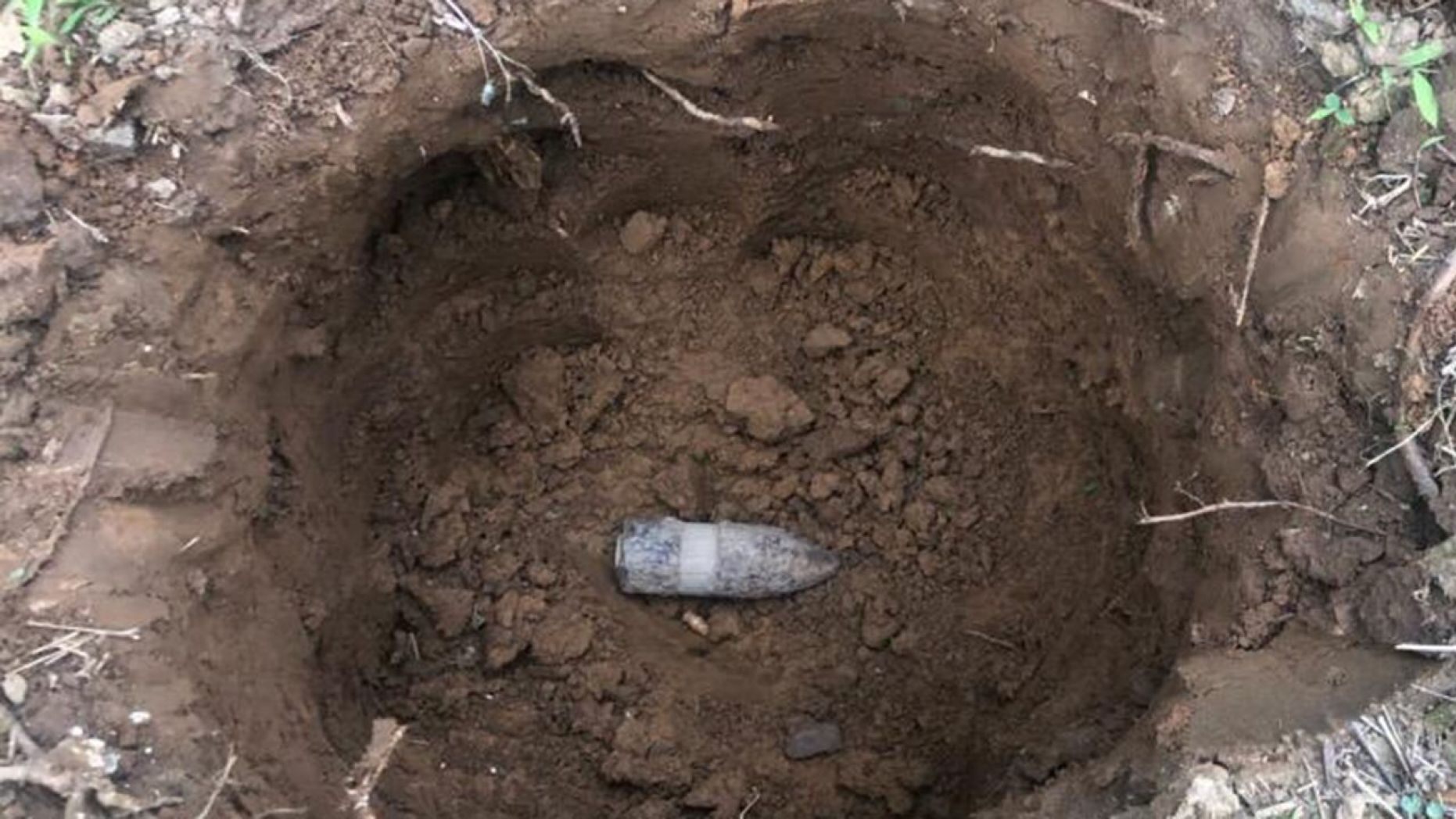 Kelly and Shannon Thomas were working on their flower bed when they uncovered a live World War I shell. (Photo courtesy Maryland Office of the State Fire Marshal)
Maryland couple finds live World War I bomb in their flower bed
By Robert Gearty
via the foxnews.com television network web site
A woman and her husband in northeast Maryland found a live World War I bomb while digging in a flower bed.
After the startling discovery Wednesday, Kelly and Shannon Thomas, of Belair, left the round where they found it and called the Harford County Sheriff’s Office.
“After examining the device, it was determined that the best course of action was to conduct an emergency disposal to render the ordnance safe,” the Maryland Office of the State Fire Marshal said Thursday in a news release. “Bomb Technicians disposed of the potentially dangerous round on the scene.”
The unexploded military ordnance, determined to be a 37 MKI projectile, made its way to the Thomas’ flower bed from the Aberdeen Proving Ground on the Chesapeake Bay 10 miles away.
“Unexploded military ordnance in the Bay and surrounding waters occasionally makes its way to the surface,” the news release said. “However, the discovery of military ordnance is not limited to tidal waters.”
Read more: Maryland couple finds live World War I bomb in their flower bed
- Reading your own obituary: Samuel Bustard, the 1918 Spanish Flu pandemic, and the evolution of New York Metro Area soccer
- Texas researcher discovers, honors African American WWI vets
- One of the earliest Monuments to African American World War I Troops
- Cole County's Grace Hershey remembered as World War I heroine