
































"Hardly prepared to play a secondary role," U.S. adopts Draft in 1917
By Erik Sass
via the Mental Floss web site
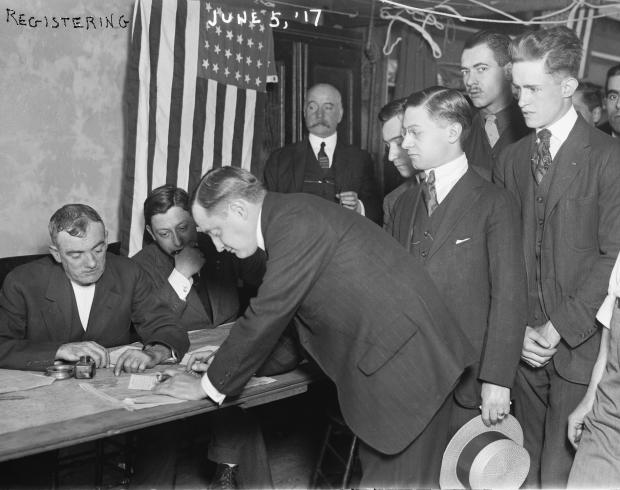 Young men at the first national registration day held in association with the Selective Service Act of 1917.After the end of the U.S. Civil War, conscription was swiftly abolished and the American military reverted to its traditional all-volunteer basis, with the U.S. Army bolstered by National Guard units when needed. During the Spanish-American War of 1898, the U.S. Army swelled to around a quarter million, all volunteers and National Guardsmen, and U.S. forces involved in the Philippine-American War of 1899-1902 totaled 126,000. Later the Punitive Expedition against Pancho Villa in northern Mexico in 1916-1917 numbered just 10,000 men, with roughly another 130,000 guarding the border.
By the time the United States entered the First World War in April 1917, the U.S. Army tallied 128,000 officers and men, along with 182,535 mobilized National Guardsmen. Needless to say, these figures were laughably small compared to the monstrous machines now locked in a titanic death struggle in Europe. In the spring of 1917 Germany had around 5.5 million men under arms, the British Empire 4.5 million, and France had two million serving on the Western Front alone – and these were just a fraction of the total manpower mobilized over the course of the war (France mobilized a total of 8.3 million men, including around half a million colonial troops, from 1914-1918).
Although America had adopted an unconvincing “preparedness program” in 1916, raising the target size for the National Guard to 450,000 by 1921, this goal was far from being realized, and the Americans would obviously be unable to make more than a symbolic contribution to the Allied war effort in terms of manpower in the near future: in July 1917 just 20,000 Americans were deployed in the American Expeditionary Force in Europe, increasing to 129,000 by the end of the year.
However the United States was hardly prepared to play a secondary role in the long run, demanding an energetic, decisive intervention to bring Germany to terms and end the war. To accomplish this the country would have to train and equip armed forces numbering four million by the end of 1918 – a massive undertaking which would require months of feverish effort, including the construction of a whole network of training camps and, most importantly, bringing back the draft.
Read the whole article on the Mental Floss web site.
External Web Site Notice: This page contains information directly presented from an external source. The terms and conditions of this page may not be the same as those of this website. Click here to read the full disclaimer notice for external web sites. Thank you.