



































Four questions for Dr. Patrick R. Jennings, National Museum of the United States Army
The Five of Hearts: "She is a legendary piece of US Army history."
By Chris Isleib
Director of Public Affairs, U.S. World War One Centennial Commission
We are following with great interest the construction progress of the new National Museum of the U.S. Army. The museum will house a remarkable collection of artifacts that will tell the story of our nation's military history, from our very beginnings as a nation, right up to present-day. We are pleased to learn that World War I will play a front-and-center role in that story. The Museum promises to have a truly world-class collection of artifacts from World War I, to include period uniforms owned by high-profile figures from the war, pivotal documents that shaped the war's outcome, weapons that were used in combat, and much, much more. Among the items that will have a permanent home there is a very special tank, the "Five of Hearts", which was a combat veteran from the battle of Meuse-Argonne, and which was recovered from the battlefield soon after the war, and returned to the U.S. as a special tribute to the the courage of those first tank soldiers to serve in the U.S. Army. We spoke to Dr. Patrick R. Jennings, Ph.D., Programs & Education Specialist at the National Museum of the United States Army, to hear more about this great museum, and about it's World War I artifacts.
We heard about the recent placement of your World War I-era tank at the museum construction site. Tell us about this tank! Whose is it, where did it come from, how did you hear about it? How did you get it here?
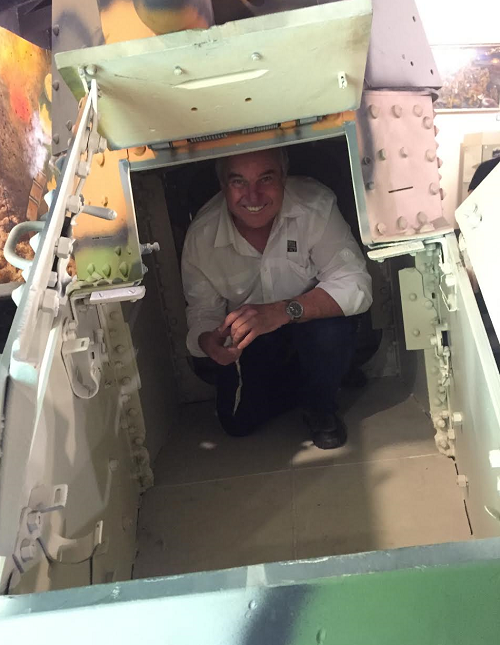 Dr. Patrick R. Jennings pictured inside the 2-man crew compartment of the Renault FT-17 tank during an inspection. (U.S. Army Photo)This particular tank, a Renault FT-17 with serial number 1516, was built by the French. The tank mounts a short-nosed 37mm gun in an armored plate, rotating, turret that had slight angles to deflect enemy fire.
It carried a crew of two – a commander/gunner and a driver - in a remarkably small space with the engine exposed just behind them. Despite the small size, the Renault FT-17 proved a capable combat vehicle so the US selected the design as the foundation for America’s first tank, the M-1917.
Final design and production of the M-1917 would, however, take quite some time, so the French supplied several FTs to the fledging American Tank Corps.
Serial number 1516 was passed down the line from depot to front line unit where it landed with Company C, 344th Tank Battalion. Dubbed the “Five of Hearts,” a tactical identifying mark, the tank went into action St. Mihiel and in the Meuse-Argonne Offensive.
I will tell you more about the storied combat history of this tank, but once it was accepted as Army property it remained just that.
Because of her history she was shipped back to the US as a “war hero” and placed at the first home of the US Army Tank Corps, Fort Meade, Maryland. Fort Meade has been home to the “Five of Hearts” since about 1919.
So, hearing about it, or finding it, wasn’t hard – she is a legendary piece of US Army history.
How did you folks determine it to be a good artifact for display? What needed to happen to make an artifact such as this display-ready? Tell us about the research & restoration & curatorial process. Who led it & who helped?
The National Museum of the US Army was informed by Ephraim Dickson III, the Acting Chief of the Army Field Museums Division that the tank was available for display, and knowing the history, that was all it took for NMUSA to bring her in.
Please allow me to explain:
During the fighting in the Fleville Sector, October, 1918, the “Five of Hearts” was instrumental in breaking the German lines near Exermont, France thus opening the way for the 16th Infantry to smash through the enemy defensive belt in that area. In that attack the tank lost her first crew – Lt. Woods and Corp. Rogers who were both wounded – and was taken over by Capt. Arthur Snyder and a driver who would, tragically, die from wounds unnamed to history.
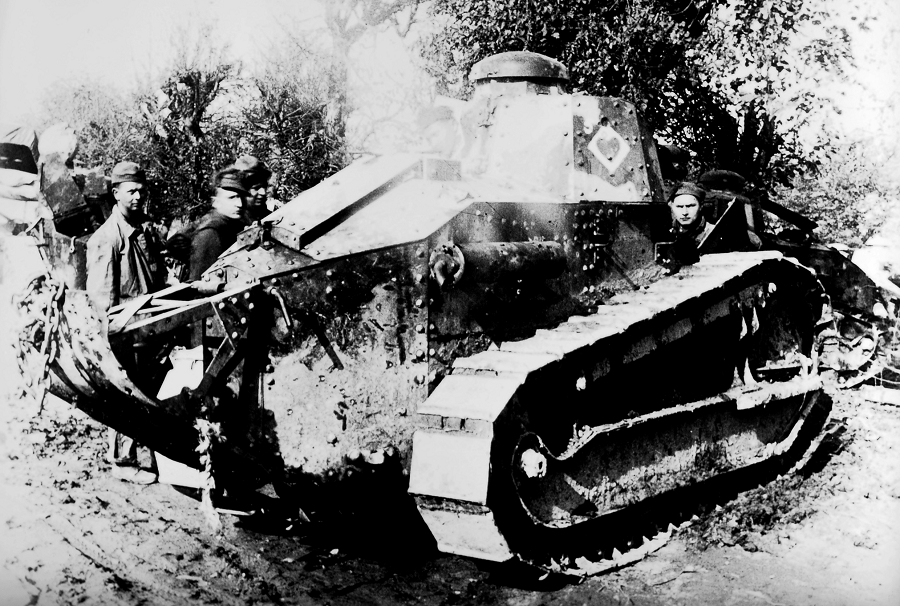 "Five of Hearts" tank after combat action in France, 1918.During the advance the “Five of Hearts” was hit more than 1300 times by German machinegun fire and armor-piercing projectiles. Her hull had chunks of armor blown away and bullets clawed at her sides. Her tracks and drive system were punched through in several places and the turret and gun mount were both jammed from enemy damage – but the doughty little tank survived.
Indeed, Renault FT-17 serial number 1516, the “Five of Hearts,” is the only know surviving US military tank that saw combat in WWI.
The effort to get the “Five of Hearts” ready for display was miracle of logistics and a symphony of timing. First she had to be evaluated, weighed and measured to see if the tank was fit to move or could even get out of the building she was displayed in.
At the same time, a US made M1917 (not a combat veteran) was selected to replace the “Five of Hearts” at Fort Meade. Engineers removed walls and riggers shifted and lifted until the “Five of Hearts” was free and the replacement was installed. From there the tank went to a restoration shop in Pennsylvania where she was stripped, cleaned, and repainted in the correct historical style after in-depth historical research. The restoration work was done by B.R. Howard & Associates while the historical work was based on remarkable foundation established by the museum staff at Fort Meade, Jim Speraw and Barbara Taylor.
Further historical research was done here at NMUSA by Harris Andrews, Neil Ablesma and myself while NMUSA Museum Specialist Sara Bowen coordinated the moves, transportation and care of the Historical Property Record. Behind the scenes we all leaned on Roger Wright who coordinated all of our work through various contractors. When the “Five of Hearts” was placed at the NMUSA site it was clearly the result of a team effort and the effort was worth it.
The Renault tanks started it all for the US Army Tank Corps - help us to put it in perspective what this tank represents in US military history.
Prior to 1917 the US Army was more a constabulary force than the global army it would become. In 1916 we were using horse cavalry and some motorized vehicles, to include airplanes, to chase Pancho Villa in Mexico but those efforts were pretty small when compared to the scale and intensity that combat in France would bring.
Indeed, the US Army didn’t even have an armor or tank organization until 1918 – the last year of the war. The Renault FT-17 was a critical tool in guiding the the global modernization of the US Army and how it would operate. Although the Tank Corps was disbanded in 1920 and the remaining tank battalions made part of the infantry, the genesis of US armor doctrine was sprung and this tank, the “Five of Hearts,” survives not only as a veteran of a century-old conflict, but a herald of modern land warfare that is traced in the National Museum of the US Army through WWII, Korea, Vietnam and the Middle East.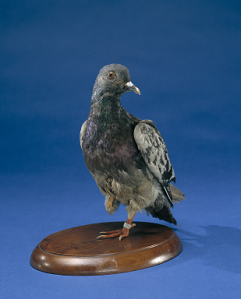
You will have other amazing WWI artifacts on display to tell the WWI story. Tell is about what else people will see when they come to see the National Museum of the U.S. Army, and the "Five of Hearts"?
The tank will be displayed at NMUSA in a gallery titled “Nation Overseas.” This section of the museum covers more than just WWI, but the Great War is the heart of the broader exhibit here. The “Five of Hearts” is, of course, the largest item displayed in the gallery, but we also have a fascinating mix of smaller, every-day items ranging from medals for valor and field utensils to colorful doughboy helmets and uniforms.
Still, before you even encounter the WWI story, you will see a cavalry uniform from the 9th Cavalry that was worn during the charge up San Juan Hill during the Spanish American War. One of the leaders in the charge, Jack Pershing, is soon seen again where we display his WWI General automobile bumper flag. We will also have on display the hero carrier pigeon “Cher Ami” who lost her eye in combat but continued to serve on the front lines, a unique and fascinating gas mask designed for a horse, and a broad display of weapons used in WWI combat.
Of equal interest is the WWI tableau that is reserved for this gallery. The gallery path will guide the visitor through a series of turns much like a trench line and bring them to a battlefield where life-sized cast figures – drawn of living soldiers from today’s Army – will be in full charge against an unseen German position as they pass a damaged German field piece.
Every thread of their uniforms is accurate as are their weapons. Crossing a glass bridge over the tableau the visitors will see the “Five of Hearts” and exit to eventually arrive at an evocative display of period photographs showing American soldiers in WWI.
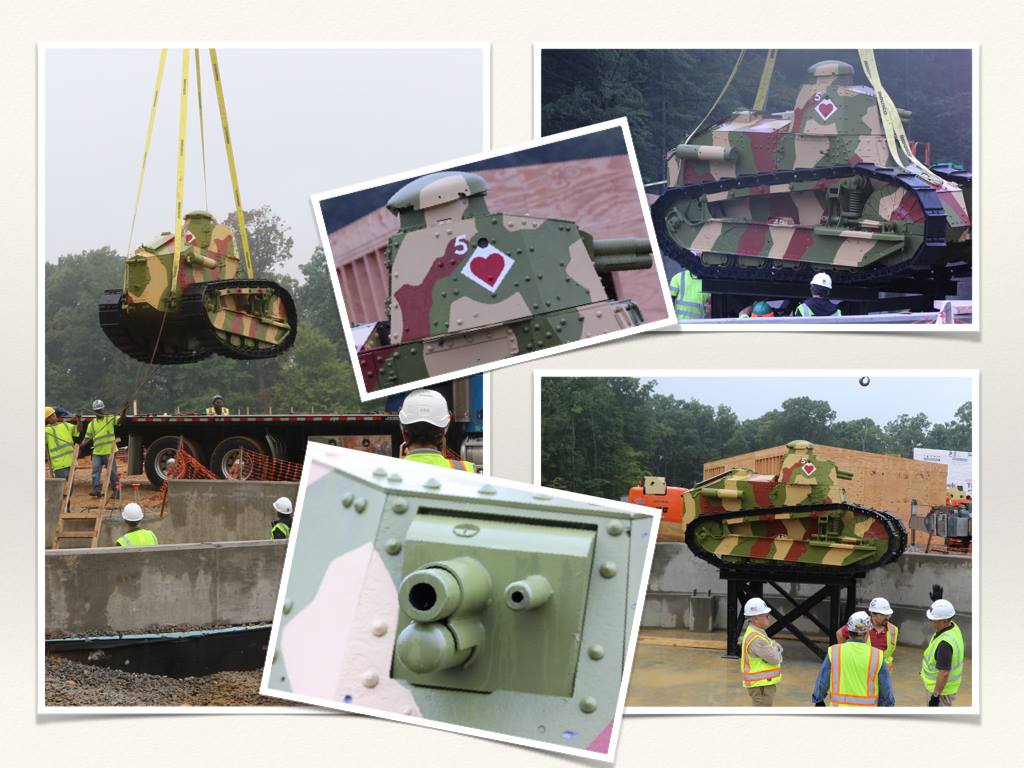 Collage of the "Five of Hearts" tank being placed at the site of the National Museum of the United States Army.