

































How World War I was fought on the Hudson Valley Front
One of the bloodiest conflicts in human history touched every part of New York State
By David Levine
via the Hudson Valley Magazine web site
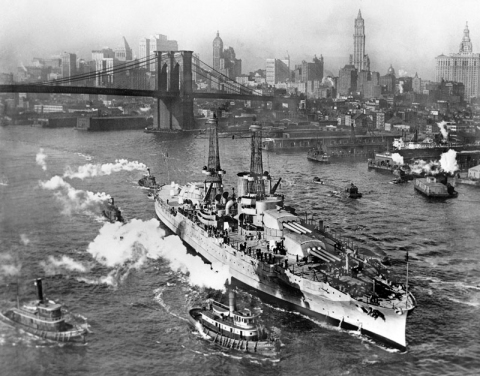 In 1916, the US was gearing up for its entry into the war. Here the USS Arizona returns to New York City after initial sea trials.It was called the Great War, but it wasn’t. World War I was terrible — one of the bloodiest conflicts in human history, responsible for more than 17 million dead and 20 million wounded soldiers and civilians.
It was called the War to End All Wars, but it didn’t — it destroyed the old world order and set the stage for the even more devastating Second World War, along with the Russian revolution, and the Cold War.
When the United States entered the war 100 years ago, the country was a relatively minor player on the world stage. The war turned it into a world power. New York State, and the Hudson Valley, played a big part. The state provided the most men, money, and materiel, says Aaron Noble, senior historian and curator of political and military history, at the New York State Museum in Albany. “One in 10 soldiers was from New York State. Fourteen thousand New Yorkers died. Twenty-five New Yorkers got the Medal of Honor,” he says, all far more than any other state. New York was the wealthiest and most populous state, it had the most developed industrial base, and it was the financial capital of the world. “The war touched every part of the state,” Noble says. Here are some of the ways it touched the Hudson Valley.
New York joins the fight
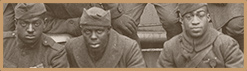
On July 12, 1917, President Woodrow Wilson ordered the entire National Guard of the United States into service. The New York State National Guard Division was officially designated the 27th Infantry Division. New York produced several regiments that went off to war, including the 69th Infantry Regiment, known as the “Fighting 69th,” and the 369th Infantry Regiment, the first African-American regiment to serve in combat in the war.
They trained at Camp Whitman, in Green Haven (now the site of Green Haven Correctional Facility), and at Camp Smith, in Peekskill. The Hudson-Mohawk river corridor and the newly built Barge Canal were important avenues to the nation’s biggest port, New York Harbor, from where 75 percent of the war’s manpower and materiel were shipped, Noble says. Iona Island was the site of one of the largest naval ammunition depots in the nation. “The river is deep enough for naval ships to travel up river to load, but it was difficult for submarines to navigate,” he says. “It was used in both World Wars.”
Read the entire article on the Hudson Valley Magazine web site here.
External Web Site Notice: This page contains information directly presented from an external source. The terms and conditions of this page may not be the same as those of this website. Click here to read the full disclaimer notice for external web sites. Thank you.