


































Four Questions for Bernhard Kast, creator of Military History Visualized
"We are hard pressed to give a clear answer to our questions relating to the past."
By Chris Isleib
Director of Public Affairs, U.S. World War One Centennial Commission
When it comes to military history on the internet, one of the top Producers working today is Bernhard Kast. His YouTube channel, Military History Visualized, took a meteoric route to fame -- garnering over 16 million views of his 160+ video segments, which were all produced just in the past year. Bernhard is the real deal -- an expert in computers/gaming, an expert in history, an expert in teaching, and a gifted storyteller. He was born in 1980, Central Europe, studied Computer Science and History at the University of Salzburg (Europe, Austria) from 2001 to 2008. In his final semester, he had the opportunity to develop and teach a course in rhetoric “Modern Rhetorical Role Models”. Later on, he went to Hamburg to work as a Sales Engineer at a Consulting Firm in the automotive industry and as Junior-Online Marketing Manager at InnoGames a company in browser-based (and now also client-based) gaming. His latest work is a remarkable piece on World War I. Our WW1CC intern Michael Stahler talked to Bernhard about his work, and about how World War I continues to impact us today.
Your channel has been up for a little over a year, yet you've produced 165 videos that, combined, have 16.3 million views. How do you engage such a wide viewership in technical, academic videos on military history?
 Bernhard KastWell, I think Military History is one of the most popular genres of History in general. Yet, most people don’t have the time to read about it as much as they would like, but still want information from high-quality sources.
So where do I come in? Well, I love to understand and explain. And I think most people notice this. I believe the strength of my videos is that I present a lot of information from quality sources in a compact manner without overwhelming the audience. I try to keep information that is crucial for an understanding and context, but leave everything else.
From tanks to artillery to aircraft to submarines, much of your coverage on World War 1 has focused on the advances in military technology. What draws you to this subject? Through these topics, what kind of picture emerges about the war?
History is a complicated subject. There are many ways to interpret sources and often there are no easy answers. Especially for times of great change, we are hard pressed to give a clear answer to our questions relating to the past. I assume this is one of the appeals of technology in general, it is rather clear cut and you can see how things developed the way they did with relative certainty.
Another aspect is of course, that we can touch, hear and see military technology, it's very physical to us and thus contrast with the behind-the-scenes politics that seems more like a labyrinth. So, technology allows us in a way to connect in a safe way, we know what we are at.
With World War One, there is the added dimension that it is often portrayed as a very static war. Yet, the improvements in many aspects were quite staggering and often forgotten. It shows the constant cycle of problem and solution. That's one of the things that I want to highlight.
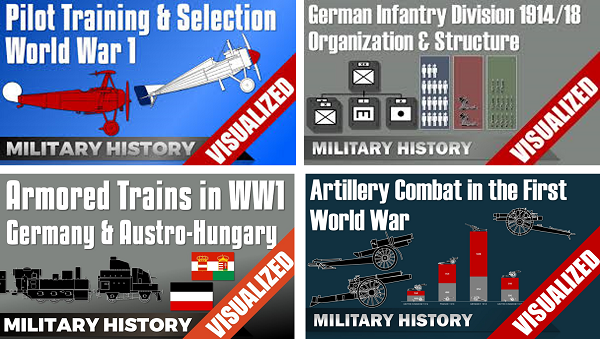 A lot of people may be ill-informed about the less-covered aspects of war, such as the organization and structure of German and British infantry divisions in the Great War. Why do you consider this important for people to know?
Long before I started this channel, I often read or heard about certain divisions, but I never really asked myself the question: What is a division? How does it work? I knew that it's a military unit but that's about as far as most of us get. Then I came across the Black ICE Mod for Hearts of Iron III and realized that I have no clue how a division was structured. Thus, I started reading up on it. I realized that showing the organization and structure of divisions can fill in a knowledge gap that I, and probably many others, have.
There are movies and series that cover individual soldiers and documentaries that cover the movement of armies, but usually the aspect in the middle is missing. A division is big enough that it has an impact on the battlefield, but small and structured enough to gain a basic understanding rather fast.
Not every history Youtube channel has a Masters degree or experience with a Military History Institute. Do you have any personal connections to military history? What has drawn you to the subject, and what about the Great War do you find engaging?
At least in my school in Austria the education about the world wars or wars in generally was rather short, the main aspect we cover were basically the period of 1933 to 1945. This seems to be similar in Germany at least according to the Historian David Stahel. Since, I always was a bit of an odd-ball and looked into stuff that was less common. I guess this state of under-development of Military History in Austria and Germany fueled my interest into it. At university, I only had 2 classes in Military History and those were only possible because we had a guest lecturer.
For me, the most interesting aspect about the Great War is the many foundations – some of which I am probably still unaware off – for military doctrine, e.g., artillery tactics in 1914 were very similar to Napoleonic times, but in 1918 many of the developed principles are still found in modern artillery doctrines. You see this across the board, in only 4 years the world was turned upside down.