



































5 Key Naval Innovations from WWI for U.S. Navy
By Elizabeth M. Collins
Defense Media Activity
One hundred years ago, convoys of troop ships, protected by U.S. Navy escorts, began to regularly arrive "over there" in France, transporting waves of American ground troops to join the Allies and fight the Kaiser in the churning bloodbath that was trench warfare.
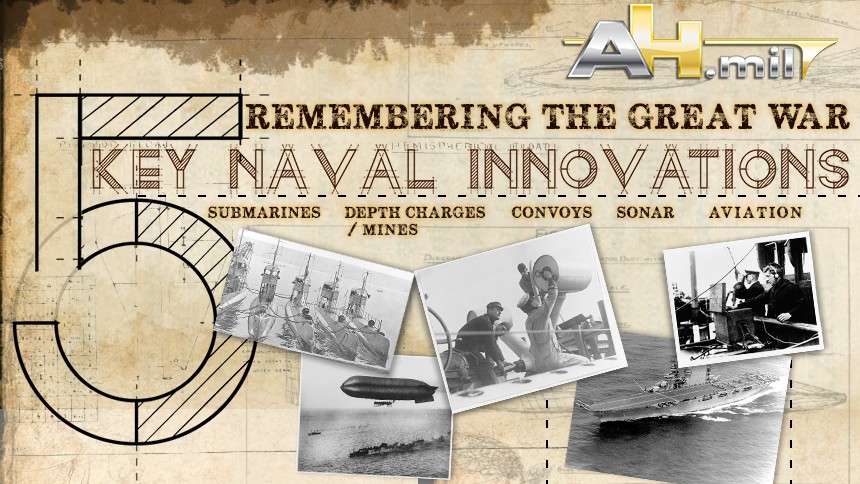 And while the Great War may not be remembered as a great naval war, it did lead to a number of advancements and innovations that would change warfare and the Navy forever.
Submarines
The signature naval weapon of World War I was the submarine. Various inventors had experimented with diving boats and underwater boats since at least the 17th century, and they made appearances in both the Revolution and the Civil War. The U.S. Navy then commissioned its first true submarine, USS Holland (SS 1), in 1900. German officials also saw potential in the new technology. They needed a way to counter the naval might of the United Kingdom, said Dennis M. Conrad, a historian with the Navy History and Heritage Command, and seized on the submarine.
In fact, Germany went from one undersea boat in August 1905 to 28 in the first two months of the Great War to 61 by June 1917, according to Fraser M. McKee in "An Explosive Story: The Rise and Fall of the Common Depth Charge." The U-boats proved remarkably successful, sinking nine British warships in only two months early in the war. The Germans also used their submarines to terrorize the Allies and blockade the United Kingdom, attempting to starve the British out of the war. They haunted Allied shipping lanes across the Atlantic, sinking millions of tons of freight and killing thousands. When the U-20 torpedoed the Lusitania in May 1915, for example, some 1,200 people died, including 128 Americans. Germany's avowal of unrestricted submarine warfare, Jan. 31, 1917, finally brought the U.S. into the war.
Read the entire article on the scout.com Warrior web site here:
External Web Site Notice: This page contains information directly presented from an external source. The terms and conditions of this page may not be the same as those of this website. Click here to read the full disclaimer notice for external web sites. Thank you.