




























The International Modernisms of World War I
By Natalie Haddad
via the Hyperallergic web site
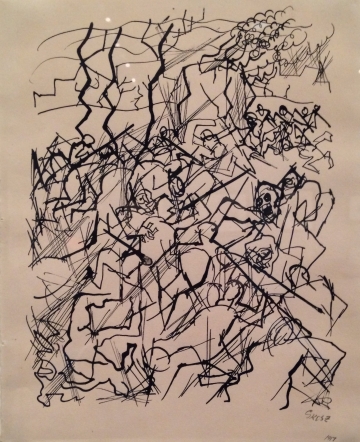 George Grosz, “War Drawing” (1917)World War I and the Visual Arts at the Metropolitan Museum of Art can easily go unnoticed, in the shadow of the museum’s Michelangelo drawing show and other major exhibitions. That would be unfortunate; while relatively small — it occupies four mid-sized rooms in the print wing — its tour through the first modern war provides insight into the conflict’s early reception and the physical and psychological toll it took on each nation involved.
Drawn primarily from the Met’s collection, the exhibition encompasses art, documentary photography, and ephemera and artifacts, the latter ranging from propaganda posters to textiles to gas masks, and brings together artists and perspectives from various nations. It is organized chronologically by room — The Outbreak; No-Man’s-Land; The Aftermath; and a smaller section, The Intersection of Arms and Art — a schema that risks an oversimplified narrative, but the modernity, austerity, and raw power of much of the art predominates.
International modernisms are represented in works by artists including Gino Severini, Wyndham Lewis, Fernand Leger, Otto Dix, and Marsden Hartley. While pieces such as Lewis’s geometric machine gunners for the cover of the periodical Blast (July 1915) and Severini’s charcoal drawing “Flying Over Rheims” (1915) toe the Futurist/Vorticist line of technological dynamism, Severini’s “Still Life: Bottle + Vase + Journal + Table” (ca. 1914-15), which collages a charcoal and gouache abstraction with newspaper clippings on French military actions, brings a level of social commentary to the image.
In many cases, the most effective works are the simplest. Belgian artist Léon Spilliaert’s poignant 1917 watercolor, gouache, and graphite painting “Rockets” transforms flares into a constellation of stars illuminating an indigo sky. Japanese-American artist Kerr Eby portrays an explosion with an expanse of negative space consuming almost the entire upper half of his drypoint print “A Kiss for the Kaiser” (1919). Eby’s mezzotint and drypoint print “No Man’s Land — St. Mihiel Drive” (1919) is more evocative, as its soft, deep gray washes over the sky, veiling troops below.
Three 1914 charcoal drawings by Marsden Hartley confirm the artist as one of America’s great modernists. The drawings — memorials to his close friend and rumored lover, Karl von Freyburg, a German officer killed early in the war — belong to a suite of works produced between 1913 and 1915 in Berlin, which also includes lush, colorful paintings. The abstraction of military insignia and symbols echoes the paintings, but the black and white palette pares down the visuals, rendering the drawings almost elegiac.
Read the entire article on the Hyperallergic web site here:
External Web Site Notice: This page contains information directly presented from an external source. The terms and conditions of this page may not be the same as those of this website. Click here to read the full disclaimer notice for external web sites. Thank you.