



































GU alumnus Laurence Stallings used WWI experience to inspire books, plays, and films
By Matt Ellison and Charlotte Kelly
via the Georgetown University School of Foreign Service web site
Laurence Stallings, who graduated with a Master’s degree from the School of Foreign Service in 1922, turned his experience as a wounded veteran in the First World War into inspiration for a career as a journalist, author, and playwright.
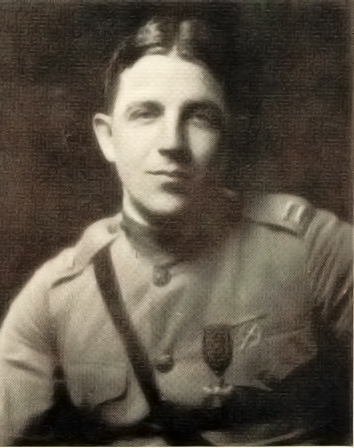 Laurence Stallings in his World War I Marine uniform in 1918.Laurence Tucker Stallings was born on November 25th, 1894, in Macon, Georgia to Larkin Tucker Stallings and Aurora Brooks Stallings. In 1912, he matriculated to Wake Forest University, where he became the editor of the literary magazine on campus, Old Gold and Black. It was there where he met his first wife, Helen Poteat, the daughter of the university president.
In 1916, Stallings graduated from Wake Forest and got a job writing advertising copy for a local military recruiting office. Then, in 1917, he himself joined the United States Marine Reserve. On April 24th, 1918, he left Philadelphia aboard the USS Henderson for overseas duty in France. Stallings served in France as a platoon commander with the 3rd Battalion, 5th Marines during the fighting at Chateau-Thierry. But then, at the Battle of Belleau Wood, Stallings was shot in the right leg leading a successful assault on an enemy machine gun installation. He was promoted to Captain, awarded the Silver Star, and given the Croix de Guerre by the French Government. Although he begged not to have the leg amputated, a wish respected at the time, he would have to have it amputated in 1922 after a bad fall on ice. He began work on his novel Plumes while recovering at Walter Reed Hospital.
Stallings was no longer able to serve due to his injury and returned home to the United States. Stallings married Helen Poteat on March 8th, 1919, and had two daughters, Sylvia, born in 1926, and Diana, born in 1931.
Stallings then attended the School of Foreign Service, where he received his Master’s degree in Foreign Service in 1922. After graduation, he began working as a reporter, critic, and entertainment editor at the New York World.
Perhaps Stallings’s greatest work was his pseudo-autobiographical novel Plumes, which told the story of Richard Plume, a U.S. Marine whose combat injuries cost him a leg and much of his faith in government and society. The novel was published in 1924 and became a huge success, with nine printings in that year alone. The novel was so popular, in fact, that it was adapted into King Vidor’s 1925 film The Big Parade, which was MGM’s largest-grossing film until Gone with the Wind in 1939.
Read the whole article on the Georgetown University School of Foreign Service web site:
External Web Site Notice: This page contains information directly presented from an external source. The terms and conditions of this page may not be the same as those of this website. Click here to read the full disclaimer notice for external web sites. Thank you.