
































In Flew Enza: Remembering the 1918 Plague Year in Berkeley
By Pat Joseph
via the Cal Alumni Association web site
In 1918, America was at war and students arriving at the University of California in the fall of that year found their campus transformed. From the Center Street entrance, the view of the hills was now obscured by large new barracks and the dark smoke issuing from the powerhouse gave the place the look of a factory. Everywhere young men wore the khaki uniforms of the various military outfits represented on campus—the Student Army Training Center, the School of Military Aeronautics, the Naval Unit, and the Ambulance Corps.
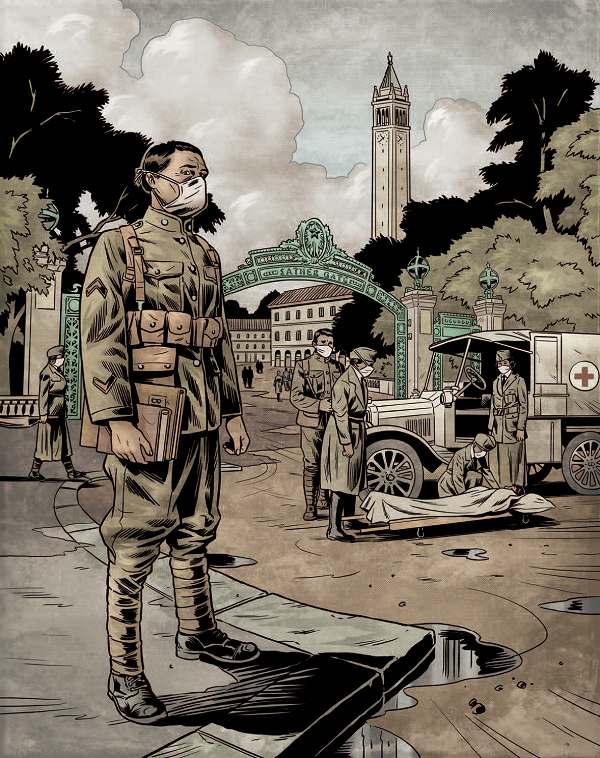 “Instead of the college atmosphere which prevailed here before the war,” one student observed, “there has grown up a disinterested attitude which has placed the war before everything else. … To try to start a discussion on anything besides the war, with a view to starting a little ‘California spirit’ has proved futile. The students simply will not respond. Their hearts are not focused on things here at college. They are far away—mostly ‘over there.’”
Yet while the coal smoke and the war in Europe no doubt cast a pall, a still more ominous cloud loomed near, for 1918 was to be a time of plague in Berkeley and around the world, the year of the so-called Spanish influenza. It was called that only because Spain, being a neutral country, did not censor its press to buoy wartime morale; when Alfonso XIII, the young king of Spain fell ill with the grippe, his subjects knew about it.
Even now, no one is sure where the flu originated, although many experts have pointed to Haskell County, Kansas, as a probable ground zero, a district so rural and primitive that many residents still lived in sod houses. A flu epidemic had emerged there in January 1918 that was like nothing ever seen before. Author John M. Barry wrote, “the strongest, the healthiest, the most robust people in the county—were being struck down as suddenly as if they had been shot. Then one patient progressed to pneumonia. Then another. And they began to die.”
In March, a similar epidemic raged through the Army’s Camp Funston (now Fort Riley) some 300 miles away and spread rapidly from there, carried in the lungs of the young conscripts shipping off to the front. In the end, the disease, no doubt accelerated and exacerbated by the war, would have greater reach than the conflict itself, penetrating as far as Asia and Africa, Europe and South America, the Pacific Islands and the Arctic.
Read the whole article on the Cal Alumni Association web site:Cal Alumni Association web site:
External Web Site Notice: This page contains information directly presented from an external source. The terms and conditions of this page may not be the same as those of this website. Click here to read the full disclaimer notice for external web sites. Thank you.