



































Travel Documents for post-WWI Gold Star pilgrimages
By David Langbart
via the National Archives Text Message blog
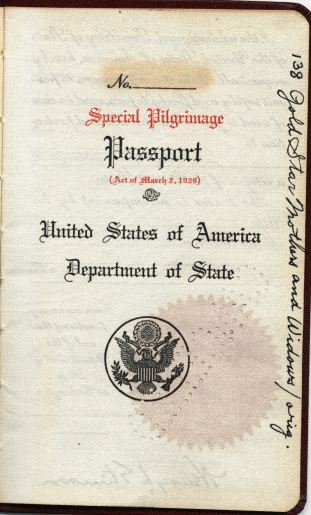 On March 2, 1929, President Calvin Coolidge signed PL 70-952. That law authorized the War Department to arrange for trips, designated as pilgrimages, by the mothers and widows to the overseas graves of soldiers, sailors, and Marines who died between April 5, 1917 and July 21, 1921. Congress later expanded eligibility to include the mothers and widows of men who were buried at seas or whose place of burial was unknown.
After World War I, more than 30,000 American dead from that conflict remained overseas, buried in U.S. cemeteries. The passage of the law resulted from the work of the mothers and widows of those servicemen and their supporters who pushed for the pilgrimage to the gravesites at government expense. International travel was not as common as it is now and the cost of such travel was beyond the means of the families of many of the dead.
The War Department prepared and submitted to Congress a list of the mothers and widows it identified as falling under the provisions of the law. The report was arranged by state and thereunder by county. In addition to the name of the mother or widow, the list indicates the relationship to the deceased service member, the name of the decedent along with rank and service organization, the cemetery, and an indication of whether the mother or widow desired to make a pilgrimage in 1930 or later. The House of Representatives published the report as an official House Document.
The resulting trips took place between 1930 and 1933. Travel outside the United States required a passport. To facilitate travel by the mothers and widows, the Department of State established the “Special Pilgrimage Passport.” Those documents were valid only during the trip in which the mother or widow participated. The Department charged no fee for those passports.
Since the Department of State issued passports only to American citizens and numerous mothers and widows did not hold that status, the Department established the special “Pilgrimage Travel Document” for use by those women who owed allegiance to the U.S. The Department charged no fee for the travel documents.
Read the whole article on the National Archives Text Message blog:
External Web Site Notice: This page contains information directly presented from an external source. The terms and conditions of this page may not be the same as those of this website. Click here to read the full disclaimer notice for external web sites. Thank you.