




























President Woodrow Wilson debuts Fourteen Points, January 1918
By Caitlin Hamon
Staff Writer
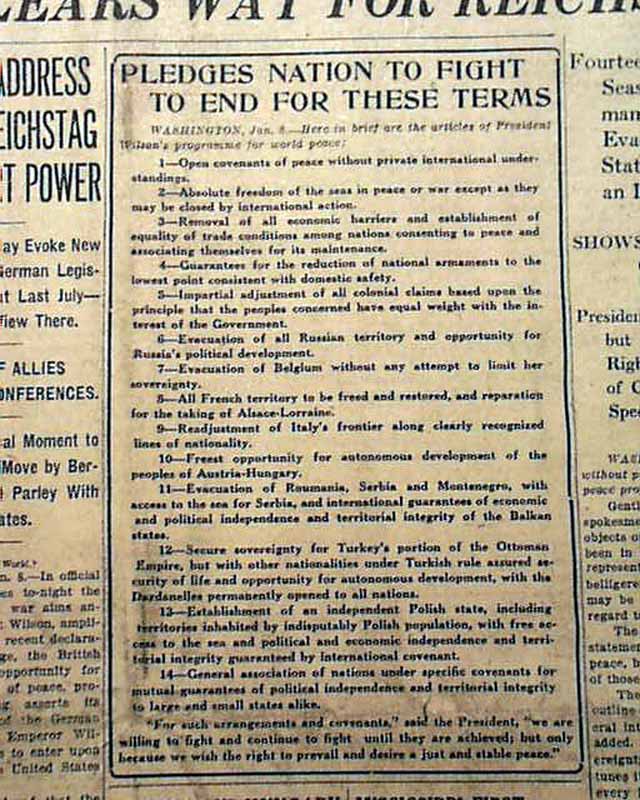
On January 8, 1918 -- long before the 1919 Treaty of Versailles -- President Woodrow Wilson addressed the U.S. Congress with what would later become known as his "Fourteen Points" that were "Fundamental to America's War Aims."
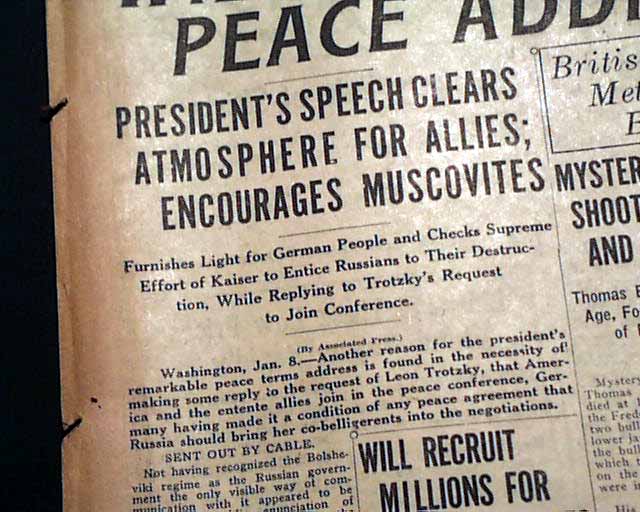 Two months earlier, Lenin had issued his 'Decree on Peace', prompting Wilson to respond with oration of his own, addressing the secret treaties amongst allies that the Bolsheviks had disclosed, as well as outline the principles for a future peace. The theme that dominated his speech was "the principle of justice to all peoples and nationalities, and their right to live on equal terms of liberty and safety with one another, whether they be strong or weak."
Up until then, there had been no explicit statement of war aims by any of the nation’s fighting during World War I. Wilson sought out his longtime advisor and friend, Colonel Edward House, to create an inquiry which would explore the issues a peace conference would identify and set achievable goals for them. After extensive research by a team, Walter Lippmann presented Colonel House with a memorandum: “The War Aims and the Peace Terms it Suggests.” On January 4, Colonel House presented the statement to Wilson, who subsequently spent the weekend reworking the memo into a numbered short statement, ending with the creation of an organization for peace.
Wilson was famous for his eloquent speeches; with his resonant voice and precise diction, oratory was his greatest asset, and this speech was no different.
“We entered this war because violations of right had occurred which touched us to the quick and made the life of our own people impossible unless they were corrected and the world secure once for all against their recurrence. What we demand in this war, therefore…is that the world be made fit and safe to live in; and particularly that it be made safe for every peace-loving nation which, like our own, wishes to live its own life, determine its own institutions, be assured of justice and fair dealing by the other peoples of the world as against force and selfish aggression.”
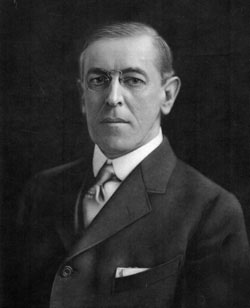 President Woodrow WilsonHe expressed that all peoples in the world were partners in this endeavor, and therefore all were necessary to his “program of peace.”
The first six enumerated points addressed the causes of world war, and urged:
I. The elimination of secret treaties in favor of open agreements
II. Free navigation of the seas
III. Removal of all economic barriers and established equal trade between nations
IV. The reduction of armaments
V. The adjustment of colonial claims and the self-determination of colonized populations in regard to their sovereignty
VI. The evacuation of all Russian territory by the German armies
The next seven clauses proceeded to rearrange the map of Europe, effectively eradicating the old imperial borders of specific territories and creating independent states. This included:
VII. the evacuation of Belgium,
VIII. the release of French territory, (particularly Alsace-Lorraine),
IX. the readjustment of the frontiers of Italy into “clearly recognizable lines of nationality,”
X. the autonomy of Austria-Hungary,
XI. the release of occupied territories in the Balkan states, establishment of political and economic independence along “historically established lines of allegiance,” as well as access to the sea for the Serbs
XII. Assured sovereignty of Turkey from the Ottoman empire, as well as the right of other nationalities to develop autonomy
XIII. Establishment of an independent Polish state, with access to the sea
And, finally, his fourteenth point -- the creation of a world organization that would provide a system of collective security for all nations-the foundations of the League of Nations.
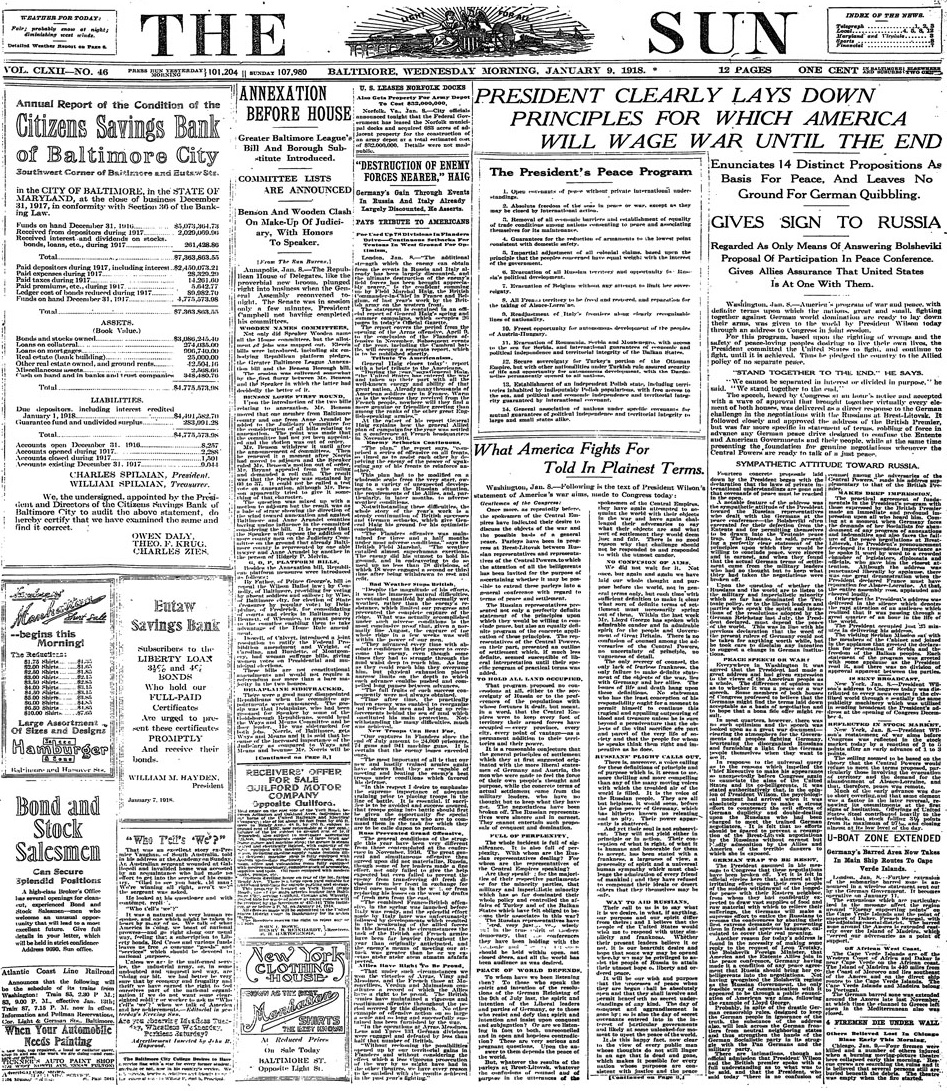 Wilson’s speech was initially received with great praise in the United States, including, begrudgingly, one of his greatest critics, Theodore Roosevelt. The abolishment of imperialism and the political and territorial independence of great and small nations was a concept right in line with American ideology and received great support. Most of the world also heartily embraced his speech; millions of copies were printed and disseminated, and in Petrograd alone over 300,000 handbills were distributed within 5 days. As the Germans advanced into Russia early in 1918, they found the walls covered with copies of the Fourteen Points, not only in Russian, but translated into German as well.
However, responses from European leaders differed greatly. French Premier Clemenceau stated, “God was satisfied with Ten Commandments, but Wilson wants fourteen.” The British had no intention of losing their best weapon, the blockade, to free navigation of the seas. The German Chancellor George Hertling saw Wilson’s references to Russia as undermining attempts at a treaty at Brest-Litovsk, stating the arrangements between the two were a separate matter, while also maintaining deliberate ambiguity about Belgium. Even Trotsky dismissed the Points as ‘Capitalist hot air.’
As the war continued, support for Wilson’s Fourteen Points began to erode. Anti-German sentiment had grown strong in the U.S. and the demand for Germany’s unconditional surrender became the reoccurring theme iterated by Wilson’s political opponents, undermining his calls for a fair peace and “impartial justice in every term of the settlement.”
Despite the negative response by the Allies, Colonel House urged Wilson to “commit the Allies to some of the things for which we are fighting,” namely to reiterate his ideals and stress the need for a League of Nations. Subsequent speeches continued to appeal to the Allies over the need for such a League, because the problems specified in his Fourteen Points affected the whole world; “...Unless they are dealt with in a spirit of unselfish and unbiased justice, with a view to wishes, the natural connections, the racial aspirations, the security, and the peace of mind of the peoples involved, no permanent peace will be attained.”
By the time the Central Powers and the Allies were prepared to negotiate Armistice in November of 1918, war rage and the need for revenge against the Germans had completely drowned out Wilson’s seemingly liberal conditions of peace. Though the Germans had wired Washington prepared to negotiate based on these Fourteen points, compromise was considered a conciliatory gesture by the Republicans in Congress and the Allies in Europe; the conditions of the November armistice spelled utter defeat for Germany.
Wilson continued to press his Points as an outline for rebuilding Europe and the creation of the League of Nations throughout the six-month treaty negotiations in Paris. Eventually, an organization for the arbitration of international disputes was created, the Covenant of the League of Nations, outlined in Part I of the Treaty of Versailles. Though Wilson continued to argue in Congress in favor of U.S. participation in the league, opposition was fierce amongst Americans, and it never came to be.
Wilson did receive the Nobel Peace Prize in 1919 for his efforts to ensure peace. He believed these Fourteen Points would become his greatest legacy, and arguably, it has been. Though the influence of this speech on events which followed are still hotly debated today, it clearly embodies the concepts of liberal internationalism in the modern age.
One can even argue it has laid the foundations for how international negotiations are conducted today. Wilson envisioned a world where nations could resolve their disputes in open congress, averting war, where weak and strong are treated equally, a concept that many around the globe continue to strive for today.
Citations:
- Fleming, T. J. (2003). The Illusion of Victory: America in World War I. New York, NY: Basic Books.
- Berg , A. S. (2013). Wilson. New York, NY: G.P. Putnam's Sons.
- Wilson, W., & User Hirgen. (2007, May 2). President Wilsons Fourteen Points. Retrieved January 04, 2018, from https://wwi.lib.byu.edu/index.php/President_Wilsons_Fourteen_Points
Caitlin Hamon is a volunteer with the United States World War One Centennial Commission.