
































Quincy, IL physician rose to Major during World War I
By Arlis Dittmer
via the Quincy, IL Herald-Whig web site
After war was declared in April 1917, 14 Adams County physicians volunteered for the reserve medical corps.
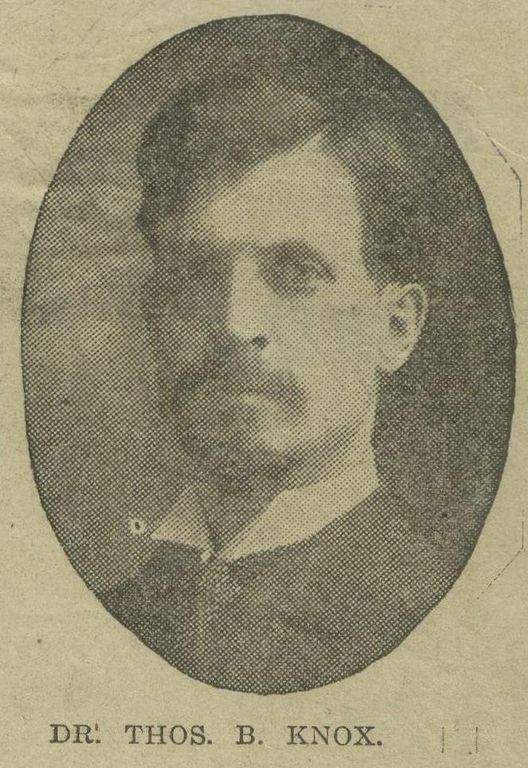 Dr. Thomas Blackburn Knox was the first to receive a commission as a lieutenant and left for Fort Riley in Junction City, Kan., in July 1917. Eventually 21 Adams County physicians served in World War I. That number represented 30 percent of the area physicians who collectively had an average age of 46. Those who were not called to the military served on draft and exception boards.
In September 1917 after a few months at Fort Riley, Dr. Knox was ordered to Camp Dix in Wrightstown, N.J., where he was to be surgeon to the 26th engineers corps. Dr. Knox was then transferred to the 312th ambulance company also at Camp Dix. In early November 1917, The Quincy Daily Herald published a letter from Dr. Knox to his friend Joe Esler. In the letter he describes the camp as very large with a hospital of 3,000 beds. He praised the Knights of Columbus and the YMCA for bringing a variety of entertainment to the recruits. His job consisted of drills and lectures for the men under his command, and he describes the doctors as Easterners and "a fine bunch of fellows, all young men around 35, a good, jolly bunch…." Toward the end of the letter he says, "The east is wonderful and I'm glad I'm here, following the flag of Uncle Sammy, and we are all happy that we are doing our bit." In closing he tells his friend Joe to, "Give my regards and best wishes to all my Quincy friends and tell them the boys need sweaters and mittens and wool socks."
In April 1918, Dr. Knox was promoted to captain and assumed command of the 312th ambulance company. In announcing his promotion, The Daily Whig quoted the Camp Dix Times as saying, "Captain Knox possesses an abundance of enthusiasm and a breezy western manner. Everyone who knows this commanding officer is delighted to know of his merited promotion and he has received scores of congratulations."
Dr. Knox left for France on June 4, 1918, on the RMS Mauretania. He sailed with his company as part of the 303rd Sanitary Train, 78th division. In Europe, he was in command of officers, enlisted men, 13 ambulances and two dressing stations where the injured received first aid before being sent behind the lines. During the summer of 1918 his company was stationed with the Fourth and Fifth British Army in Flanders behind Arras and then transferred back to the American sector in September and in October took part in the battle of the Argonne Forest.
The battle lasted 47 days. Dr. Knox's company spent 28 days of the battle at the front with the 311th and 312th infantries. He told The Daily Whig, "There is where we went into hell. The casualties in the infantry were heavy and we lost some of our men, but the ambulance boys died mostly from disease because of the conditions in which we were forced to live during the heaviest fighting and then some of them were killed when struck by shells." The company also lost ambulances because of shelling and had to use trucks to carry the wounded.
Read the whole article on the Quincy, IL Herald-Whig web site:
External Web Site Notice: This page contains information directly presented from an external source. The terms and conditions of this page may not be the same as those of this website. Click here to read the full disclaimer notice for external web sites. Thank you.