
































100 years later, Great War’s impact on Greenville remains evident
By Andrew Moore
via the Greenville Journal web site
This year marks the 100th anniversary of the end of World War I, a conflict that dragged nations from all across globe into four years of unprecedented bloodshed.
Between the start of the war on July 28, 1914, and end of the war on Nov. 11, 1918, more than 18 million people were killed and 21 million wounded. The American diplomat, George Kennan, described the war as “the seminal catastrophe of this century.”
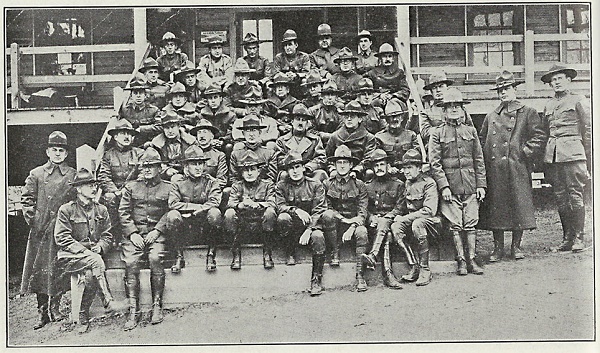 Medical Staff at the Base Hospital, Camp Sevier, SC, 1918.However, the war did much more than cause a global massacre. It allowed millions of women to enter the workforce, featured the initial step of the United States as a world power, and helped to transform Greenville into the city it is today.
Building a camp
When the United States declared war on Germany in April 1917, Secretary of War Newton Baker ordered the construction of 32 training camps, according to local historian and documentary filmmaker Don Koonce. “Most of these cantonments or training camps were to be spread across the Southeast where moderate weather would provide more training days and shorter preparation time before sending the men overseas,” he said.
Local business leaders sensed an economic opportunity and began lobbying for a camp soon after. They were successful. In July 1917, the U.S. Army appointed Greenville’s J.E. Sirrine & Co. and Gallivan Construction to build a 1,900-acre training camp near the base of Paris Mountain for the newly created 30th Infantry Division, which was composed of National Guard soldiers from South Carolina, North Carolina, and Tennessee.
The division was nicknamed the “Old Hickory” division in honor of U.S. president Andrew “Old Hickory” Jackson, who was born near the borders of the three states.
Soldiers from the 1st South Carolina Infantry arrived in Greenville soon after and began to construct the camp, according to Koonce. About 20,000 additional soldiers arrived in the following weeks, and by Aug. 31 the camp was considered complete. It was named Camp Sevier in honor of John Sevier, a Revolutionary War hero and Tennessee’s first governor.
Read the whole article on the Greenville Journal web site:
External Web Site Notice: This page contains information directly presented from an external source. The terms and conditions of this page may not be the same as those of this website. Click here to read the full disclaimer notice for external web sites. Thank you.