































True Sons of Freedom
By Jennifer D. Keene
Historical Advisory Board, United States World War One Centennial Commission
via the American Legion web site
When Delaware artist Edward Loper Sr. was a young man, “there were certain kinds of black men who I admired and they were the kind of black guys who ... came out of the first world war. They had self-respect ....”
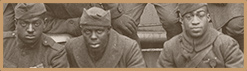
Often forgotten today, these veterans were pivotal figures in the modern civil-rights movement who fought valiantly to break down racial barriers within the military and at home. Returning home with their heads held high, they inspired the next generation of black servicemen to continue the struggle against racial discrimination.
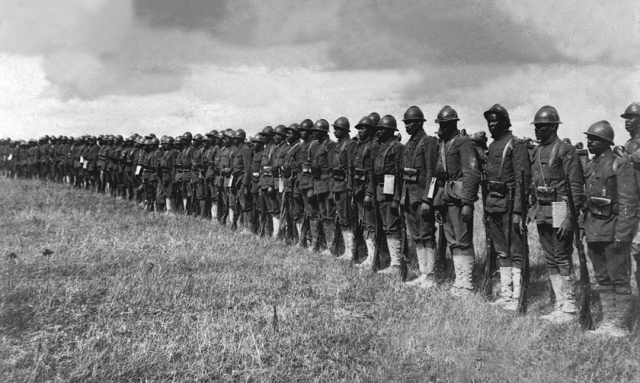 At first glance, the challenges that African-American men faced in the World War I-era Army seemed almost insurmountable.
Upon the U.S. declaration of war in April 1917, all existing eight black National Guard infantry regiments quickly filled to capacity with volunteers. As a result, over 96 percent of the 367,710 African-Americans who served during the war were conscripted by local draft boards staffed by white men. Blacks eventually formed 13 percent of the wartime Army, even though they represented only 10 percent of the civilian population.
How would the Army use these men? Who would lead them? Alarmed white Southerners sent frantic letters to Secretary of War Newton E. Baker, predicting a future race war if large numbers of black men received military training. For his part, Gen. John J. Pershing, commander of the American Expeditionary Forces (AEF), believed that black men could fight well, but only if led by white officers.
Consequently, over 89 percent of African-Americans were assigned to noncombatant units, mostly in quartermaster and engineer units with white officers. But the black community had some clout to influence official policies – after all, black participation in the war effort was essential. Under pressure from civil-rights organizations, especially the National Association for the Advancement of Colored People (NAACP), the War Department agreed to create one complete black combatant division, the 92nd Division, and melded the National Guard units into four infantry regiments to form a “provisional” 93rd Division. Baker also authorized one black officer training camp at Fort Des Moines, Iowa, to provide company-grade officers for the 92nd Division.
Read the whole article on the American Legion web site:
External Web Site Notice: This page contains information directly presented from an external source. The terms and conditions of this page may not be the same as those of this website. Click here to read the full disclaimer notice for external web sites. Thank you.