


























World War I helped shape U.S., Nebraska future
By Kerri Rempp
Editor, The Chadron Record, via the Rapid City Journal web site
World War I led to “ultra-patriotism,” the build-up of American forces and military facilities and had long-term impacts on society.
That was the take-away from a presentation Thursday, February 22 by Sandra Reddish, a historic sites coordinator for the Nebraska State Historical Society, at the Mari Sandoz High Plains Heritage Center. Her presentation, which drew about 30 people, was meant to highlight the center’s current exhibit, “Over Here: Americans at Home in World War I. The exhibit runs through March 12. Reddish explored the context of WWI and displayed several items from her personal collection of WWI era items, including uniforms, a suitcase Victrola and a 1918 record, and postcards.
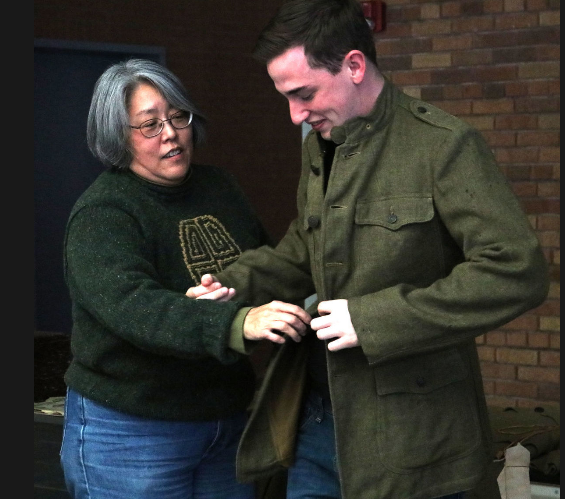 Sandra Reddish (left) assists volunteer Cristian Hulsey of Alliance into a WWI uniform from her collection. Reddish spoke about the era and showcased some of her artifacts at the Mari Sandoz High Plains Heritage Center recently. (Rapid City Journal)The war started in August 1914, and early players believed it would be over by Christmas.
“For some reason people think war’s going to be short,” Reddish said.
Most American citizens didn’t want the country entering the war, and the 1915 song “I Didn’t Raise My Boy to Be a Soldier” became a popular tune.
“That’s the sentiment of the nation,” Reddish explained.
By April 1917, when America entered WWI, that sentiment had changed, in large part due to three things: the sinking of the Lusitania, an explosion at Black Tom Island that was the work of saboteurs, and the Zimmerman Telegraph.
But the U.S. was a nation unprepared for war, with only 121,797 men enlisted, a lack of equipment and weapons and no planes or tanks. The country created a draft to build up its military, and on June 5, 1917, the first day of the draft, 9 million men enlisted. America learned its lessons from the Civil War draft, keeping the procedure at a local level and drumming up support with lots of fanfare.
“They made it a huge community deal,” Reddish said.
Deferments were granted for sole providers with dependents, agricultural and industrial workers.
Dawes County enlisted 838 men June 5, 1917, and by September of the next year had enlisted 2,061. The county granted deferments for 265 men with dependents, 97 agricultural and 26 industrial workers.
America was also unprepared in terms of facilities and had to build training camps throughout the U.S. Most Nebraskan soldiers ended up shipping out to Kansas or Iowa, a point in history Reddish finds peculiar.
Read the entire article on the Rapid City Journal web site.
External Web Site Notice: This page contains information directly presented from an external source. The terms and conditions of this page may not be the same as those of this website. Click here to read the full disclaimer notice for external web sites. Thank you.