



































W. E. B. Du Bois, World War I, and the Question of Failure
By Chad Williams
via the Black Perspectives web site of the African American Intellectual History Society
2018 marks both the sesquicentennial of W. E. B. Du Bois’s birth and the continued centennial of World War I. That convergence of commemorations offers a unique opportunity to reflect on Du Bois’s legacy as it relates to the war, a pivotal moment in his long life and career.
From the opening guns of August 1914 until his final days, Du Bois wrote extensively about the war and reflected on its significance. For Du Bois, the war marked not only an epochal historical event, it was deeply personal.
I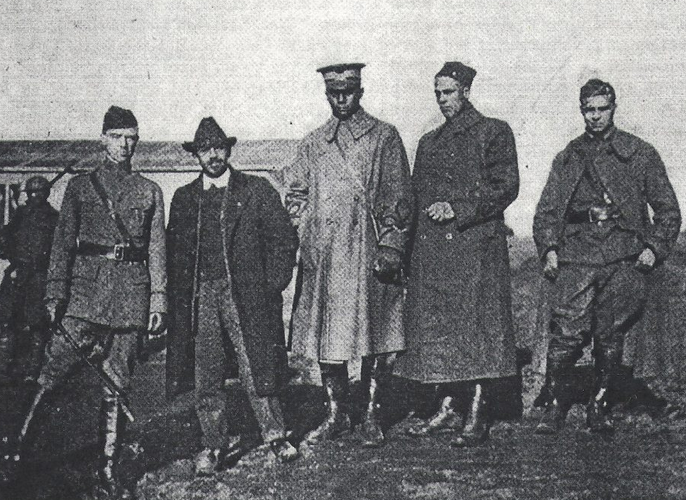 W. E. B. Du Bois with black officers in Le Mans France 1919 (The Crisis June, 1919)n his book Darkwater, completed in the wake of the armistice and in the midst of the “Red Summer” of 1919, Du Bois asked a poignant question: “How great a failure and a failure in what does the World War betoken?”
This question remains haunting. But what would it mean, in the context of the history and memory of the war, to view Du Bois himself as a failure? Approaching Du Bois this way is generative for not only understanding his complicated relationship to the war, but also for problematizing his commanding, yet often romanticized, presence in African American intellectual history.
In reckoning with the idea of Du Bois as a failure in the context of the First World War, I am less interested in what he published than I am in what he did not publish.
For most of the interwar period, Du Bois labored to write what he believed would be the definitive history of the Black experience in the war: The Black Man and the Wounded World. He produced an 800-page manuscript comprised of twenty-one chapters that examined the causes of the war, its impact on the African diaspora, and, most centrally, the role of Black soldiers in the conflict. It would have been a monumental book, rivaling Black Reconstruction as Du Bois’s most ambitious work of history. But The Black Man and the Wounded World went unpublished.
The story of Du Bois’s failed attempt to write and publish The Black Man and the Wounded World is long and complex. In lieu of telling the full story, I highlight three specific dilemmas related to this project that speak to the troubling place of World War I in Du Bois’s life and mind.
Read the entire article on the Black Perspectives web siteBlack Perspectives web site:
External Web Site Notice: This page contains information directly presented from an external source. The terms and conditions of this page may not be the same as those of this website. Click here to read the full disclaimer notice for external web sites. Thank you.