


































A Century After WWI, the Weapons of Old Wars Keep Turning Up on Beaches
By Wayne Parry
Associated Press, via the Popular Mechanics web site
MANTOLOKING, N.J. (AP) — A century after World War I ended, discarded munitions from that and other wars continue to make their way onto beaches around the country.
Items ranging from tiny fuses to full-scale mines are displaced by beach replenishment projects, sucked from the ocean floor and pumped ashore, or by strong storms that uncover them.
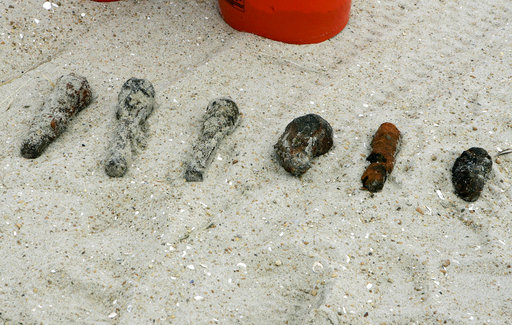 This Feb. 10, 2009 file photo shows some of the more than 1,100 old fuses and small anti-aircraft shells that have been found as the U.S. Army Corps of Engineers searches for any remaining World War I era munitions along the Atlantic Ocean in Surf City, N.J. A century after World War I ended, munitions from that and other wars continue to surface on beaches around the United States, usually during beach replenishment projects when they are sucked from the ocean floor and pumped ashore onto the sand, or exposed by strong storms. (AP Photo/Mel Evans, File)The most recent discovery came in March 2018 when seven WWI rifle grenades were found on the beach in Mantoloking, New Jersey, which is undergoing a beach replenishment project to undo damage from Superstorm Sandy more than five years ago.
Many of the items were simply dumped overboard at the end of World Wars I and II; others remain from military drills or target practice. They've been discovered in at least 16 states from New Jersey to Hawaii.
"Surprisingly or not, this stuff continues to turn up," said Niall Slowey, an oceanography professor at Texas A&M University, who has studied the phenomenon extensively. "They disposed of millions of tons of this stuff."
No one knows how many pieces of munitions remain offshore, partly because the military's own records as to how much was disposed of aren't great. A Defense Department report to Congress in 2009 said more than half of sea disposals of munitions was done in the Atlantic Ocean; the Pacific got another 35 percent, and lesser amounts were dumped off Hawaii, Alaska, the Gulf of Mexico and the Caribbean. The material was dumped as near as 5 miles from shore, in water as shallow as 50 feet.
Slowey and a colleague released a 2012 study estimating there are millions of pounds of undersea bombs in the Gulf of Mexico alone.
Disposal of unneeded munitions at sea was commonly accepted practice until 1970.
"They thought it was beyond harm's reach," Slowey said. "People could not envision that there would be any interaction with material that deep on the ocean floor. But there is a lot more on the sea floor than anyone could have envisioned."
New Jersey has been home to some well-publicized discoveries, including more than 1,100 pieces of munitions pumped ashore during beach replenishment work on a mile and a half of sand in Surf City and Ship Bottom on Long Beach Island in 2007. The items, mostly fuses, prompted temporary bans on the use of metal detectors and the digging of holes in the sand more than a foot deep. It also created a cottage industry in T-shirts with slogans like "Our beaches will blow you away!" and "I got bombed on L.B.I.!"
Read the entire article on the Popular Mechanics web site here:
External Web Site Notice: This page contains information directly presented from an external source. The terms and conditions of this page may not be the same as those of this website. Click here to read the full disclaimer notice for external web sites. Thank you.