































The story behind "I Want You"
By Phil Connelly
via the Ravalli Republic web site
Most likely, you’ve never heard of artist James Flagg. But, I bet you are aware of his most famous work of art.
Flagg was born on June 18, 1877, in Pelham Manor, New York. From a young age, he very much into drawing and by the time he was 12 years old, he already had an illustration of his appear in a national magazine.
 Two years later, he was a regular contributor for Life magazine and by the following year, he was on the staff of Judge, another national magazine. At age 17, he began his formal training at the Art Students League of New York.
After returning from Europe where he studied fine art in both London and Paris, he contributed numerous illustrations for books and magazine covers, as well as producing humorous and political cartoons. He even had a recurring comic strip about a tramp named Nervy Nat that appeared in Judge from 1903 to 1907.
However, his most famous and enduring work would occur shortly after the United States entered World War 1. The U.S. army launched a contest for who could create the most inspiring patriotic poster.
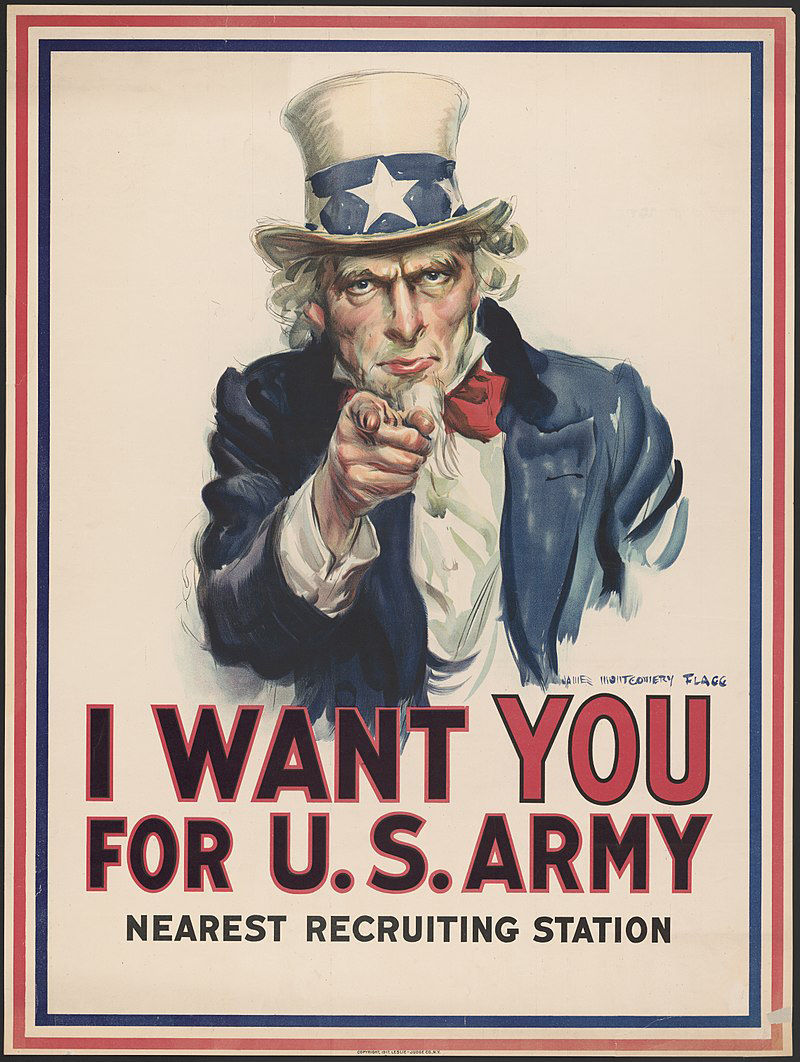
Flagg, then 40, entered the contest with his now iconic drawing that featured a rather stern-faced version of Uncle Sam with an out-stretched finger pointing straight ahead. The caption below loudly declared in bold red and blue letters “I WANT YOU”.
After Flagg’s drawing was selected, over four million copies were produced and distributed throughout the country. Flagg would go on to produce close to 50 wartime drawings and posters for the government’s propaganda department known as the Committee on Public Information.
Interestingly, the army wanted an inspiring poster so quickly that Flagg did not have time to secure a suitable model. So Flagg used his own likeness, sitting in front of a mirror. He later added the goatee, hat, and appropriate wrinkles.
Besides encouraging men to enlist, Flagg’s drawings urged citizens to save money, work harder to help win the war, and plant victory gardens.
So, Flagg came up with a brilliant and lasting image that inspired Americans during the First World War. Well, not exactly. In 1914 in England, another artist had produced a virtual twin of Flagg’s drawing. In this drawing, a grim looking Lord Kitchener (Secretary of State for War) was seen with the same extended arm urging British men to enlist in the army.
Read the entire article on the Ravalli Republic web site.
External Web Site Notice: This page contains information directly presented from an external source. The terms and conditions of this page may not be the same as those of this website. Click here to read the full disclaimer notice for external web sites. Thank you.