
































Easter 1918 bittersweet as WWI was underway
By Patricia Benoit
via the Temple (TX) Daily Telegram newspaper web site
Easter Sunday, March 31, 1918, was a bittersweet observance, full of dark humor and gas masks on the front lines of World War I.
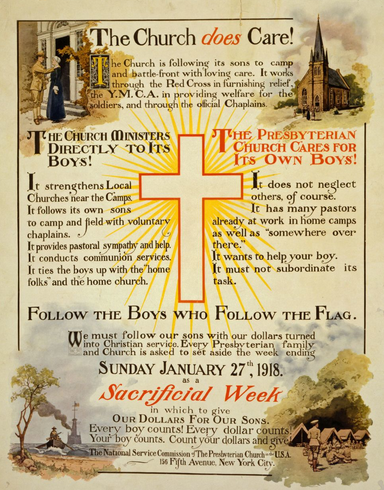 This 1918 poster produced by the Presbyterian Church was part of fund-raising efforts to provide a roving chaplain to American troops overseas during World War I.Soldiers couldn’t help but compare their lives before the war and their current circumstances on the battlefield in a combination of hope and dread. Elmer W. Sherwood (1896-1979) seemed resigned to his situation as he wrote in his diary: “This is Easter Sunday, but instead of wearing a new suit, I have the one I received in the U.S.A., and I look like a tramp. But who cares? Not I. Work as usual until noon.”
In another region of the French battlefront, First Lt. Sylvester Warren of Belton (1886-1945) wrote to his mother, Mary Alice Warren (1867-1951) about Easter services 1918.
Warren, a Santa Fe Railway telegrapher stationed with the U.S. Army Corps of Engineers in France during World War I, was among those from half a dozen U.S. railways who had been dispatched to keep the rails moving. They nicknamed themselves the “Two-Two-Toot regiment” that ran to what Warren called “the skeleton city of Verdun.”
American railroaders were in charge of the rail lines to free French trainmen to other fronts. “It was exciting to see the first locomotive (from the States) give its long scream as it neared the camp,” Warren wrote his mother. “Every man forgot Army restraints for the moment. They jumped and ran to see the big iron beauty roll in.”
Pretty soon, the iron steeds were busy hauling troops, horses and equipment 24 hours daily. Despite the jubilance, an Easter lull forced Warren and his compatriots to face their own mortality and to grasp the full meaning of sacrifice at Easter.
In late 1917 and early 1918, an infusion of fresh troops from the U.S. had swarmed into the French countryside to aid the Allied forces exhausted after several years of the German onslaught. Gradually, the Kaiser’s army had been beaten back somewhat, and the tide of battle seemed to favor entente, according to the Temple Daily Telegram.
That news wasn’t reassuring to soldiers who daily faced disease, bombs and bullets. Warren and other soldiers at his outpost were the fortunate ones despite the dangers. Others had it worse. Beginning at the start of Holy Week, seven days earlier, another contingent marched at night resting 10 minutes every hour. Then, the troops would go sound asleep on the hard-surfaced roads. Beds and sheets were luxuries they could only dream about.
Read the entire article on the Temple Daily Telegram web site.
External Web Site Notice: This page contains information directly presented from an external source. The terms and conditions of this page may not be the same as those of this website. Click here to read the full disclaimer notice for external web sites. Thank you.