































New Free WWI Battlefield Travel Guide created by Ronald Snip
By Betsy Sheppard
Staff Writer, United States World War One Centennial Commission
Ronald Snip is the author of an illustrated travel guide about World War I, which describes the area between the city Reims (Marne) to Saint-Mihiel (Meuse) as well as Moselle and Haut-Rhin.
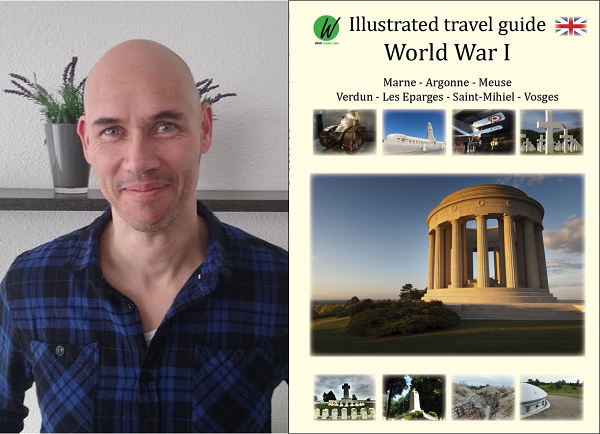 Author Ronald Snip and his free English language WWI battlefield travel guide.It is the only up-to-date, English travel guide that clearly describes the remnants of the First World War in these regions. Each topic covers two pages, with the GPS coordinates, address, location information and a detailed map in addition to images of the location, as well as a web page where additional information can be found.
To create this guide, Snip contacted museums, tourist information offices, the French army, the German Volksbund, the ABMC and American Memorials Overseas and the center of World Peace in Verdun for input. This collaboration helped his guide become so comprehensive.
Snip discovered his interest in World War I through history books. His father was interested in war history, so they had many books about war and watched many war history documentaries. In 2011 Snip visited the Belgium Ardennes, wanting to know more about the 1944 Battle of the Bulge. His accommodations were close to the French border, so he decided to visit Verdun one day to see if anything was left regarding World War I.
He was amazed by much was left. Trenches, Forts, Museums and ruined villages were in such a good state that it looked like the battle had taken place yesterday. From that day on, Snip decided to learn more about World War I, to visit all the Western Front, from the Belgium coast to the Swiss border.
From these travels, Snip created a travel guide of the regions Marne, Argonne, Meuse (Verdun and Saint-Mihiel), Moselle, the Vosges, and Haut-Rhin. The remains of World War I in those areas are very well preserved. There are several forts which are open to the public which partially withstood the terrible bombing during the Battle of Verdun (1916). Snip finds the various mine craters and trenches to be incredibly impressive because they show how violent the war could be, as entire hills with villages and enemy positions have been blown away.
He also finds that the trenches sometimes humanize the interaction of war, as the French and German trenches were sometimes only twenty meters apart.
Snip hopes that his travel guide provides readers with insight about World War I. He foresees people visiting American cemeteries and memorials and then discovering all the other interesting places in those areas through his guide. The guide can also be used in an educational manner as provides an overview of the remains of World War I.
Snip plans to write a second guide in the same layout which covers the following regions (Marne (west of the city Reims), Paris area, Aisne, Oise, Somme, Pas-de-calais and Nord).
The online version of Ronald Snip’s travel guide can be found here: https://war-travel.com/illustrated-travel-guides/north-east-france. The online version is free to use. If people want a printed version with shows clearly the detailed maps and photos, the guide book can be ordered online via the website for € 19,95 or in several museums and tourist information offices in France for € 17,50.
Betsy Sheppard is a Spring 2018 Intern with the U.S. World War One Centennial Commission.