




























Bringing Indian-American Contributions in WWI into Historical Discussion
By Elizabeth Ivanecky
via the StudyBreaks web site
Many college professors caution their students against using Wikipedia to conduct scholarly research, yet encourage the blacklisted website when it involves beginning preliminary research at least. For St. Lawrence University (STLU) senior Tanveer Kalo, spending time perusing Wikipedia led him to learn more about the Indian-American community.
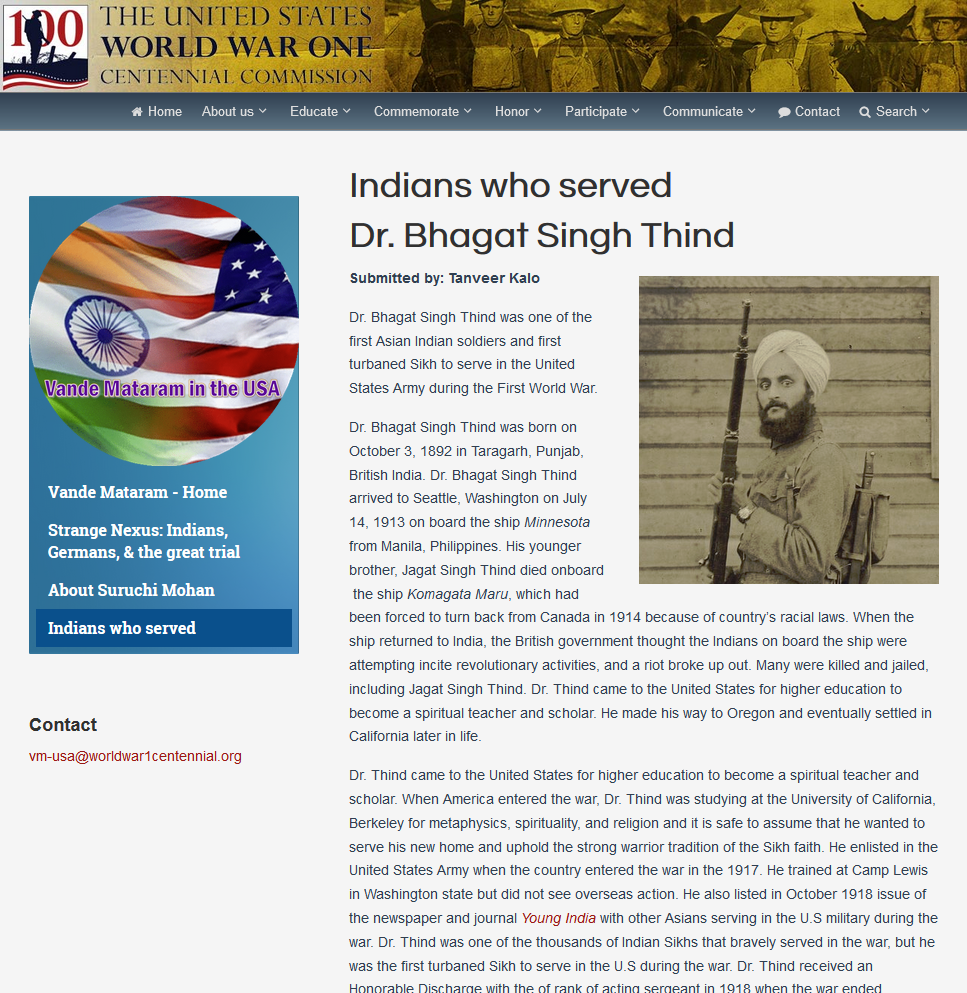 Kalo, a government major and history minor from Queens, stumbled upon Dr. Bhagat Singh Thind, the first turbaned Sikh to serve in the U.S. military in 1917, on Wikipedia. Thind would be the first of many Indian-American WWI veterans whose stories the STLU senior would share online.
Just over 100 years ago, Thind immigrated to the United States in 1913 in pursuit of higher education at the University of California, Berkeley. In 1917, he enlisted in the U.S. Army during World War I. After having served in the military, Thind fought a legal battle for citizenship back in America but was twice denied by the Immigration and Naturalization Service who claimed that he was not a “free white man.”
Today, the issue of obtaining a citizenship among immigrant communities in the United States is not so divorced from the difficulties immigrants experienced in the past. The uncertainty of DACA and Executive Order 13769 “The Travel Ban” present hurdles to citizenship for several different immigrant groups.
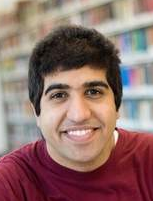 Tanveer Kalo“Thind’s story is a really big American story because you had an immigrant come here to fight for a better life. He had to fight for his life and rights that he had as a citizen because of his service to the U.S. military,” explains Kalo. “It’s a very unknown story about the Indian-American community that not many people realize.”
During spring of 2017, Kalo, as a student-researcher, interned with the United States World War I Centennial Commission (WWICC), exploring the Indian-American community further while at the same time adding informative content to the Commission’s website.
The STLU senior conducted research under the supervision of Theresa Sims, WWICC Director of Strategic Relations, and Captain Chris Christopher, Publisher at WWICC. Using the South Asian-American Digital Archives (SAADA) website and later documents from “Young India,” a weekly journal published by religious leader Mohandas Karamchand Gandhi in 1919-1931, Kalo created the page “Indians who served” on the WWICC website.
The page details the stories of many Indian-Americans who served in WWI and even some who have served in both WWI and WWII such as Manganlall K. Pandit. Kalo has received much positive reception both nationally and even internationally for his work on Indian-American soldiers.
“One of the soldiers who I highlighted for the Commission’s website in ‘Indians who served,’ Colonel Pashupati Joseph Sarma, is buried in Arlington National Cemetery in Arlington, Virginia. A descendant of his contacted me saying ‘You wrote this page on my great-uncle. Thank you so much. We didn’t know the extent of his service.’ Then he provided more information on his great-uncle in terms of his life story coming to the United States and then serving in the U.S. military,” says Kalo.
Read the entire article on the StudyBreaks web site here:
External Web Site Notice: This page contains information directly presented from an external source. The terms and conditions of this page may not be the same as those of this website. Click here to read the full disclaimer notice for external web sites. Thank you.