





























Max Beckmann: The Faces of World War I
By Ginny A. Roth
Curator of Prints & Photographs, History of Medicine Division, National Library of Medicine
“My heart beats more for a rougher, commoner, more vulgar art … one that offers direct access to the terrible, the crude, the magnificent, the ordinary, the grotesque and the banal in life. An art that can always be right there for us, in the realest things of life.”
– Max Beckmann
Max Beckmann, 1884–1950, was a painter and print-maker, primarily known for his self-portraits. Although Beckmann railed against being tagged as belonging to any art movement, he is most commonly classified as an Expressionist artist, until his work dramatically changed in the 1920s.
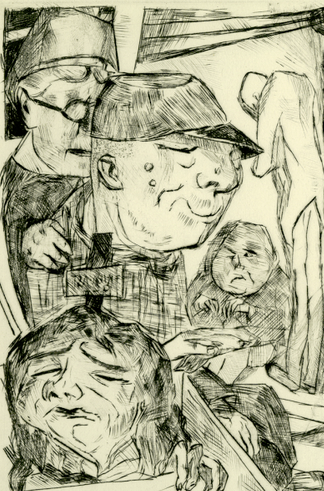 Detail from Irrenhaus (Madhouse) by Max Beckmann, 1918Expressionism was a movement that developed in Germany and thrived between 1905 and 1920 as a reaction to the rapid growth and industrialization of cities. Expressionist artists created their work based on a subjective view of the world; a world that reflected the emotions of the artist himself. It was a departure from Impressionism, a style whose proponents worked to capture the objective reality they saw.
But Expressionists were not looking to capture reality. They rejected realism and embraced the emotion, fear, turmoil, and human emotion within that reality. Expressionism became dominant in Germany following World War I, “where it suited the postwar atmosphere of cynicism, alienation, and disillusionment.”
Max Beckmann volunteered in the Medical Corps in Belgium as an orderly at the start of World War I in 1914. He was discharged after having a nervous breakdown in 1915, which led to the dramatic transformation of how he depicted himself and humanity in his art. Through his post-war art he sought to save the ”injuries of the soul” he suffered during his service. His trauma led him to create haunting, expressive figures using techniques of distortion and extreme angularity once he returned to civilian life.
The National Library of Medicine (NLM) had a unique opportunity to acquire two original Beckmann prints which he created during his recuperation after he was discharged from service. Upon examining them, I heard the silent screams and felt the emotional pain of the figures he created. Without a single word they emulate the crippling effects that the war had on Beckmann, his acquaintances, and his view of the world.
The prints were originally part of the private collection of Aaron Sopher, 1905–1972, a Baltimore artist and associate of Beckmann. Sopher’s work currently hangs in the Smithsonian Art Museum and has appeared in the Baltimore Sun, the New Yorker, and Harper’s Bazaar. Like Beckmann, Sopher felt a moral responsibility to portray individual devastation in a meaningful manner, although his works were created in America during the Depression.
Read the entire article on the National Library of Medicine web site here:
External Web Site Notice: This page contains information directly presented from an external source. The terms and conditions of this page may not be the same as those of this website. Click here to read the full disclaimer notice for external web sites. Thank you.