

































WWI history on display at Fort Benning museum
By David Vergun
via the Army.mil web site
FORT BENNING, Ga. -- Many installations across the Army are marking or have marked the centennial of the construction of their posts, which occurred in the weeks and months following the U.S. declaration of war on Germany, April 6, 1917.
Fort Benning was one of the last installations to be activated in October 1918, just a month before the armistice was declared on Nov. 11, 1918.
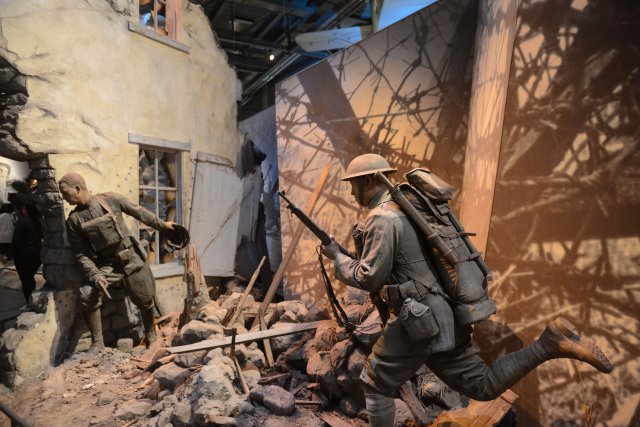 U.S. Soldiers in combat during World War I, displayed at the National Infantry Museum & Soldier Center. (Photo Credit: David Vergun)To mark the occasion, the WWI history on display at the museum here has devoted a large exhibit to what is sometimes referred to as "the Great War."
David S. Hanselman, director of the Maneuver Center of Excellence's Museum Division, provided a tour.
The war effort was monumental, he said. Prior to World War I, the active and reserve components numbered only about half a million. By war's end, the combined total had grown to over four million.
The Selective Service Act of 1917 required all males aged 21 to 30 to register for military service. The act was amended in August 1918 to expand that age range to 18 to 45. More than half of those who served during the war were drafted and the rest volunteered.
The Army preferred that Soldiers volunteer. To support the recruitment effort, a number of colorful and creative recruiting posters were produced.
One poster promised free "food, clothing, living quarters, medical attention, dental attention, baseball, football and movies-theatre; plus $30 per month." No mention was made of combat hardships.
Another poster proclaimed: "There's the world before you, young man. Do you want to see it, earn a trade and live a strong, healthy life? If so, enlist and be happy -- you can't beat this!"
Another poster was designed to entice Soldiers already in the Army to re-enlist. It reads in part: "The Army is a big workman's school and you can learn any trade you desire -- from shoemaker to aviator mechanician -- and you earn while you learn."
Many who joined the Army ended up fighting the Germans on the Western Front in France and Belgium. A large painting depicts a scene from the front titled "The Menin Road," by Paul Nash.
The description below the painting states: "Many artists tried to capture the utter desolation, wreckage, mud and hopelessness of 'no man's land,' that horrifying place of death and fear between opposing forces on a World War I battlefield."
Read the entire article on the Army.mil web site.
External Web Site Notice: This page contains information directly presented from an external source. The terms and conditions of this page may not be the same as those of this website. Click here to read the full disclaimer notice for external web sites. Thank you.