

































A New Reading of World War I American Literature
By Keith Gandal
via the Johns Hopkins University Press web site
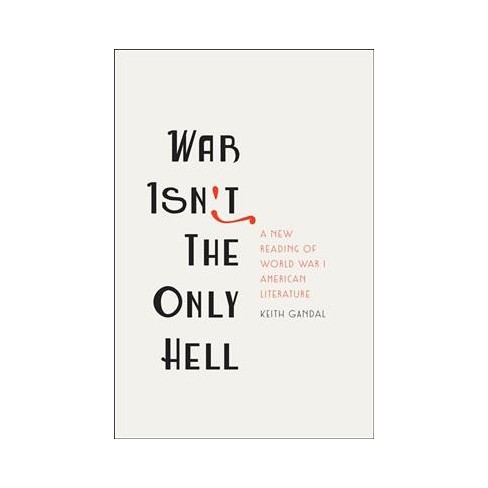
One hundred years after U.S. involvement in World War I, it is time to revisit our literature that came out of that conflict--because we are only now, finally, able to understand it in its actual historical context. That is the purpose of my new book, War Isn't the Only Hell: A New Reading of World War I American Literature. It draws on military archives and cutting-edge research by social-military historians to fully and properly come to terms with the works of thirteen of our major writers, including some of our most famous authors and some who were in their own time well-known but have been mostly forgotten.
 Keith GandalThe Great War is sometimes called “America’s forgotten war.” This is the case, not only because World War I came to be overshadowed by World War II, but because, as Steven Trout suggests, there is no single prevailing account of the war that became registered in the national memory, as there is with World War II. Instead, we supposedly have two sets of contradictory narratives, some patriotic and excited, some haunted and disillusioned.
We know what American involvement in World War II was about; we are less clear what World War I meant to the country. Historians and literary critics have tended to divide our Great-War literature into pro- and antiwar works, but this is too blunt a procedure because it fails to do justice to the mixed reactions that in fact characterize most of these works. Moreover, it is misleading because commentators have largely mistaken the motivations behind a large portion of the disillusionment and excitement.
 I would suggest that another reason for World War I’s “forgotten-war” status, which also explains the reductive critical approach, is that, until very recently, we had forgotten a tremendously important aspect of the U.S. experience. In fact, that war involved a chapter of American history that eventually changed this country forever.
As I argue in my book, World War I began America’s national embrace of meritocracy, a conception of status and a practice of governance that had roots in the founding principle of human equality and that would move the country toward an understanding of equality not simply as equality of political rights but also as equality of socioeconomic rights, or equality of opportunity for advancement.
To raise and organize a huge army and officer corps almost from scratch, as I show in War Isn’t the Only Hell, the army conducted America’s first, large-scale national experiment with meritocracy, mostly assigning men to positions and ranks based, not on class, family, and ethnicity, as had been the practice in the Civil War, but on merit. Though the army was notoriously discriminatory against African Americans, it nonetheless made a groundbreaking attempt to extend egalitarian treatment to all other ethnic groups, as well as to the poor and working class. This policy was not a matter of social justice but of the practical, bottom-line aim of winning the war. Indeed, the army’s original plan was for no discrimination against African Americans as well, but the military brass was overruled by a federal government pressured by alarmed white southern leaders. And meanwhile--despite, on the one hand, the vicious army discrimination instead instituted, and, on the other, continuing protests by white southern officials concerning black participation--inclusion of African Americans in the war effort involved some black troops in battle, saw a limited number of black officers, and gave hundreds of thousand of black men a chance to experience a country (France) that was not governed by racial discrimination and Jim Crow laws and that came to embrace them.
Read the entire article on the Johns Hopkins University Press web site.
External Web Site Notice: This page contains information directly presented from an external source. The terms and conditions of this page may not be the same as those of this website. Click here to read the full disclaimer notice for external web sites. Thank you.