































Treasure trove of WWI Diplomatic Courier Service Artifacts in en route to the State Department in Washington D.C.
By Barbara Gleason
Diplomatic Security Service, U.S. State Department
For many, the term “diplomatic courier” might conjure up classic Hollywood images of movie heroes like Tyrone Power or Cesar Romero, adventuring through foreign lands, delivering our government’s most important communiques.
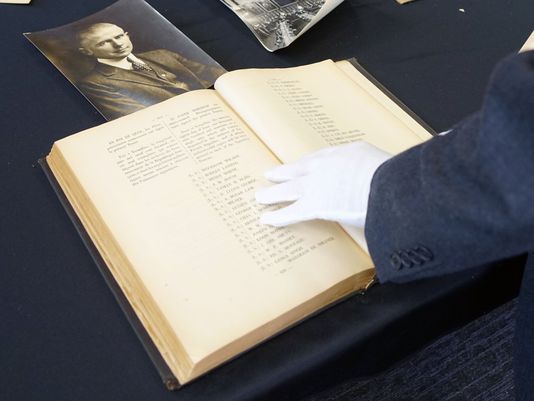 Wearing a protective glove, Robin Peaslee Dougall, the grandson of U.S. Army Maj. Amos Peaslee, shows off his grandfather's draft copy of the Treaty of Versailles. (Photo: Trevor Hughes/USA TODAY)These adventurous courier duties are still relevant today -- and they were particularly relevant in the pre-telephone, pre-radio, pre-internet communication era World War I.
Today's U.S. Diplomatic Courier Service traces its founding to December 2, 1918, when Gen. Pershing directed the creation of a group of handpicked Army couriers to perform host of diplomatic duties. This first group of couriers -- known as the Silver Greyhounds -- was created. organized, and led by Army Major Amos J. Peaslee.
Peaslee's Silver Greyhounds were tasked with reopening diplomatic routes to U.S. Embassies and diplomatic posts across post-war Europe, and into Bolshevik Russia. They were integral to the peace process that ultimately led to the Armistice, and the signing of the Treaty of Versailles.
When the Silver Greyhounds disbanded in 1919, their jobs were turned over to civilian management through the State Department, which still depends on its 100-strong Diplomatic Courier Service to oversee the secure transport of everything from top-secret reports to blank passports and visa paperwork to encrypted communications equipment and construction materials for new U.S. Embassies in unfriendly countries.
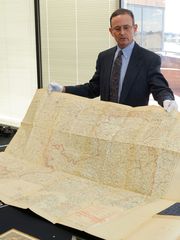 Wearing protective gloves, Robin Peaslee Dougall, the grandson of U.S. Army Maj. Amos Peaslee, shows off a map contained in his grandfather's draft copy of the Treaty of Versailles. Major Peaslee’s treasure trove of personal documents, and many artifacts related to the Diplomatic Courier Service were donated, in a small ceremony, by his family to the U.S. Department of State on April 11 in Denver.
These historical items, known collectively as the Peaslee collection, had an adventure of their own. The collection originated in Europe a century ago, eventually found its way to the Peaslee family estate in East Greenwich, New Jersey, then, to a family garage in Seattle, WA.
Finally, the artifacts found their way to a suburban townhouse in Colorado Springs, where they were recently rediscovered.
Now safely identified and secured, the collection is on its way to State Department Headquarters in Washington D.C. -- via diplomatic courier.
The contents of the collection are incredible -- they include Major Peaslee’s personal engraved copy of the Treaty of Versailles, documents from his time in Russia during the Russian revolution, historic photos, travel documents from across Europe, and other unique items from his colorful career.
Once in Washington DC, the items of the collection will be curated and assessed by State Department historians for their historical value. The intent is to make them available digitally for viewing and research.
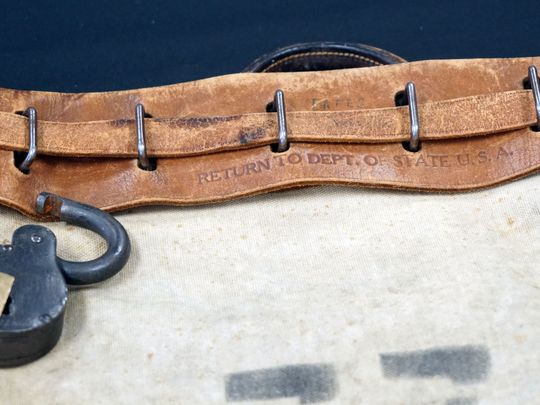 One of the original diplomatic courier bags used by the U.S Diplomatic Courier Service, along with its lock. (Photo: Trevor Hughes/USA TODAY)