





























Memorial Day Preview: The Sounds of WWI-Era Minnesota
via the Lakewood Cemetery (Minneapolis, MN) web site
Minneapolis, MN — This year marks the 100th anniversary of the end of the First World War. At Lakewood Cemetery, we’re paying special tribute to this anniversary at our annual Memorial Day Celebration by remembering those who served at home and abroad during the Great War. Part of our tribute will be a special history exhibit that explores what life was like for Minnesotans in 1918 through the stories of individuals now buried at Lakewood.
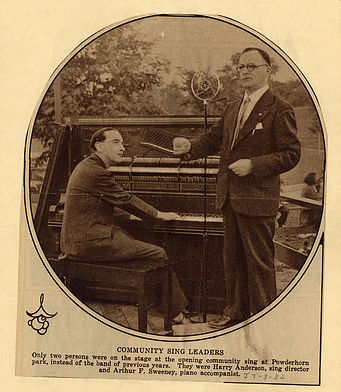 Harry Anderson, right, leads a community singalong in Powderhorn Park. Source: Minnesota Community SingsOne of those featured will be singer and music professor Harry Anderson, Sr. Born in the 1880s in England, Anderson was immersed in the WWI-era Minneapolis musical community as a professor and choral leader. But his story is about more than music. It’s a story of community, patriotism, and the impact of WWI on Minneapolis’s musical and artistic legacy.
Let’s set the stage. The United States was a tense place during WWI. Federal and local governments were suspicious of German-Americans’ ties to the Central Powers, who were vying for political, military, and imperial control over Europe. German-Americans were the largest ethnic group in Minnesota during the War. Many Minnesotans of all backgrounds were eager to display their loyalty to the U.S. and support the war effort.
There were a lot of ways for those on the home front to support the Great War. Women sewed bandages for injured soldiers. Children planted vegetables and grains in “Victory Gardens” so that large-scale food production could be directed toward the war effort. With suspicion rife, many Minnesotans (especially the 84% of the population that was foreign-born) could also use these public acts of support to demonstrate their allegiance to the U.S. and the Allied Powers. Parades dominated public spaces, raising morale and allowing Minnesotans an opportunity to put their patriotism on display.
One of the most interesting ways of raising morale on the home front was through music. Patriotic songs dominated popular culture during the War: 70% of popular songs copyrighted in 1918 were WWI songs. Starting around the time that the U.S. entered WWI in 1917, an organization called the Minneapolis Civic Music League (chaired by William MacPhail, who also resides at Lakewood) and the Minneapolis Board of Park Commissioners hosted large-scale “sings” in many of the city’s parks—no audience, just participation. “Community Sings” of these patriotic and popular songs were led by neighborhood song leaders. These sings presented a way for residents to gather together to show their patriotism. It is even said that some local government officials would keep tabs on attendance in order to gauge individuals’ loyalty. Community Sings took place in every county and township in the state. It is estimated that 70,000 Minnesotans attended the group sings in 1918 alone.
Read the entire article on the Lakewood Cemetery web site here:
External Web Site Notice: This page contains information directly presented from an external source. The terms and conditions of this page may not be the same as those of this website. Click here to read the full disclaimer notice for external web sites. Thank you.