




























Remembrance and the Great War
By Douglas Feiden
via the Our Town newspaper (New York, NY) web site
It is the ultimate Upper East Side trivia question. But first, a warning: Most lifetime neighborhood residents get it wrong.
How did York Avenue get its name? Did it come from A) The Duke of York? B) New York City itself? C) Yorkville, the community it traverses? D) The Continental Army’s triumph at the Battle of Yorktown? Or E) None of the above?
If you answered “E,” give yourself a free, 1.6-mile victory promenade up York from East 59th Street to East 92nd Street.
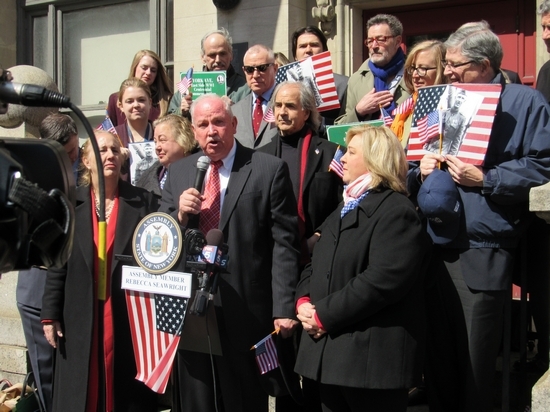 Retired Col. Gerald York, the grandson of World War I hero Sgt. Alvin C. York, at the April 11 ceremony marking the 90th anniversary of the renaming of York Avenue, formerly Avenue A, for his grandfather. He is flanked by Manhattan Borough President Gale Brewer (at left), state Senator Liz Krueger and state Assembly Member Rebecca Seawright. Photo: Courtney Ferrissey / Assembly Member Rebecca SeawrightThe 33-block swath between the Queensboro Bridge and Asphalt Green is actually named for Sgt. Alvin C. York, the citizen‐soldier-hero of the U.S. Expeditionary Forces in World War I whose exploits 100 years ago, under withering German machine gun fire, won him a Medal of Honor.
In the last great push of what was then known as the Great War, in the Forest of Argonne in France, on October 8, 1918, York’s company was trapped behind enemy lines, and with most of his fellow soldiers killed or injured, he advanced, all-but alone, toward a machine-gun nest.
By the time the smoke cleared, he had killed at least 25 German gunners, silenced 35 machine guns and captured 132 soldiers, who he then marched backed toward American lines, according to 1919 Army citations and contemporaneous press accounts.
Hailed as the “greatest civilian solider of the war” by General of the Armies John J. Pershing, York’s deeds were called the “greatest act by any private soldier of all the armies of Europe” by Marshal Ferdinand Foch, the French commander of Allied forces in World War I.
New Yorkers took notice of his derring-do: He got a ticker tape parade in 1919, the New York Stock Exchange halted trading as brokers hoisted him on their shoulders and carried him around the floor, and on April 11, 1928, after a vote by the old Board of Aldermen, forerunner of today’s City Council, the uptown portion of Avenue A was named in his honor.
Flash forward exactly 90 years: On Wednesday, April 11, outside the Webster Library branch, at 1465 York Avenue near 78th Street, a group called the East Side World War I Centennial Commemoration marked the anniversary of the street renaming and recalled York Avenue’s colorful history as part of the celebrations to mark the end of the war.
Read the entire article on the Our Town web site.
External Web Site Notice: This page contains information directly presented from an external source. The terms and conditions of this page may not be the same as those of this website. Click here to read the full disclaimer notice for external web sites. Thank you.