



































Sabin Howard Blog
Visual structure of storytelling in A Soldier's Journey
Note: We are delighted to host a new posting this week by Sabin Howard. Sabin is a renown sculptor who is working with our Centennial Commission to create the new National World War I Memorial in Washington DC. Sabin'S sculpture for the memorial, A SOLDIER'S JOURNEY, is envisioned as a larger-than-life-sized bronze wall, that depicts the personal, yet universal, experience of a soldier who goes off to war. In this post, Sabin talks about composition and story structure, as it applies to this special work of art. -- Chris Isleib, Director of Public Affairs, United States World War One Centennial Commission
By Sabin Howard
A Soldier's Journey balances a range of opposing feelings and actions in the same epic composition.
It reflects both what is civilized and what is savage about humanity in a story that explains The Great War.
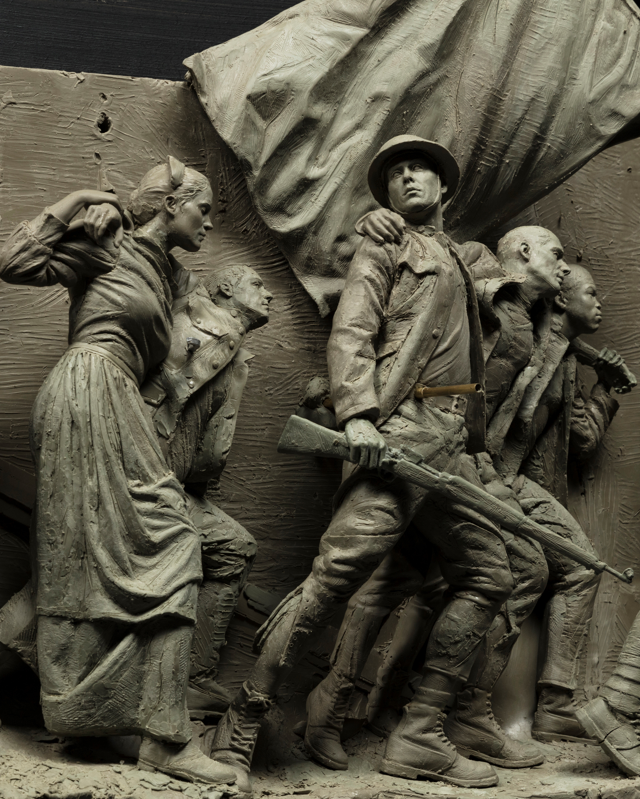 Detail from the Memorial sculptureThe ideals of heroism, family, and caring are juxtapositioned with the violence, terror, and aggression of battle in the WW1 relief sculpture.
The WW1 relief sculpture is uniquely suited to fit within Pershing Park because it is a multifaceted view of humanity and because it goes beyond the traditional glorification of men in battle.
It is a complex story that narrates the full spectrum of human feelings.
Clarity in visual narration has been established through simplicity of design and structure.
The geometry of the structure is laid out in this way with meticulous purpose.
The purpose is to create a universally understood story regardless of age, culture, or society.
Structure of a Story
A Soldier’s Journey is divided into 3 acts; a beginning, a middle, and an end.
Each of these sections is equally divided into beginning, middle, and end.
Each section of the story thus has a start action, a movement or transition in between, and an end or exit action.
The mathematical spacing of the parts is the story and that spacing is critical for the understanding and clarity of the visual narrative.
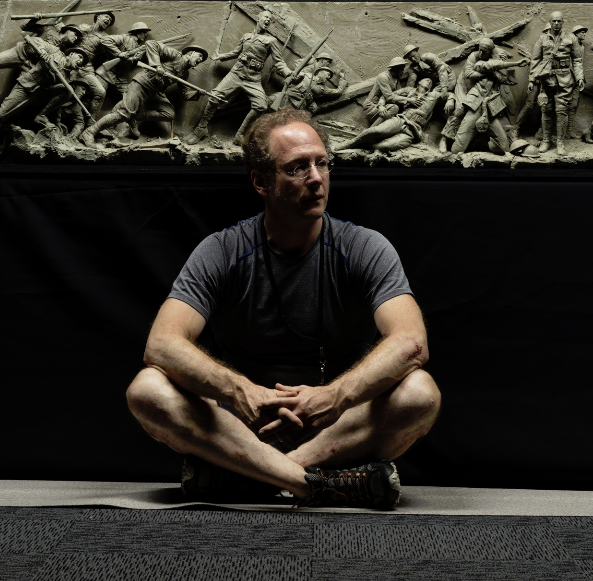 Sabin HowardBecause each section has opposing feelings and actions at each end, a specific distance is needed to bridge the gap.
The transition between the opposing feelings has to be a certain distance in order to create visual clarity in the story.
Pacing is critical for clarity in telling this story to the Memorial visitor.
The Spacing between these parts is how I have created pacing.
For example, you cannot ram a battle scene into a quiet scene; nor can you lurch from a quiet scene into an energetic scene without the proper transition and spacing.
Parts need to build into each other and flow with the correct rate of energy and speed to maintain harmony of the whole.
Transitions are crucial to all forms of narrative storytelling, whether visual, verbal, or musical.
Read the entire article on the Sabin Howard Blog web site here:
External Web Site Notice: This page contains information directly presented from an external source. The terms and conditions of this page may not be the same as those of this website. Click here to read the full disclaimer notice for external web sites. Thank you.