






























WWI Symposium at US Army History and Education Center
By Chris Isleib
Director of Public Affairs, United States World War One Centennial Commission
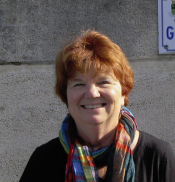
 Betsy Anderson is the WW1CC's Volunteer Coordinator, and she manages the contributions from our various friends, who help us with event planning, social media writing, photography, partnerships, and administrative issues. Betsy recently had the pleasure of representing our Centennial Commission at a WWI Symposium sponsored by the Pennsylvania WWI Centennial Committee at the US Army History and Education Center in Carlisle, PA. We were thrilled that she was able take a few moments to share her experiences with us.
You just returned from a great WWI symposium in Carlisle PA. Tell us about the overall event.
 Betsy AndersonThe all-volunteer Pennsylvania World War I Centennial Committee organized the day long symposium, featuring Pennsylvania historians and authors who have made in-depth studies of World War I topics. The U.S. Army History and Education Center was an ideal location - it is currently running an exhibit "Goodbye Broadway, Hello France" with age specific educational materials for students.
The event had some huge sponsors -- the US Army History & Education Center, the Pennsylvania Centennial Committee -- and some major name historians. What specific topics were covered, and what did you learn?
The Eddystone Rifle, the deployment of the National Guard, the Hog Island Shipyards in Philly, and the Contributions of Women and Civilians to the war - who could resist such a broad menu of topics? Kurt Sellers brought an Eddystone and a Mauser rifle for comparison of the features that made the Eddystone such a potent weapon.
I was fascinated to learn that a large quantity of black walnut was needed to manufacture the rifle, and the government requisitioned trees from all over the country. In both rifle manufacturing and shipbuilding, women made up about 20 per cent of the workforce. John Shepherd reviewed the deployment of the National Guard and explained how the 1903 Dick Act set the parameters for how the National Guard worked with the Army during the war. Since my father was a career member of the National Guard, I understood a lot more about the relationship between the Guard and Army after listening to John.
Gloria House took the story of her grandfather's work as a young teenager at the Hog Island Shipyards in Philadelphia and turned it into a historical novel, Spirit of Philadelphia. Her research taught me a lot about industrial conditions and the enormous effort that went into mobilizing the U.S. for war. Barbara Silletti, a librarian and living historian, spoke about the many contributions of women, in the military, Red Cross, and on the home front. While the women's service paved the way for women to get the vote soon after the war, they were not recognized at the time.
Who attended the symposium? How were the presentations received?
Carlisle is home to the Army War College and many graduates have stayed on to teach or work with the US Army History and Education Center. I met archivists from the National Park Service and the Pennsylvania Historical Commission, as well as many genealogists and even a quilter who and makes memory quilts. There were many informed questions from this deeply engaged audience. Several people referred to fathers, grandfathers, and great uncles who had served. They had a personal as well as academic interest in what happened during the war.
Was there mention of the work that the Centennial Commission has been involved with, or thoughts on the way forward in the centennial year?
Pennsylvania Committee President Barry Johnson invited me to introduce Bells for Peace: A National World War I Remembrance. People were enthusiastic about getting their communities to participate and eagerly sought more information. I distributed Bells for Peace flyers, podcast postcards, and information about the memorial and the World War I Commemorative Silver Dollar. The day confirmed that people are very interested in commemorating and learning about this forgotten war.
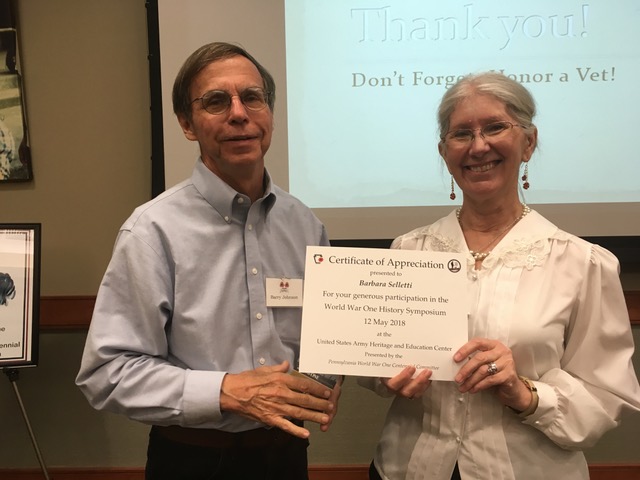 Event organizer Barry Johnson with presenter Barbara Selletti
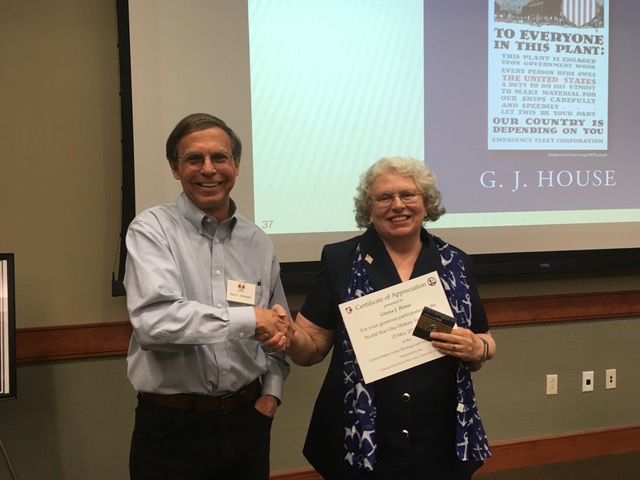 Event organizer Barry Johnson with presenter Gloria House
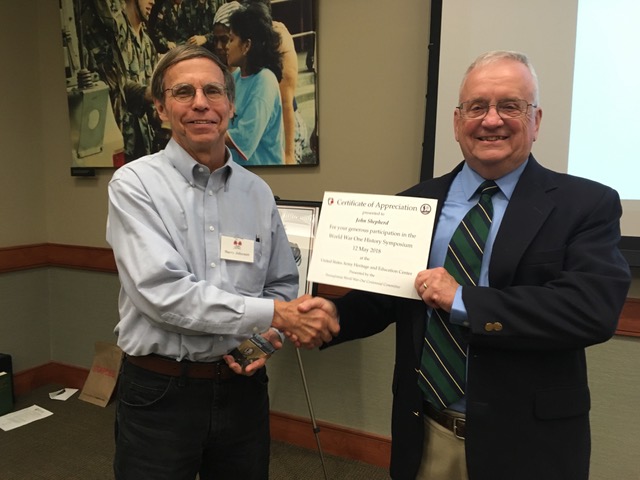 Event organizer Barry Johnson with presenter John Shepherd
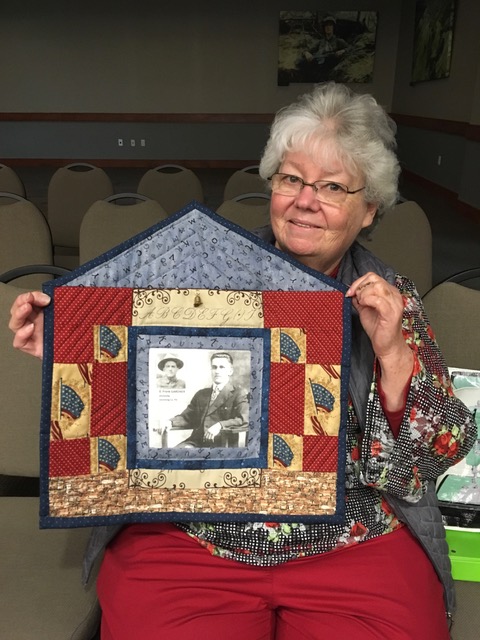 Attendee Carol Sones shows a photo of her doughboy grandfather in her story quilt
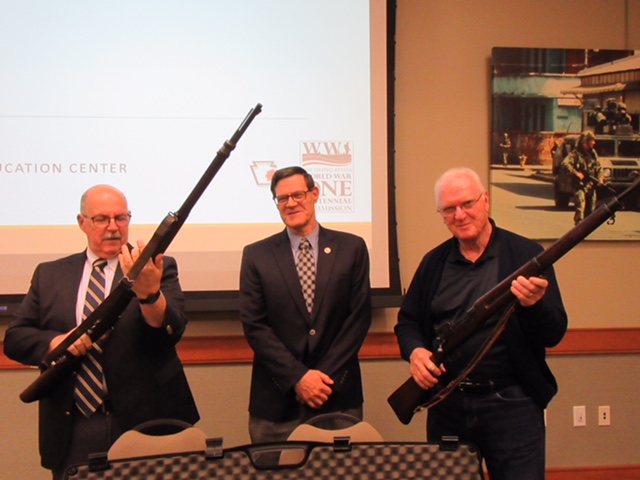 Presenter Kurt Sellers (center) shows artifact WWI rifles, the Eddystone Rifle and a German Infantry Mauser.