





























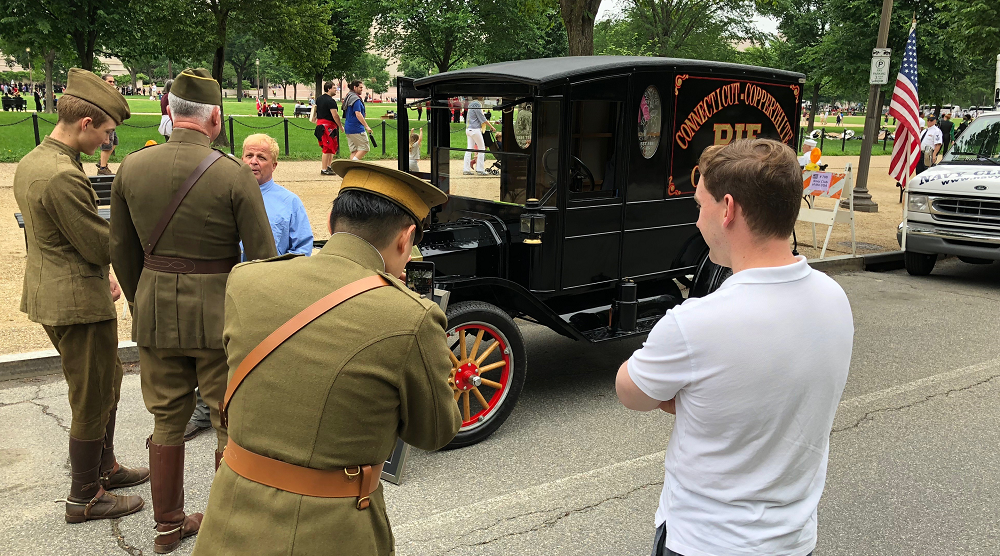
 Mike Copperthite (blue shirt, third from left) talks to US World War 1 Centennial commission volunteers about his historic Model T pie truck before the start of the National Memorial Day Parade in Washington, DC on May 28. (Photo by Chris Isleib, Director of Public Affairs, World War One Centennial Commission)
Copperthite pie company heir recalls WWI efforts which provided ‘Dough for the Doughboys’
By Anthony C. Hayes
via the Baltimore Post-Examiner web site
At first glance, the black Model T box truck – replete with it’s creamy-white “Connecticut – Copperthite Pie Company” lettering – may seem hopelessly out of place. Why would a century-old delivery van be included in Washington, D.C.’s Memorial Day Parade? After all, Memorial Day is a time set aside to commemorate our fallen military heroes. Pies are for the post-parade picnics – a pleasant by-product of the late-spring holiday.
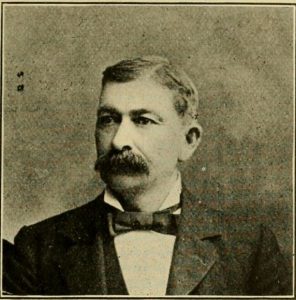 Baking magnate Henry C. CopperthiteIt may surprise parade spectators to learn that the pristine Model T – and hundreds of others just like it – actually played an important part in helping the Allied forces win World War I. In this centennial year, as Americans look back at the patriotic privations of the First World War, the history behind the quaint pie truck and its owners is one well worth remembering.
“My great-great-grandfather, Henry C. Copperthite, was in the 79th Highlander Scottish troops of the Civil War,” explained Michael J. Copperthite. “He was a wagon driver at age 14 and was stationed at Georgetown College, here in D.C. The 79th participated in the battles of 1st Bull Run, Chantilly, Antietam, and several others. After the war, Henry drove a wagon for Olds Bakery in New Haven, Connecticut. New Haven was where he learned the pie trade and met his bride: Johanna O’Neil.
“Henry came back to Washington in 1885 and started making pies in the back of a wagon. His first day’s sales netted him about ninety cents. But by the time of the Spanish-American War, he was selling 19,000 pies a day to soldiers stationed at Camp Alger in Virginia. The pies he sold to the Army were always wholesale – never retail. By 1913, the company had 230 wagons, 600 horses, 1,500 employees and was baking 65,000 pies a day. We became the largest pie baking concern on the planet and the second largest baker in the United States.”
Michael said that even though Henry became a millionaire, he never forgot his humble beginnings as a wagon driver. Nor did he forget his Army friends.
Read the entire article on the Baltimore Post-Examiner web site here:
External Web Site Notice: This page contains information directly presented from an external source. The terms and conditions of this page may not be the same as those of this website. Click here to read the full disclaimer notice for external web sites. Thank you.