
































Author Nancy Cramer
"I realized the story of the retreat was a book I must to write"
By Nancy Cramer
Special to the United States World War One Centennial Commission web site
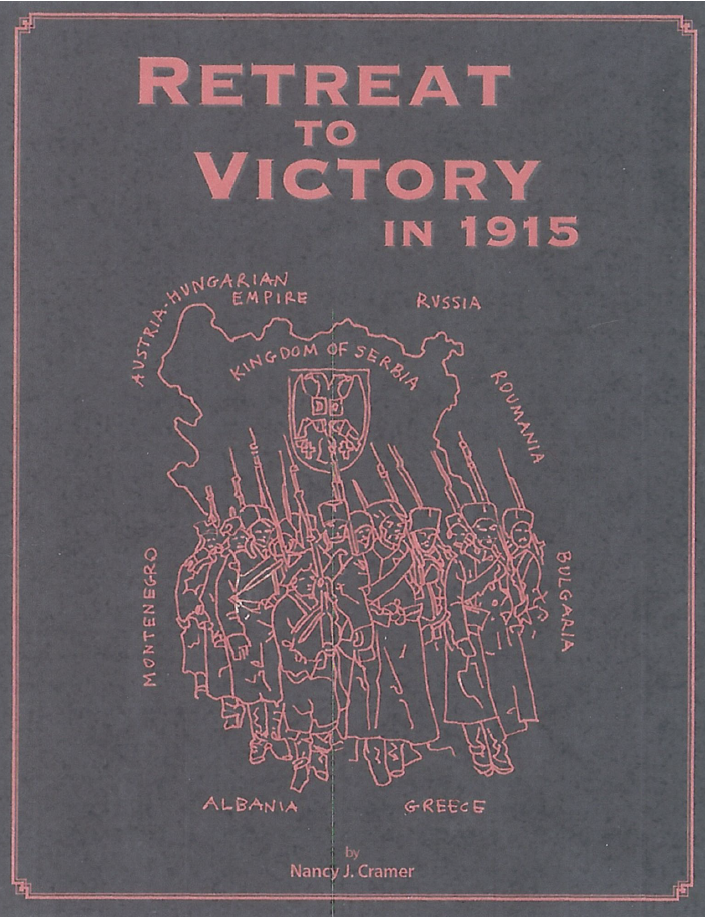
Nancy Cramer, author and long-time volunteer at the National World War I Museum and Memorial in Kansas City, is publishing her 5th book on WWI, "Retreat to Victory," about the Serbian army retreating and not surrendering in WWI. It is a story unknown to most Americans, but worthy by its heroism, courage, determinism, and hardships. Many Serbs died in their efforts to reach safety, with only about half of them surviving. They recuperated, and went to northern Greece, and alongside the Brits and French, defeated the Bulgarians who surrendered in October, 1918. Nancy writes about how the book came to be written and published.
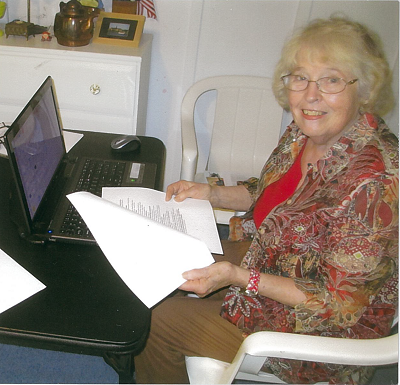 Nancy CramerIn 2012 I toured the Balkan countries which included Serbia. The night before entering Serbia, I made a quick internet search of that country, because I knew little about it. I found a story about the 20,000 young boys the Army had conscripted in 1915, and the Army’s efforts later in 1916 to send them in 1916 to safety in other countries The Serbians had fought valiantly in 1914 and temporarily defeated the Austrians.
The next year with the mighty guns and soldiers of the German army, Serbia was attacked again. This time, out manned at least six to one and outgunned 12 to one, the Serbs had no chance of defeating the invaders. They could not win, but they would not surrender.
The leaders made an unusual decision. The Army would retreat through Serbia and cross over the 7,000-8,000 feet high roadless mountains to the shores of the Adriatic Sea. It was in mid-winter with unusually high snow falls and low temperatures. Allied ships would be waiting in the Adriatic Sea to rescue them despite attacks by German subs and Austrian airplanes on the helpless refugees on the beaches.
The story of the boys touched me deeply, as a mother and elementary school teacher. While in Serbia, I asked many questions about the retreat, took numerous photos, and filled several notebooks. On my return home, I realized the story of the retreat was a book I must to write. I made two return trips to Serbia, hiring my original guide, who spoke excellent English and several local languages and could translate for me. My admiration for these brave people, not just the soldiers, but the peasants who accompanied them on the retreat, grew as my knowledge increased about their plight.
Other countries, especially medical teams from England, responded to the medical needs of the Serbs, which were greatly underserved. For civilians especially, their needs were overwhelming at times. In late 1914, for example, Serbia experienced the worst typhus epidemic the world had known to that time. The work of these medical teams became another theme in my book. So now it included the flight of the boys, the retreat of soldiers and peasants, and foreign medical professionals.
 In stories written on the scene by a few intrepid English and American newspaper correspondents I found examples of amazing selflessness, bravery, and willingness to endure the worst kind of hardships the retreat posed. These included starvation, freezing of limbs and or of body, rear attacks from the Germans, and ambushes from the unfriendly Albanians.
Refugees, soldiers and oxen slid off the icy mountain passes, falling to death or suffering injury in crevasses or streams below. Arms and legs were broken in falls on the paths; poor health invited serious diseases, such as pneumonia and tuberculosis. Vengeful native Albanians robbed and even killed or butchered some of the Serbs. Few shelters could be found for resting at night. Government stations stocked with food often were emptied when another group arrived. Constant hunger grew even worse when record snowfalls prevented foraging. Some trekkers would reach a port, only to see the last ship leaving, overloaded with passengers. That meant walking another 200 kilometers to the next port, and dreading to find the same situation.
A final topic in my book is the personal interviews I made with a dozen or more descendants of survivors of the retreat. Many of the survivors had lived to old age, but few could escape the memory of the horrors they had experienced which haunted by them until death.
My research included what I sometimes called “The Bloody History of Serbia.” Because of its long occupation by the Ottoman Empire, the Serbs frequently rebelled. In the early 20th century, landlocked Austria had domestic agenda to absorb Serbia and create a long railway through the country to the Mediterranean Sea. Austria was determined to increase its borders at any cost to the local inhabitants. Atrocities of the worst kind were frequently committed by them and Serbia’s long time enemy, the Bulgarians. I learned also that as many as 20,000 American-Serbs sailed to Serbia to fight along side their brothers. Former Slavic citizens of Austria’s conquered countries often deserted to join their Slavic neighbors, at great risk of death if captured. The Russians were persuaded to allow Slavic prisoners they had captured from the Austrians, to join the Serbs in later fighting in northern Greece of Salonika Campaign, when with the push from 125,000 Serbs who had recuperated from the retreat were shipped there to join French and British soldiers.
This story is little known among Westerners, and even among the many Serbian Americans I have met through the local St. George Serbian Orthodox Church. The priest, Father Aleksander, has been most helpful. And if there continued to be any doubt about my writing this story, it ended when I accidentally met two relatives of one of the survivors who live in this area.
The Serbian mantra was in 1915 “Every Serb is meant to be a soldier.” This belief, along with their strong feelings of family and country, and the influence of their religion, sustained Serbs during their ordeal. Determination, ability to overcome some of the worst obstacles, and relying upon their strong Christian faith are the hallmarks of the Serbian campaign and retreat.
What we can learn from World War I, the Serbian story in particular, is how important it is for all of us to learn about other cultures, their history, and their beliefs, not just the geography, politics or economics. That is the path to worldwide understanding and acceptance of peoples, regardless of their country or background. Otherwise, perhaps years later, they will take dissatisfaction with their problems into their own hands, i.e. Africa, Hungary, Romania and others. We need to understand humanity in its best instances, as well as in its most hideous circumstances.
Had more understanding, with less efforts to punish and take revenge been aspects of the peace treaty in Versailles in June, 1919, it is possible that World War II might have been averted. It is not the place of the Big Powers to divide and remake the world into countries, of they ignore local traditions, and former boundaries without consent of the people involved. We need to accept how tribalism, religious differences, and cultures permeate their lives. (i.e. the Middle East especially.)
Nancy Cramer has taught children and adults for nearly 30 years, and was in part-time private practice as a Licensed Professional Counselor for nearly 20 years. She wrote curriculum for elementary science and National World War I materials; judged Greater Kansas City Science Fair 33 years; Optimist Club Students Oratorical and Harry S. Truman History contests. She is the author of two published books on World War I; a third book is in process of being published and a fourth one will be in print by end of summer 2018. She is a public speaker on variety of subjects including for more than 30 years, including “Traveling Abroad,” as well as being a volunteer at National World War I Museum for four years. She continues teaching at non-credit classes for seniors.