



































From the World War I Centennial News Podcast
War Tech: Ice City
 In June 22nd's WW1 Centennial News Podcast, Episode 77, host Theo Mayer describes the “Ice City”, a refuge and network of tunnels carved within a glacier by the Austro-Hungarian army. The following is a transcript of that segment:
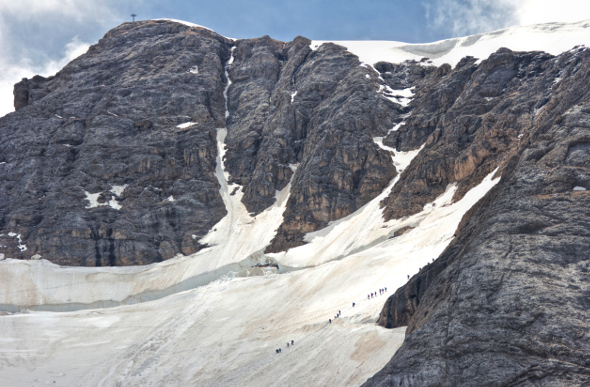 In 1916 the Austro-Hungarians build Ice City within Marmolada glacier, pictured here today.
“We're headed back to the high Dolomite Mountains, where the Austro-Hungarians and the Italian armies fought bitterly during World War I, and we're gonna look at the Ice City. Now, fighting in those craggy steep mountains created a set of logistical problems quite unlike those of the muddy, flooded field of Flanders or the chalky wooded terrain of Northern France. Italian and Austro-Hungarian soldiers needed to fight off hypothermia, frostbite and rock slides as they fought each other from stalemate to bloody stalemate. The armies had to carry, drag, and hoist artillery way up the mountain to 12,000 feet, and when the artillery was fired across the enemy, it didn't have mud to sink into as it exploded. Instead, it sheared off sharp rocks and sent stone shards flying in all directions. Now, way up in the rocky crags, digging trenches just wasn't an option, so they went inside the mountain and underground. The Italians built outposts attached to the sheer cliff sides while the Austro-Hungarians took to tunneling deep inside of the mountains and the glaciers- including what's known today as the Ice City. From the summer of 1916, Austrian lieutenant Leo Handle led an effort to build tunnels deep into the glacier to avoid both Italian fire and the unstable environment of alpine warfare. After more than 10 months of hard work, over seven miles of tunnels had been dug out of the ice, providing room for more than 200 soldiers with barracks, kitchens, chapels and food stores for good measure. To help the soldiers navigate the endless web of tunnels, signs were made, featuring the names of celebrities, world cities and fairytales.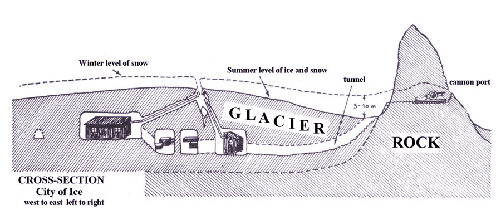 Cross section of Ice City
The Ice City worked and the Austrian casualties from Italian attacks and the harsh mountain weather dropped significantly, but there were problems. Even though they built a very clever ventilation system, smoke from stoves and fires was always a problem. Also, glaciers aren't very stable so warping tunnels and new crevasses meant that you always had to watch yourself, but it was apparently a heck a lot better than the Italian open air cliff forts. In the fall of 1917, the soldiers of the Ice City abandoned their project. Today, much of the cave structure has fallen apart but remnants can still be located in the summer time when they appear at the front of the glaciers as the snow melts. A museum dedicated to this grand architectural undertaking can be found at Rocca Pietore in the province of Belluno in Italy.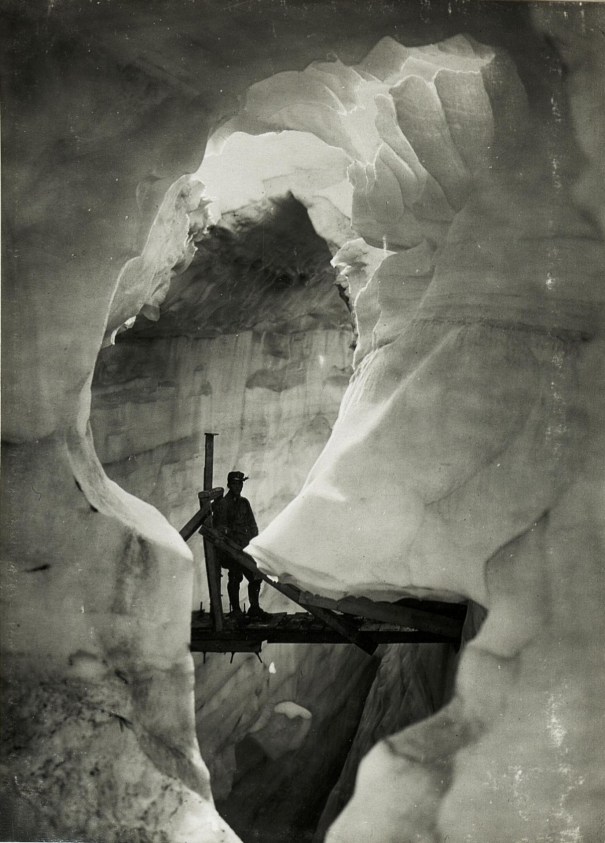 An Austrian soldier inside of Ice City, 1917. The Ice City, an incredible feat of engineering in a time of desperation and this week's subject for World War I War Tech.”
Podcast Notes and links
http://www.museomarmoladagrandeguerra.com/en/the-museum/the-ice-city/