


































“I Hate To Write” gives mother's perspective on cataclysmic changes of WWI
By Paul White
Special to the United States World War One Centennial Commission
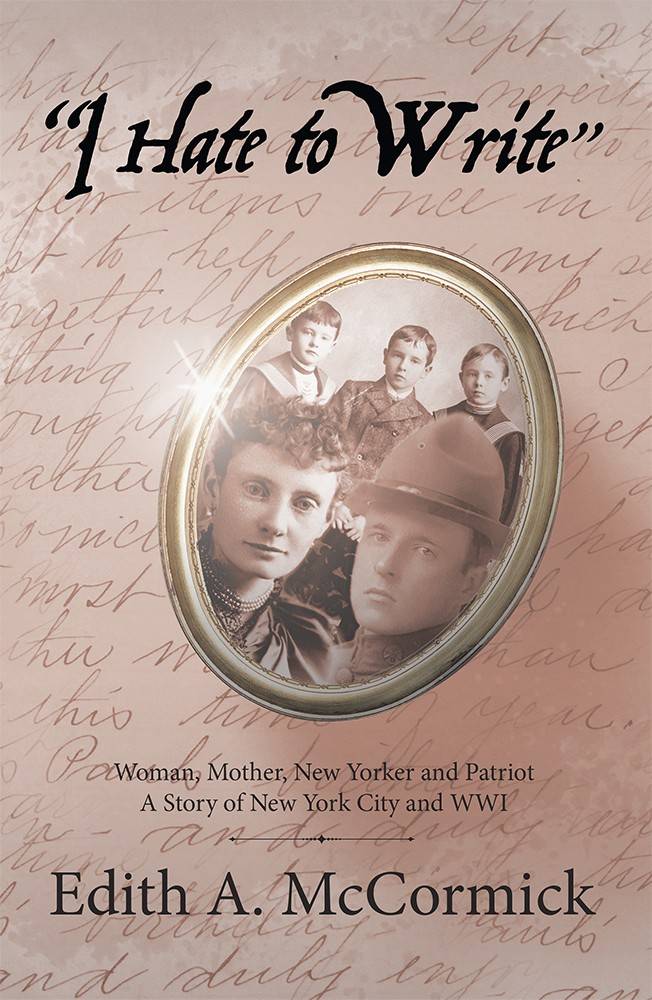
“I Hate To Write” is the story of my great grandmother Edith Agnes MacDonald McCormick an Irish immigrant, a mother raising three sons in NYC in the early 1900’s through WWI. Edith is a woman of courage and fortitude and through her “Record”, she provides a compelling, extraordinarily personal glimpse into NYC family life, but also the events occurring at the turn of the century through the cataclysmic changes of WWI.
 Paul WhiteWhy the title “I Hate to Write”? Because these three words begin Edith’s diary and though she may say she hates to write, she writes marvelously. This is a story of family, courage, faith, war and terrible personal loss.
Edith opens our eyes to a time when flight was a breathtaking novelty. It was a time prior to air conditioning, when horses were dying in the sweltering heat of New York summers, when people sought summer relief in the seashore cottages of Staten Island. Edith’s day to day thoughts are illuminating, as she comments upon such events as Theodore Roosevelt and the Panama Canal, the Russo-Sino War, Peary’s discovery of the North Pole, our entry to and involvement in WWI and more.
The patriotic zeal and the support for her country and its allies that Edith exudes is compelling. Equally compelling is Edith’s concern for her three sons as America is increasingly drawn into the war in Europe. Edith’s concern for her two older sons was justified as both John and his younger brother Paul enlisted in the army shortly after President Wilson declared war.
Official records of the National Guard of the United States for the State of New York certify that John Kernan McCormick, 7th Regiment New York Infantry & National Guard (nicknamed the “silk stocking” unit) was honorably discharged from the National Guard by reason of being drafted into the military service of the United States, August 5, 1917. John was soon sent to Camp Wadsworth along with other silk stocking sons of New York‘s upper crust society as part of the newly formed “107th” Regiment, 27th Division, sent to France, led by General John O’Ryan. At that time, John was 26 years old and employed as a lawyer.
 Like many Doughboys heading into harm’s way, John drafted his last will and testament while still at Camp Wadsworth but sure in the belief that he was leaving for the battlefield of France. This document was executed July 8, 1917 and named his mother Edith as both executor and beneficiary of all his property, real or personal. No doubt John had listened to instructors who had been in the trenches and recognized the harsh realities of war.
It is ironic to consider that John was placed in harm’s way to a greater degree than his brother Paul a Lieutenant in the Railroad Artillery by virtue of John’s 27th Division and 107th Regiment being attached to the British 2nd Army and later the 4th Army, rather than fighting as a unit within General Pershing’s American army.
It is also interesting to note that the 107th was comprised of many Ivy League men, and sons of privilege and influence, which made normal merit promotion to the officer ranks that much more difficult. An infantryman in any of America’s wars has always been first and foremost ”In Harm’s Way”. This proved to be true as O’Ryan’s 27th Division “Rough Necks” suffered more than 1800 killed in action and nearly 8,500 wounded. Corporal McCormick and his 107th comrades paid dearly as some 579 of his regiment were killed in action or died of wounds.
Official records of the 27th Division cite the bravery of John’s 107th Regiment taking of what was thought to be an impregnable series of German defenses near Bony. The 107th and 1st New York regiments carried the fight to the Germans on the 29th aided by a barrage from guns massed wheel to wheel, supported by forty tanks, “bit’ into the main Hindenburg Line. 27th Division battle records reveal attack and counterattack by both sides. Records documenting the fierce German response state “a battalion of the 107th and a battalion of the 105th, with machine gun battalions, met the counterattack. It was repulsed, and the Germans came on again. Casualties on both sides were terrible. Bayonets, bombs, teeth and even fists were used. It was in many places, man-to-man fighting. The enemy fought fiercely, but he was confronted by madmen making history for the National Guard of New York, and he lost”.
 Corporal John Kernan McCormickCorporal John McCormick’s death as a result of German shellfire the morning of October 17, 1918 was tragic given the heroism of September 29th, 30th. His comrades went on to assault the Germans, fording the LaSelle river to do battle. The Germans had faced the same “wild men” here that they had faced at the Hindenburg Line. The day netted the New Yorkers more than 1,400 prisoners.
The Germans retreated, fighting heavy rearguard machine gun actions for four days. More prisoners, cannon and machine guns fell to the Americans. They pursued the enemy to the line of the Canal de la Sambre. Here ended the European War record of the New York division.
The souvenir program for the March 25, 1919 Parade of the 27th Division offers” there are many hundreds of graves scattered over the Flanders and Picardy flats. Most of them show up their white crosses near the village of Bony and Guillement farm. It was there that most men fell. A monument stands to-day at each place. What will always stand out in the 27th Division and the 107th Regiment’s records, like the Statue of Liberty above New York harbor, is the breaking of the Hindenburg Line.
John McCormick was remembered by his Company “D”, Commander Thomas G. Simpson and his comrades as intelligent and brave. Simpson writes in a February 1919 letter “I have lost one of my best N.C.O’s. John was a friend of mine and many a time “Mac” and I would sit alone and talk mutual topics. He was my Company historian. I can barely describe the loss he is to us and to me personally’.
Thomas Lyuskey of Company “D” writes John’s mother January 9, 1919 from Tuffe, France
My Dear Mrs. McCormick,
Being a colleague and a very good friend of your son John, since the time of our enlistment in the old 7th N.Y. and being with him in the same dugout at the Deikenbush Line in Belgium, I want to extend to you my sympathy in your bereavement.
After coming out of the line from the attack on the Hindenburg Line, south of Vendehule, near Bellicourt, John, because during the attack, he showed himself more steady, courageous and fearless than most of the other corporals, was chosen to take charge of the Burial Detail and work in conjunction with Fathers’ Hoey and Kelly. This was 8 days of nothing but work and many a pitiful sight came his way. After the detail was dismissed, he was told to take his detachment and report to his Company. On the way, reporting to “D” Company, the four men with him went to the hospital with indications of the “Flu”. One of them Pvt. Peter A. Egan, who died later & John reported alone to the Company in the front line near Vaux Audigny about 5pm, October 16th. He lost very little time in digging himself some form of shelter to make things as comfortable as conditions would permit in a foremost position like that. About 2:30am on the 17th, a 77mm shell, better known to us as a “Whiz Bang” struck the top of John’s dugout killing him instantly. His body was taken back to the Battalion Headquarters as soon as possible. From the men, who were on the Burial Detail, I’ve learned that he was buried near Vaux Audigny, but the exact Grave Location & Map Reference has not been received by the Company. That is the reason I’ve delayed this letter in hopes that it would contain the above.
Soon we are going home to receive everything that N.Y. folks can give us. John has received nothing but just plain everyday “Hell” but thank God for the Hereafter which we have learned to believe in and hope for, and which, I know John is sharing for his service & sacrifice for God, Country & Humanity.
Corporal John K. McCormick, Company D, 107th Infantry 1210345 was cited by Special Order No. 86 from the Army of the United States of America posthumously “For courage and determination in effecting the capture of enemy prisoners in the Battle of the Hindenburg Line, September 29th-30th, 1918”. Corporal McCormick is buried in the Somme American Military Cemetery at Bony, Aisne, France.
 Paul White, AOMDA, speaking at Somme American Military Cemetery on Memorial Day.Edith McCormick would visit her son’s grave two times. The first time was in August 1919 shortly after the Armistice of November 11. The second time was in 1931 when Edith and 7,000 other Gold Star Mothers would make a series of state by state pilgrimages to visit their son’s graves. It is worthy to note that upon returning home, Edith wrote a lengthy, complimentary “An Appreciation” letter to Secretary of War Patrick Hurley. That letter would be published in the Quartermaster Review, September - October 1931.
Amazingly, though my great grandmother Edith died in 1943…her emotional reach and generosity to the school children of Bony and St. Quentin, France where her son fought, died and is buried continues to this day through a scholarship fund she established in 1931. That scholarship amazingly survived the Nazi occupation, WWII, and honors her son Corporal John Kernan McCormick.
Of course, Edith and her son John’s reach has extended to myself and my family as I have been to the Somme American Military Cemetery on a number of occasions and have been honored to speak at Memorial Day celebrations.
Independent perspective and opinion is everything. Here is what other people have to say about “I Hate To Write”:
James W. Gerard, President of the American Overseas Memorial Day Association writes the following words of the book...
“As a life-time participant in Memorial Day ceremonies at American Military Cemeteries in France, I've long heard the stories about Americans who fought and died in the service of their country and for the defense of France. The story of the McCormick family - brothers John, Paul, and Frank, and their mother, Edith - is remarkable for its intimacy amongst themselves, the insightfulness in which they bring to life, the intricate details of their lives and the gruesome aspects of the "War to end all wars'. This collection of letters and daily entries is a testimonial to the American spirit with which Edith not just perseveres and succeeds as a widow and single mother, but to the indomitable sense of duty, honor and courage shown by John and Paul as they nobly and faithfully served their country. And, despite heartbreak and loss, we also gain a sense of the inimitable grace by which Edith left a perpetual legacy in a tiny corner of France, proving Tocqueville's point of America as a charitable and just nation”.
Jack Flood, Commander, USN (Retired) offers….
“'I Hate to Write' is a compelling chronicle of a courageous and adventurous woman, as told through her own diary and correspondence. Written during the early 1900’s through the First World War, it is the story of one woman’s family life in New York City and her three sons, two of whom would fight in France. Her letters and journal reveal a mother’s thoughts and experiences about the eventual war with all the daily stresses and emotions experienced when loved ones are fighting abroad. To a deployed service member in a war zone, the only thing that rivals a hot meal, is a letter from home. Her frequent letters are answered in kind, giving us a unique perspective of a soldier’s life in the field. However, unlike today’s instantaneous communications, mail took weeks, with five weeks deemed “record time”. We are completely absorbed in her concerns and agonizing emotions after major battles, awaiting word of her sons’ fate as she prays for their safe return”.
Jeffery Lewis Pettit adds….
Edith McCormick’s Journal and letters tell the unforgettable story of a remarkable lady living in New York City at the turn of the century. Her astute comments on international events and the joys and sorrows of day-to-day living provide a glimpse of upper middle-class life of a woman who becomes a single mother on the eve of World War I. Sadly, family losses to illness and disease were as commonplace then as our mass shootings are today. The most compelling part of her narrative occurs when her two beloved sons readily join the Army to go “Over There”. Edith’s journal entries and correspondence with her sons painfully reminds us of the agony all parents suffer whose children choose to defend their country in this way. That dialogue ends tragically just before the Armistice, November 11, 1918.
“I Hate To Write” is available from Amazon or at hrgread.com.
Paul White is a Legacy Member of the NY 7th Regiment, and a Member of the American Overseas Memorial Day Association. He is the founder of HRGread.