



























Belleau Wood attained iconic status via training, luck, and post-war focus
By Tony Perry
Special to the United States World War One Centennial Commission web site
While much of America may prefer to forget World War I, the U.S. Marine Corps is dedicated to keeping alive the story of Belleau Wood, the battle in June 1918 that changed the course of the war.
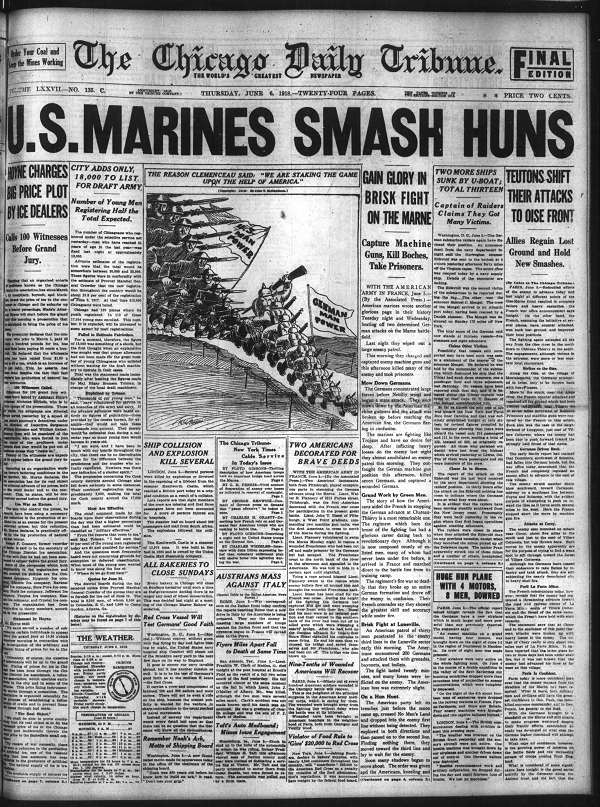 The Chicago Tribune headline about Belleau Wood on June 6, 1918: Marines Smash HunsHistorians often list Belleau Wood with the 1805 battle against the Barbary Coast pirates and the 1945 flag-raising on Iwo Jima as among those iconic moments that shaped both the public perception of the Marine Corps and the Marines’ view of themselves.
A hundred years on, the Marine teach the lessons of Belleau Wood to recruits. During bayonet training, for example, they learn about Sgt. Major Ernest Janson, a Medal of Honor recipient who used his bayonet to kill two of his enemy and force others to flee on the first day of the fight for Belleau Wood.
Each year Marines newly assigned to the 5th Regiment, some merely teenagers, receive a decoration called the fourragere – the same decoration bestowed by the French government upon Marines after Belleau Wood. The French hold an annual ceremony to show appreciation for the Marines stopping the Germans from reaching Paris.
The 2nd U.S. Division that blunted the German drive was composed of both soldiers and Marines. Because of the positioning of the U.S. troops on the battlefield, the Marines bore the initial brunt of the German assault. Army troops have their own story of bravery at Belleau Wood but the Marine Corps is dedicated to retelling the story of how the green Americans thwarted their enemy.
An anonymous blogster under the nom-de-Internet of Angry Staff Officer has urged the Army to follow suit: “I’ve never encountered a Marine who didn’t know where Belleau Wood was or what happened on Iwo Jima. This should be the model.”
For Belleau Wood to attain iconic status took training, some luck, and a good deal of post-war image making.
The luck came when Floyd Gibbons, a reporter from the Chicago Tribune who had pleaded and bullied his way into accompanying the Marines, filed a story in the opening hours of the Belleau Wood battle claiming that the Marines were routing their enemy. In truth, weeks of hard fighting remained.
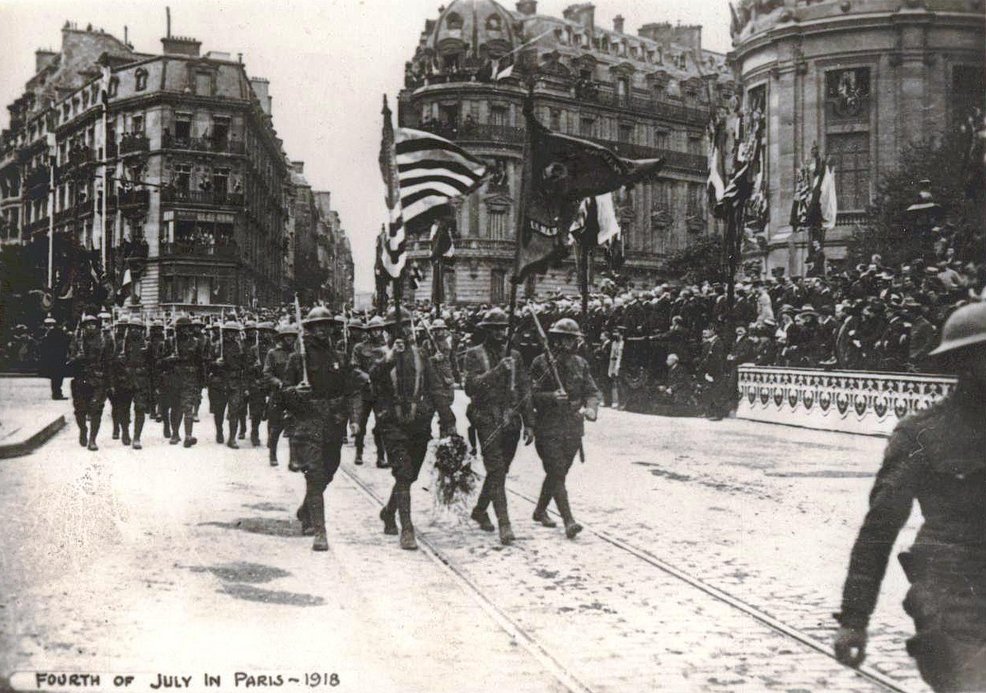 U.S. Marines parade through Paris on July 4, 1918.But the story slipped through the censorship imposed by Army Gen. John Pershing and the impact on the American public was electric. A tale of heroism – and a few myths - had been born.
“U.S. Marines Smash Hun,” screamed an eight-column headline on the front page of the Chicago Tribune, followed the next day by an equally large headline, ”Marines Win Hot Battle,” and the next day by “Marines Sweep Foe Back.” A front-page cartoon had Uncle Sam cheering “Bully For The Marines.”
The New York Times alerted its readers, “Our Marines Attack, Gain Mile at Veuilly, Resume Drive At Night, Foe Losing Heavily…”
Other reporters picked up the theme and for three days the censorship rules were dropped. Nothing motivates a reporter like being scooped by a competitor and nothing irritates editors more than “their man” being beaten.
“American Marines wrote another glorious page in their history Tuesday night and Wednesday morning beating off two determined German attacks on the (river) Marne battlefield,” said the lead to an Associated Press account.
The (London) Daily Mall reported, “German troops fled before the bayonets of the American marines…” The story adds that several wounded German soldiers “complimented the Americans on their fighting, saying that they were as good soldiers as the Germans.”
A German commander reported to his superiors that, “The various attacks of the Marines were carried out smartly and ruthlessly. The morale effect of our fire did not materially check the advance of the (Marine) infantry. The nerves of the Marines were still unshaken.”
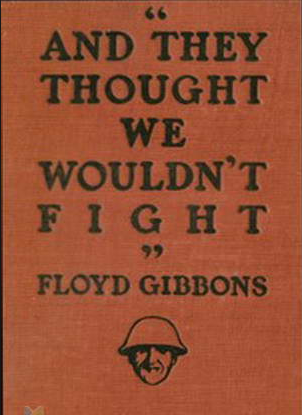 Reporter Floyd Gibbons' book about Belleau WoodBelleau Wood and near town of Bouresches were not considered secure for three weeks. And even after Belleau Wood, months of vicious, often hand-to-hand fighting continued at other locations – although none so close to Paris – before the Nov. 11 armistice.
Still, a die had been cast, Belleau Wood had won a fame that other battles, larger and possibly more consequential, would not achieve.
“Due to a freak circumstance, Belleau Wood was already a famous fight, and the Marine Brigade’s reputation had eclipsed the public’s awareness that the A.E.F. (American Expeditionary Forces) also included a few soldiers,” wrote American military historian S.L.A. Marshall.
Three decades later, the Army chief of staff, one Dwight David Eisenhower, told the Marine commandant that the Belleau Wood coverage still annoyed the Army. An Army artillery officer in France, one Harry S. Truman, was also peeved, later carrying his annoyance at the Marines into the White House.
Pershing undoubtedly was also unhappy that news accounts focused on the Marines. He had not been enthusiastic about the Marines deploying to France and had initially treated the ranking Marine officer in France, Brig. Gen. John Lejeune, with coolness mixed with condescension.
The French were buoyant and praised the Marines for stopping the German march to Paris a bare 60 miles away. The woods were renamed Bois de la Brigade de Marine. Medals were bestowed, including a Croix de Guerre for Gibbons. French Prime Minister Georges Clemenceau was “enraptured” and raced to Belleau Wood “to add his voice to the paeans of praise for the heroes who had barred the road to Paris,” according to Marshall.
A massively attended parade through Paris on July 4 featured the Marines, including the future Marine commandant, Lemuel Shepherd, and his dog Kiki.
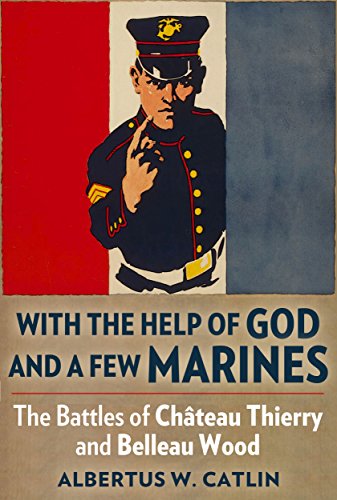 Book by Col. Albertus Catlin, commander of the 6th Regiment, who was wounded at Belleau Wood.“They say a Marine can’t venture down the boulevards of Paris without risk of being kissed by some casual passerby or some boulevardiere,” Army Major Gen. James Harbord, then commander of the 2nd U.S. Division, wrote in his diary.
The military correspondent for Berlin’s Bossiche Zeitung, in a story run on the front page of the New York Times, conceded that the German High Command’s bold plan to push through to Paris had flopped: “The German supreme command cannot well procede now against the newly consolidated French front, which is richly provided with reserves…The battle can only proceed slowly. A decision cannot be procured in a few days.”
Gibbons was wounded in the opening assault but was back at the front within weeks. His bosses in Chicago soon realized that Gibbons would be more useful on the home front spreading the word about the Marines and soldiers who were finishing the job of beating the Germans.
Gibbons arrived in New York aboard an Army transport ship and was greeted by a Marine honor guard and a gaggle of reporters. “In my small way I am going to do what I can to stiffen the country’s backbone against the coming German peace offensive,” Gibbons said.
A coast-to-coast speaking tour was arranged. At New York’s Carnegie Hall, he was introduced by Gov. Alfred E. Smith. In Minneapolis, Gibbons told a cheering crowd how “one brigade of Marines outfought and defeated three entire divisions of Huns, at their farthest advance toward Paris.”
At Belleau Wood, he said, Marines “advanced through that hail of fire and slaughtered the Germans with bayonets.”
By year’s end, Gibbons’ book about the fighting at Belleau Wood was published, entitled “And They Thought We Wouldn’t Fight,” a jibe directed at the Germans and possibly those British and French officers who doubted the fighting spirit of the Americans.
“The bravery of that Marine brigade in the Bois de Belleau fight will ever remain a bright chapter in the records of the American Army,” Gibbons wrote. “There is no bugle call, no sword waving, no dramatic enunciation of catchy commands, no threatricalism – it’s just plain get up and go over.”
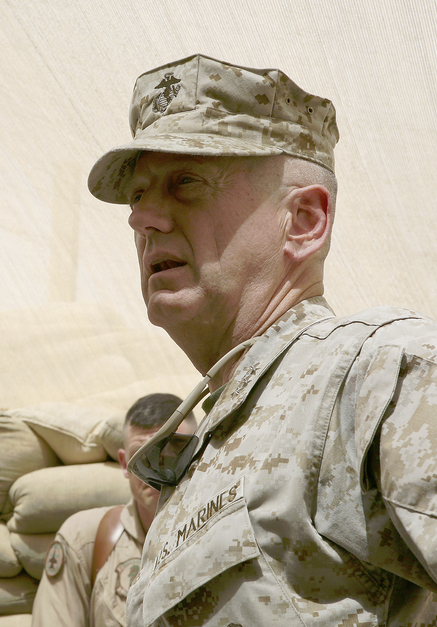 Then-Lieutenant General James Mattis evoked the memory of Belleau to Marines invading Iraq in 2003.The Marines recognized the opening provided by Gibbons and soon published their own book, “With The Help of God and a Few Marines: The Battles of Chateau Thierry and Belleau Wood,’ by Col. Albertus Catlin, commander of the 6th Regiment who was wounded at Belleau Wood.
More books followed. Recruiting posters exploited the victory. An exhibit at the Smithsonian explained Belleau Wood.
Before Belleau Wood, the Marine Corps was known mostly in military circles as a small and highly disciplined force. It had fought with distinction in the Philippines, Samoa, Vera Cruz, Santo Domingo, Peking, and other far-flung flashpoints. Those were small-scale fights against mostly disorganized bands of rebels, tribesmen, and irregulars.
World War One was the first time America sent a force to Europe under a worldwide gaze. America would face the German army considered—certainly by the Germans—as the most modern and lethal fighting force in the world, with artillery, strongly disciplined troops, and a highly evolved system of communication and command-and-control.
By spring 1918, with the Americans not yet in the fight, the Allies were in dire shape. The horror of trench warfare was stretching into a fourth year. The French army fought on bravely but also suffered mutiny in the ranks. Some French civilians, particularly in Paris, called for an end to the fighting, even if it meant giving up parts of French soil and letting the Germans claim victory.
As the Germans began a multi-site offensive, Pershing was worried the Germans would reach Paris. “Something akin to panic prevailed in Paris,” Pershing wrote. The U.S. 2nd Division was sent to Belleau Wood. After weeks of fighting, a Marine major sent a triumphant message to his superiors, “Woods now U.S. Marine Corps entirely.”
It is a story of grit and a refusal to back down that has been taught to decades of Marine recruits eager to live up to the Marine legacy.
Marine Gen. James Mattis, who is now the secretary of defense, knew exactly how to rally his young charges in 2003 on the eve of the invasion of Iraq to defeat the Iraqi army and topple Saddam Hussein. “This,” he said, “is your Belleau Wood.”
Tony Perry retired from the Los Angeles Times after three decades as a reporter, including multiple trips to Iraq and Afghanistan.