
































From the World War I Centennial News Podcast
Historian Corner:
Dr. Jay Winter on the Cultural Impact of WWI
 In June 29th's WW1 Centennial News Podcast, Episode 78, renowned historian and author Dr. Jay Winter spoke with host Theo Mayer about the profound cultural impact of World War I, particularly on remembrance and war memorial design. The following is transcript of the interview:
Theo Mayer: Jay, you've been focusing on World War I since before the Centennial. How did you come to focus on this time period?
Jay Winter: Again, studying the first World War in 1965 when I was an undergraduate at Columbia University, the first World War struck me as Europe's Vietnam. So it was the contemporary echoes of the war in Vietnam that affected my choice of subject and indeed is part of the explanation for the vast expansion of first World War studies from the 1970s on. 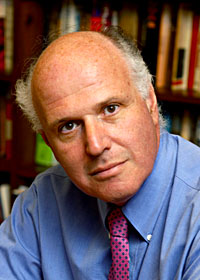 Dr. Jay WinterTheo Mayer: Well, now we've talked with a number historians and others about the many changes that this period brought around. In fact, we've been referring to it as "The War That Changed The World." Would you agree with that?
Jay Winter: Absolutely, the technology of information and images was revolutionized. One of the leading revolutionaries was the Kodak company, who put in the hands of ordinary soldiers the Kodak vest pocket camera that made it impossible for armies to enforce their regulations that soldiers shouldn't have images of war. They should simply fight and let the propaganda agents take care of that. In some ways, what the first World War did was to open up ordinary soldiers' vision of what war is, including American soldiers of course, and prepare the ground for the fact that you can't control images. It's the prehistory of Abu Ghraib in Iraq.
Theo Mayer: Fascinating, and Jay, in some of your writings, you're specifically talking about World War I and how it changed the way we mourn our dead. Could you elaborate on that?
Jay Winter: The first World War produced 10 million dead men, either killed in combat or died from disease, and of those, five million have no known graves. It's as true for the American armies, as it's true for others. War has always been a killing machine, but what 1914-18 did because of artillery was to turn it into a vanishing act. The issue of missing soldiers, soldiers who died but no one has a trace of them, becomes universal in the first World War. It's the birth of the war of the disappeared, and it's also the moment when a number of different countries all attempted to represent this revolution through creating tombs for unknown warriors. In other words, not people who disappear, but a body that doesn't have a name. And it's those that we honor as in Arlington Cemetery.
Theo Mayer: Well, you're certainly right about that. In the thousands of locales of World War I memorials around the country, the names of the lost sort of formed the central theme for the communities and for the memorials. Is that also true in Europe?
Jay Winter: Very much so. The names are all that really mattered. This is a phrase that the British poet Rudyard Kipling who lost his son too, who literally vanished during the Battle of Loos, and his body has never been found. He put that in all of the Commonwealth, initially imperial, but now Commonwealth war graves, cemeteries, "Their name shall liveth forever more, because there's nothing left." Artillery killed 80% of the men who died in the first World War. It was mechanized, assembly line, machine-run killing. Four years of war, the biblical message that we all return to dust, was relived with a savage irony attached to it. The notion of honoring the dead meant honoring an individual who once walked by your side and who now simply vanished from the face of the Earth.
Theo Mayer: In addition to all you've done, you've also were asked to consult on the design for the Historial de la Grande Guerre, a major World War I memorial with multiple locations in France, a really unique design. What were some of the thoughts and considerations during that museum's design process? 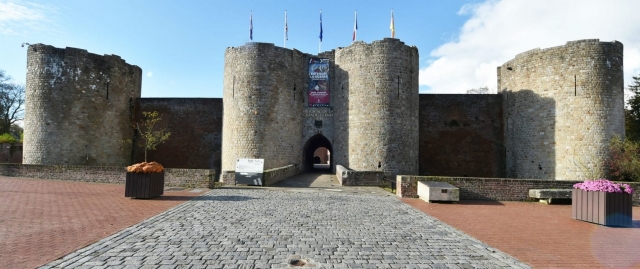 Historial de la Grande Guerre
Jay Winter: Well, it was quite something in 1985 to be asked to design a museum. You know, we historians are used to thinking in two dimensions. To actually think in three dimensions about what a museum of the first World War should look like, and what I ultimately came up with was the idea that 20th century warfare needs to have a horizontal axis in order to do justice to the subject. The reason is, soldiers dug trenches to stay alive. But the second reason is this. The language of glory, the language of heroism, 19th century language about war is vertical. 20th century war and the language we use to represent it is much more horizontal. Think of Maya Lin's Vietnam Veterans Memorial. That particular design is entirely horizontal, and you can see the advantage. Horizontality is the language of mourning. Verticality is the language of hope and celebration. In Europe, absolutely, you do not celebrate the first World War. You commemorate it. A horizontal design can express commemorating the war much better than a vertical design.
Theo Mayer: Well, as you know, the US World War I Centennial Commission is building a World War I memorial in Washington DC and, you know, it's something that's currently missing in the capital. I know you've been following the project because you've commented on it. What do you think of the plans for the national World War I memorial?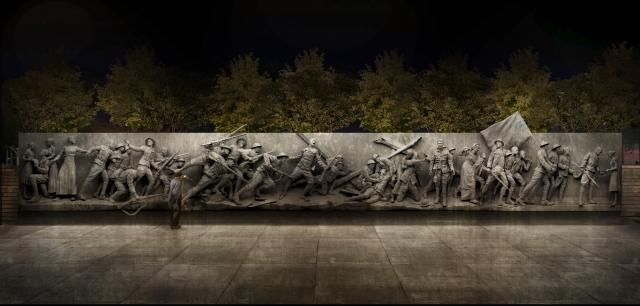 The proposed design for the National World War I Memorial in Washington D.C.
Jay Winter: I think they're very interesting, and indeed there are a number of reasons why I think it's actually consistent with the change in representation that has taken place in museums all over the world. First is, it's a wall, and what American soldiers did was fill the holes on the Allied side, and also pay for them. To have a wall, that's what to do to represent the first World War. And secondly, a wall showing men fighting for each other, and I think the third advantage of having a wall that shows men in combat is, to make it clear that the first World War was the first of 20th century wars that didn't do what they were supposed to do. It was the war that made the next one almost certain. I hope funding becomes fully available to design in question, I fully support it!
Podcast Notes and links
http://www.latimes.com/opinion/op-ed/la-oe-morrison-winter-20140625-column.html
http://www.dw.com/en/world-war-i-created-new-culture-of-mourning/a-17233945
https://www.amazon.com/Remembering-War-between-History-Century/dp/0300110685