































Getting to Know A WWI Serviceman
By Patrick Gregory
Special to the United States World War One Centennial Commission web site
He wanted to tell his own story of the war: that much we know. And he also went to great lengths to do so. What is less certain is precisely what that story would have encompassed, had he come to write his memoirs in later life. What all would it have said, and in what form?
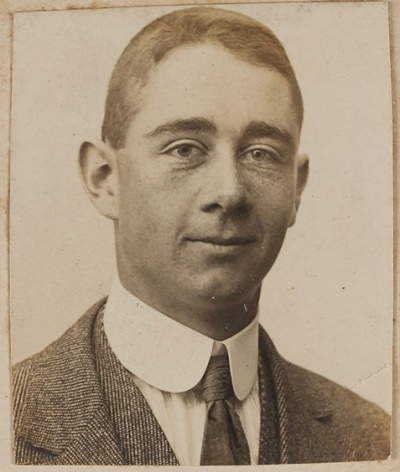 Arthur Clifford Kimber (Courtesy of the Archives of the American Field Service and AFS Intercultural Programs.)Instead, that task fell to a complete stranger. One who was older and a continent and a century distant; one who was writing alongside this serviceman’s niece in her later years, a woman he would never live to meet.
Arthur Clifford Kimber was 21 when he set off for France in 1917 and just 22 when he died. Leaving behind his final year studies at Stanford University, he volunteered for a war he felt was justified. One in which he had to do his bit. Although even then there was also the prospect of some adventure, a young man’s excitement at getting involved in a conflict he had read so much about 6000 miles away.
Whatever happened, he wanted to keep a record of his adventures for use in later life. To that end he agreed to write letters from the moment he left home, as often and as detailed as he could manage. He would number them lest any got lost in transit, so he would know, if necessary what blanks needed to be filled in. Whichever letters arrived back home in Palo Alto would be typed up by his mother and two brothers. He wrote 160 in all and remarkably all survived.
Although he did not.
What lived on give a valuable glimpse of the war at first hand. Around the edges of his personal story we can glean some of the wider shape of the United States’ developing role in Europe as the months of the war wore on. The letters were written at a rate of two or three per week every week, mirroring 18 of the 19 months of America’s participation. They begin in the springtime sunshine of California, April 1917, and end in the rain of north-eastern France in the autumn of 1918, the night before his death. Patrick Gregory
They chart Kimber’s progress from the moment he boards the first of many trains, boats and vehicles to the Western Front, carrying a precious cargo, an American flag, after a grand leave-taking ceremony in San Francisco. We trace his progress across the United States to New York and a parade down the packed streets of Fifth Avenue. We follow him by armed steamship across the Atlantic and travel with him through England and France – his first impressions of war-time London and Paris – and on to the flag’s presentation on the front south of Verdun.
But more importantly, there is the business of war; and it is here that we really get to know Kimber. He serves first as an ambulancier: a volunteer driver for the American Field Service, a corps which seconded its sections to French military forces.
From there, it is on to full military service as he began training, one of the early recruits to the nascent US Air Service. He would fly as a fighter pilot with new squadrons: escadrille SPA. 85 of the French Air Service and with the US 22d Aero.
Throughout, his voice comes across to us brightly and remains clear over the intervening century. It is war in all its guises: the danger, the excitement, absurdity, the fun, the petty, the everyday concerns, boredom, the mundane, the heroic; and with sudden death never far away. It is a window on 1917 and 1918, as we take a peep at wartime Europe.
In order to allow the modern reader an opportunity to follow his story properly, we felt it necessary to build a narrative around his letters, a narrative which could put him in his proper historical context. We needed to combine his personal story with the bigger picture: the wider panorama of America’s war.
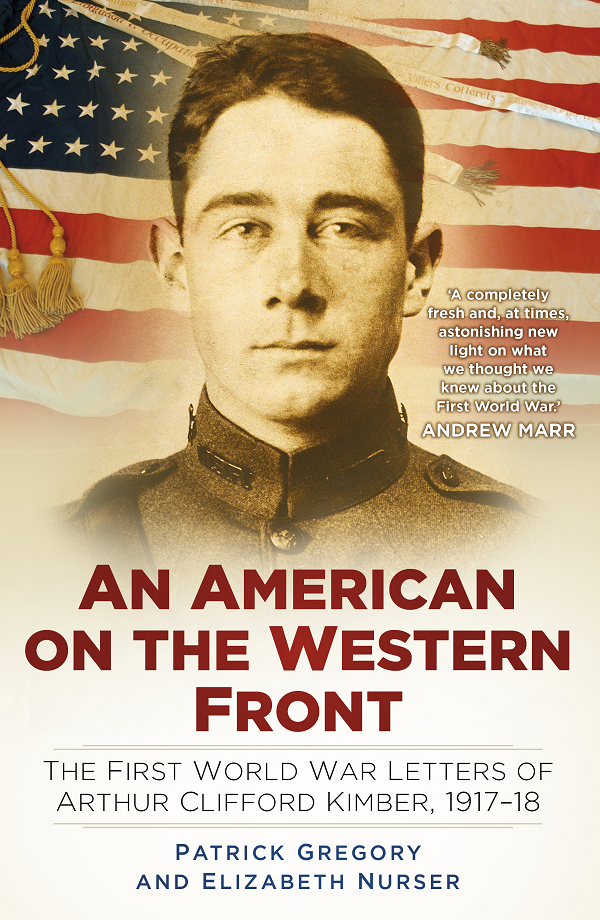 A partial account of Kimber’s time in France, The First Flag, had appeared back in 1920 and it had contained a few small snippets of his writing. But it left the vast bulk of the letters untouched. The originals and his typed-up accounts remained untouched in boxes over the decades, moved from pillar to post: stored in basements, attics and garages in America and Britain; diligently kept but overlooked.
As the centennial of America’s war loomed the keeper of those boxes, Elizabeth Nurser and I decided that the time had come to bring them out. Elizabeth has lived in Britain for more than 60 years, a native of California, arriving in the 1950s as a Fulbright scholar. She is the niece of our young serviceman and I am Elizabeth’s son-in-law. For her it was unfinished business. For me, as a journalist, a story that needed to be told.
It involved three years of work: converting old pages to new electronic text; of writing and researching, proofing and editing; of picture research and indexing; constantly accessing libraries and online archives and checking otherwise obscure details, including old railway timetables. Chapters went back and forth between son-in-law and mother-in-law. What I wrote, Elizabeth edited and fired back, with the keen attention to detail born of 50 years in publishing.
I hope Kimber would think we have done him justice. I came to develop a real affection for a young man I never met. An understanding of his life and his passions. I shared his grief when his friends died and felt a real and terrible sorrow when he himself died in the last weeks of the conflict, on the opening morning of the Meuse-Argonne campaign.
Yet his diligent note-taking has also helped foster in me what has become a deeper interest in and study of a war which changed Europe a century ago and which also announced America’s arrival on the world stage. For that I will always be grateful.
Patrick Gregory is co-author with Elizabeth Nurser of An American on the Western Front: The First World War Letters of Arthur Clifford Kimber 1917-18 (The History Press) American on the Western Front & on Twitter @AmericanOnTheWF