


































 The central feature of the proposed World War I memorial is this narrative allegory in bronze by sculptor Sabin Howard, with 38 figures depicting a soldier’s path from home to the crucible of the battlefield and back home again. (Photo by Sabin Howard)
The Battle of Pershing Park
What the fight to build a World War I memorial near the White House reveals about the state of civic art and architecture.
By Catesby Leigh
via the Weekly Standard web site
These days M. Paul Friedberg is looking like one lucky guy. A retired modernist landscape architect in his late 80s, he has only a few purportedly important projects to his credit, and his reputation rests largely on an innovative approach to playground design. A few years ago, Congress redesignated his derelict Pershing Park (1981), situated just east of the White House and Treasury Department along Pennsylvania Avenue, as a World War I memorial, authorizing the park’s much-needed “enhancement” with “appropriate sculptural and other commemorative elements, including landscaping.”
But it turns out the federal Commission of Fine Arts, which reviews such projects in the nation’s capital, is determined to retain the essence of Friedberg’s Pershing Park—especially qualities associated with its now-empty central pool and boxy, granite-clad fountain, which has been out of action for over a decade—even if doing so stands in the way of the creation of an appropriate war memorial.
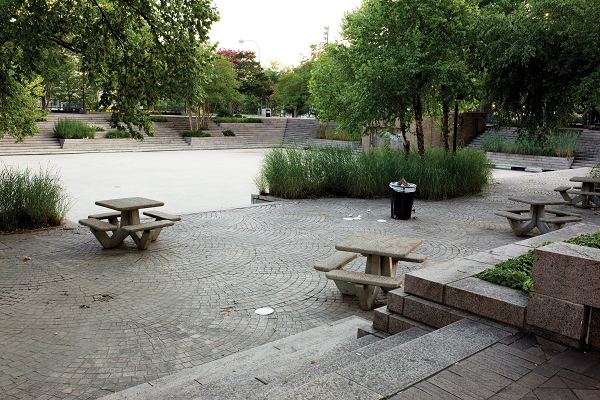 Pershing Park as it looks today: Ugly tables hunch near the empty pool, enclosed on two sides by granite steps and planters. (Photo: Hannah Yoest for TWS )So much for congressional intent.
Elevated above the din of street traffic by grass berms, heavily screened by trees and equipped, at its southeast corner, with commemorative mahogany granite slabs and a larger-than-life-size statue of General John J. Pershing, Friedberg’s largely sunken park features unattractive lighting fixtures and a rather drab brownish hardscape. A domed steel-and-clear-plastic kiosk, where refreshments were once sold, stands near the shallow pool, abandoned. The park is situated on a trapezoidal, 1.75-acre site along Pennsylvania Avenue between 14th and 15th Streets. To the north lies the venerable Willard Hotel; to the west a handsome park focused on an equestrian statue of General William Tecumseh Sherman; to the south the White House Visitor Center, housed within the vast classical pile that is the Commerce Department building; and to the east, postmodern mandarin Robert Venturi’s forlorn Freedom Plaza (1980), which, aside from a few months as a camping site for Occupy D.C. protesters in 2011-12, mainly serves as a skateboarder’s resort.
Read the entire article on the Weekly Standard web site here:
External Web Site Notice: This page contains information directly presented from an external source. The terms and conditions of this page may not be the same as those of this website. Click here to read the full disclaimer notice for external web sites. Thank you.