

































Bells of Peace Partner
Washington Memorial Chapel at Valley Forge
By Aaron Rosenthal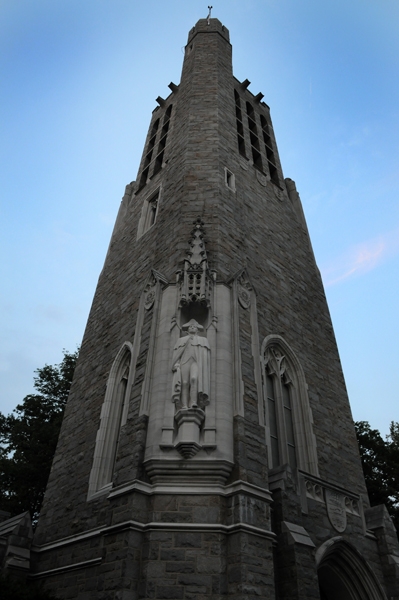 The National Patriots Bell Tower of the Washington Memorial Chapel at Valley Forge.Staff Writer
On November 11, 2018 at 11:00 a.m. American citizens and organizations will be invited to toll bells in their community to commemorate the 116,516 American men and women who lost their lives during World War One. Participating in this momentous event is the Washington Memorial Chapel at Valley Forge, who will proudly utilize their National Patriots Bell Tower, a prestigious structure complete with 58 bronze bells and a combined weight of 26 tons, to toll its bells Twenty-One times in commemoration of America’s World War One fallen. The Chapel itself has an interesting story, built as a memorial to George Washington and his troops encamped at Valley Forge, it has continued to be a memorial to America’s fallen in every war since.
 In the case of World War One the Chapel’s statue entitled “Sacrifice and Devotion,” dedicated to the mothers of America who have lost their sons in battle, has become a pilgrimage site for the families of soldiers who never came home from the war. Additionally it has also been the meeting place for the Descendants & Friends of the 314th since 1978.
In the following article we interview Nancy Schaaf and Gardiner Pearson to learn more about the Chapel and its connection to World War One. Nancy Schaaf is a Maryland World War I Centennial Commissioner whose grandfather served with the 314th Infantry of the American Expeditionary Force, and is a member of the Descendants & Friends of the 314th, while Gardiner Pearson is a Member of the Board of Directors for the Washington Memorial Heritage.
Tell us a little about the history of the Chapel. Why did the Chapel become a pilgrimage sight for those who lost loved ones in World War I? What makes this Chapel unique?
Pearson: In a Washington’s Birthday sermon in 1903, Dr. W. Herbert Burk of All Saints Church in Norristown, Pennsylvania described his vision of a “wayside chapel” on the site of the Valley Forge encampment of 1777-78. It would be a “fit memorial” to George Washington, his troops, and to all the patriots who fought for the nation their sacrifices helped create.
By June 19, 1903, the 125th anniversary of the Continental Army’s marching out of their Valley Forge encampment, Burk had raised enough money to lay the cornerstone for the Washington Memorial Chapel. Over the next twenty years thousands of Americans donated money to build this memorial. The beautiful building that resulted incorporates some of the best craftsmanship that existed in America at the time, most of it from the Philadelphia area. This includes the architectural design by Milton B. Medary, Jr., which ranks among the finest examples of Gothic Revival architecture in the country, the wood carvings of Edward Maene, the stained glass windows by Nicola D’Ascenzo, and the elaborate wrought iron by Samuel Yellin.
The Chapel, however, is not just a memorial to George Washington, the Founders and the Patriots who secured our independence and the liberties we enjoy today. It is also a memorial to those brave men and women who have fought to defend those liberties in the 240 odd years since we became a nation.
And, while it is a beautiful building, in its art and architecture it tells the story of the discovery, exploration and settlement of America, of our war for independence and of the founding of our political system. In short, it is a celebration of our great nation, and as such, it belongs to all Americans.
In the Memorial’s beautiful art, we are also reminded that our country is not the result of a single momentous event, but of numerous people and events in generations before and after the Revolution. Many left homes and livelihoods to step up in support of their country and ideals. Others, like the immigrant craftsmen who produced our irreplaceable stained glass windows, our exquisitely carved wood choir, and our celebrated wrought iron gates and fixtures, found in America the freedom and opportunity to pursue their art and in so doing, left a lasting contribution on our lives. The thousands of Americans who visit the Memorial each year find the form and substance of its message inspiring.
What has motivated the Chapel to participate in our Bells of Peace Initiative? Why is this initiative so important?
Pearson: The Washington Memorial Chapel has been closely associated with the Descendants of the 314th Infantry Regiment for many years. The Chapel was a pilgrimage site for mothers and soldiers in World War I and continues to honor all who have served our country. The Chapel’s carillon of 58 bells, housed in the National Patriots Bell Tower, dominates Valley Forge National Historical Park and marks Memorial Day, Independence Day, Veterans Day and other solemn occasions with the tolling of its bourdon bell. The Chapel believes the Bells of Peace initiative is important, and that the commemoration of the 100th anniversary of the 1918 armistice is significant. The Chapel’s participation is logical.
What is the significance of the 314th Infantry of the American Expeditionary Force? Why has the organization chosen to meet at this chapel since 1978?
Schaaf: Organized as part of the 79th Infantry Division A.E.F. the men of the 314th were trained at Camp Meade, MD.
 The 314th Infantry of the American Expeditionary Force in the trenches in World War I.The regiment saw extensive combat in the Meuse Argonne Offensive. They captured the town of Malancourt and assisted the 313th Infantry the following day in capturing the town of Montfaucon.
The 79th Division was moved in place to participate in the third phase of the Meuse Argonne Offensive; the 314th drove forward and captured the towns of Crepion, Waville, and Moirey. The following day the unit captured Buisson Chaumont, Hill 328.
They then advanced against Cote de Romagne and stopped firing at 11AM, the time of the armistice. At war’s end that day, the 314th made the greatest drive of the offensive into German lines, east of the Meuse River.
The regiment continued training, passed a review by General Pershing, shipped home, and was discharged at Camp Dix, NJ in May, 1919.
As they returned from war, aboard the Princess Matoika, the unit formed the organization to continue the brotherhood that they formed during the war. Originally organized as the Veterans of the 314th Infantry A.E.F., the veterans have since passed on and the organization name changed to the Descendants & Friends of the 314th.
The veterans met annually in various locations across Pennsylvania and New England, beginning in the fall of 1919, to honor their fallen (http://314th.org/annual-reunions.html ).
While training at Camp Meade they built a log cabin to serve as a recreation hall. In 1922 they purchased their log cabin from the War Surplus Department and moved it to the grounds of the Washington Memorial Chapel at Valley Forge, PA. They placed more than 500 of their WWI artifacts inside and maintained it as a museum and memorial to their fallen and other Doughboys of the Great War.
The organization continued to meet and in 1978 they moved their annual memorial service to the current site at the Washington Memorial Chapel. They are the only known World War I unit organization that has continuously met, without interruption since 1919. In May 2018, the Washington Memorial Chapel joined us as we held our 100th annual Memorial Service, continuing our long-standing bond with the Chapel.
The Log Cabin Memorial was gifted back to Fort Meade in 2012 and the Descendants & Friends of the 314th continue to work towards a reconstruction site. The Memorial was chosen as a recipient of the 100 Memorials/100 Cities program by the WWICC.
Would you be able to tell us more about the sculpture “Sacrifice and Devotion” and why it became an important pilgrimage site for the families of soldiers who died in World War One? Where can our readers go to learn more about the Washington Memorial Chapel at Valley Forge?
Gardiner: In 1914 Bela Pratt, a well-known sculptor of the late 19th and early 20th centuries executed a statue for the Heckscher family in memory of their mother and dedicated to the mothers of the nation. Entitled "Sacrifice and Devotion" it was placed in the garth or garden of the Washington Memorial Chapel’s cloister. It depicts a woman kneeling in prayer for her children. This sculpture, newly installed at the time of World War 1, focused the grief of mothers who lost sons in battle, and coupled with the Chapel setting, provided a source of strength and consolation. Hearing stories of these mothers’ visits, President Woodrow Wilson declared the Chapel was the "Shrine of the American People"
To find out more about the Chapel and the story of its role in World War I, check out this link: https://www.nps.gov/vafo/learn/historyculture/treese5c.htm
To find out more about the Bells of Peace program, check out this link: https://www.worldwar1centennial.org/index.php/commemorate/event-map-system/bells-of-peace-a-world-war-i-remembrance.html
Aaron Rosenthal is a Summer 2018 Intern with the U.S. World War One Centennial Commission.
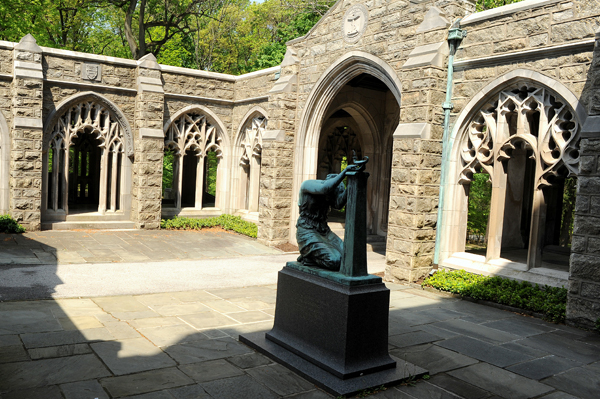 "Sacrifice and Devotion," this sculpture became a heritage site for the families of those lost in World War I