
































Carnoustie Golf Club, The Open, Tommy Armour, and WWI
By Aaron Rosenthal and Josh Singer
Staff Writers
With this past weekend’s Open Championship at Scotland's famous Carnoustie Golf Links, we take you back to the first British Open ever played at Carnoustie in 1931, to tell the story of its champion, Tommy Armour.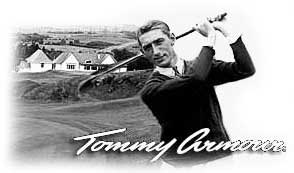
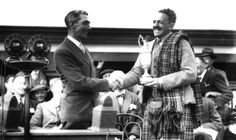 Tommy Armour (left) being handed the Claret Jug trophy after winning the 1931 British Open.Few people know that Armour, dubbed the “Silver Scott”, was a WWI hero -- who took up golf to help recover from his significant war wounds.
For his many victories on the PGA tour, Tommy Armour became a household name for golfers in the U.S. and in Europe during the 1920s and 1930s.1 1931 saw a close race that went to the end between the Scottish-American Armour and the Argentinian's Jose Jurado. Tailing him for the entirety of the competition until the final round, where he managed to finish just a shot clear of Jurado, winning it all 296 to 297.2,3
However, before his tour on the professional golf circuit, Tommy did his tour of duty during the First World War, fighting for the British. He distinguished himself on the battlefield and the grit and determination that he gained from combat were applied to his golf game, resulting in a man with different legacies on both sides of the Atlantic.
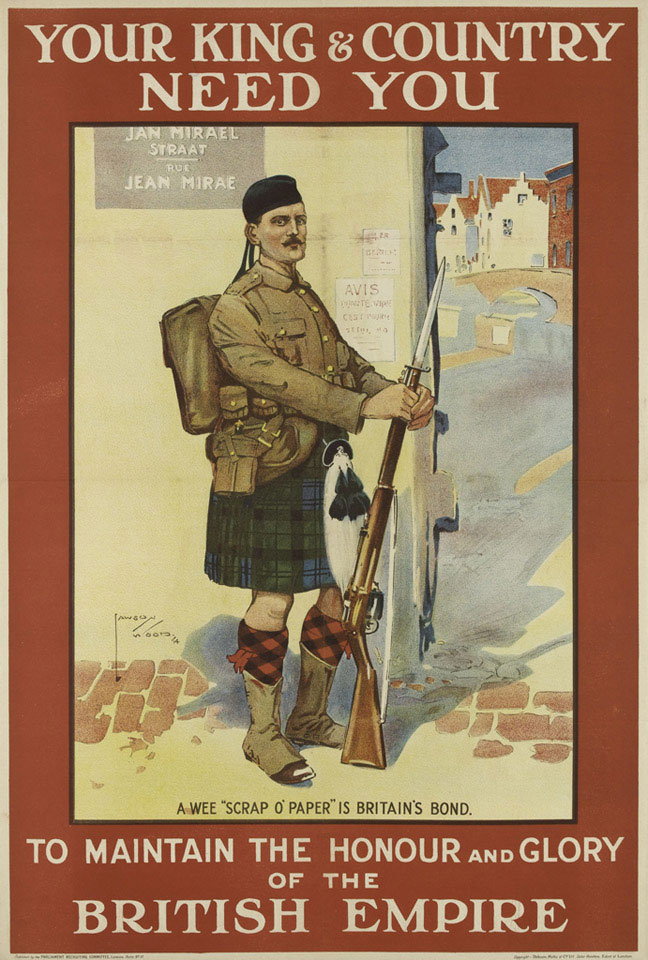 Born in Edinburgh, Scotland, Tommy Armour attended a boarding school in that city before being admitted to the University of Edinburgh. When the war broke out in 1914 Tommy was only 18, but nonetheless he enlisted to serve his country.4
Joining the British forces as a private, he trained to become a machine gunner with the Black Watch Highland regiment.5 This regiment, comprised exclusively from the Royal Regiment of Scotland, is known for their unique uniforms, comprising the traditional red hackles and Tam o’Shanters of a Scottish military unit.6 As the war raged in the fields of France,Tommy lived up to his namesake and joined the newly established Tank Corps. Unfortunately this new venture would nearly cost the man his life for at the Battle of Ypres in 1918 the tank he was serving in was directly hit by a German mustard gas shell.7 The gas spread throughout the tank compartment and completely blinded him.
While recovering behind the front however, he began to regain his eyesight in his right eye; but his left eye would remain almost completely blinded for the rest of his life. Besides his eyesight, he also had severe injuries to his head and left arm, requiring surgery and the placement of a metal plate on his skull.
After his recovery he continued to serve in combat and retired after the end of the war with the rank of Staff Major.8 While healing from his wounds, Tommy took up the game of golf to pass the time and improve his motor skills, which had suffered from his injuries. He took well to the game, and in 1920 burst onto the professional scene when he won the Irish Amateur.9
He would then move to the U.S. and play in the PGA, turning pro in 1924 at the age of 30. During his golf career he would win the U.S. Open (1927), PGA Championship (1930), and as previously mentioned, the Open Championship (1931).10 This feat of skill is incredible considering only 10 other professional golfers have won three out of the four major PGA tournaments.
This puts Tommy Armour on par with such greats as Arnold Palmer, Walter Hagen, and Phil Mickelson. The only major Tommy was not able to win was the Masters, which was founded when he was past his prime. He was 38 when the tournament was created, and his best finish at Augusta National was a tie for 8th in 1937.11
For a man with such talent it is surprising to find that it all could have never happened, and that Tommy’s love of the game originated from his service in the First World War. He made his country proud on the Western Front and then demonstrated mastery of a game he picked up for fun.
Tommy Armour is a man of two worlds, and his experience on the battlefields helped shape his future on the links.
1. Ted Brock, “Armour, Thomas Dickson (“Tommy”)”, Encyclopedia.com, accessed July 18, 2018.
2. “Tommy Armour”, revolvery.com, accessed July 18, 2018
3. Paul Donnelly, First, Last, and Only: Presenting the most Amazing Golf Facts from the last 600 Years, “The only One eyed Player to win the US Open,” (Great Britain: Octopus Publishing Group, 2010), accessed July 19th, 2018. https://books.google.com/books?id=mC4YAwAAQBAJ&pg=PA1926&dq=thomas+dickson+armour&hl=en&sa=X&ved=0ahUKEwipr5_Xu6ncAhXIaFAKHWdaA3YQ6AEILzAB#v=onepage&q=Thomas%20armour&f=false
4. “Black Watch Royal Highlanders,” National Army Museum, accessed July 19, 2018, https://www.nam.ac.uk/explore/black-watch-royal-highlanders
5. Brock, Encyclopedia.com
6. Donnelly,
7. Brock, Encyclopedia.com
8. Keith Souter, Little Book of Golf, accessed July 18, 2018
10. Keith Souter, Little Book of Golf, accessed July 18, 2018
11. The one that got away: Players who won three legs of the Grand Slam,” March 25, 2015, accessed July 19, 2018, https://www.pgatour.com/grand-slam/news/2015/04/12/grand-slam-three-majors.html
Aaron Rosenthal and Josh Singer are Summer 2018 Interns with the U.S. World War One Centennial Commission.
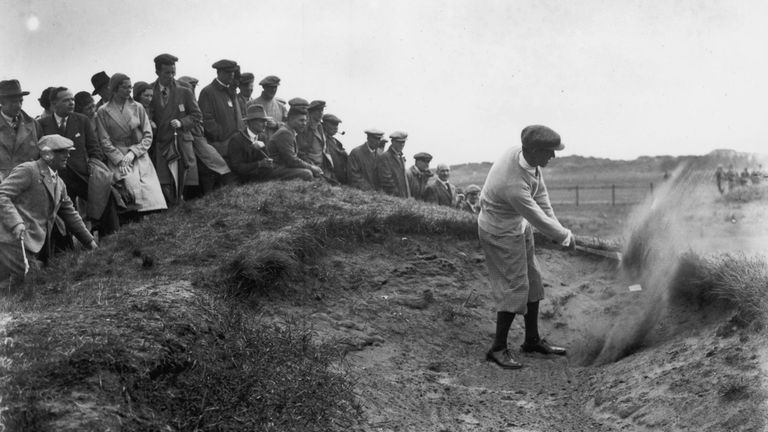 Tommy Armour hitting out of the bunker at Carnoustie in 1931.