




























From the World War I Centennial News Podcast
Commission News:
Rebekah Wilson and the "Turning the Tide" Stamp
 In July 27th’s WW1 Centennial News Podcast, Episode 82, former commission staffer and Director of Operations Rebekah Wilson came on the show to share the story behind our new commemorative stamp. The following is a transcript of the interview:
Theo Mayer: This week in Commission news we're happy to announce a new Centennial commemorative collectible. Joining the U.S. Mint 1918 World War I Commemorative Silver Dollar, this week, the U.S. Postal Service issued the World War I "Turning the Tide" Stamp. It's a really great-looking piece, so anyone who's into snail mail, stamp collecting, or really wants a great commemorative collectible for kids or grandkids, head to the post office and snag a sheet or two of these awesome Forever Stamps. The new stamp was offered to the public in a First Day of Issue dedication ceremony hosted at the National World War I Museum and Memorial in Kansas City. The stamp features a soldier wearing a steel combat helmet. In his right hand, he holds the pole for the America flag that he's grasping in his left. In the background of the stamp, you can see smoke and barbed wires against the yellow rays of the sky. Two World War I biplanes fly over the battlefield. The illustration was created by artist Mark Stutzman, who's the same talent that created the renowned young Elvis stamp. According to the Postal Service, the World War I illustration was painted using an airbrush on illustrator board, a technique that evokes the propaganda posters used during World War I. It's a great look.
World War I Centennial Commissioner Debra Anderson was a guest speaker for the ceremony, and mentioned the effort to gain the support for the stamp. "We knocked on as many doors as we could, and wrote as many letters as we could to help the veterans to be remembered. We're thrilled that the Postal Service has chosen to provide them with this honor." As Commissioner Anderson points out, a stamp doesn't just happen. This grassroots campaign started at the fledgling U.S. World War I Centennial Commission, at their very first official meeting on October 29th, 2013, with a suggestion by Commissioner Jerry Hester. Joining us to tell us the story of this early initiative to get a commemorative World War I stamp is Rebekah Wilson, one of the original Commission staffers, and the former Director of Operations for the World War I Centennial Commission. Rebekah, welcome back for a chat. It's great to have you here.
Rebekah Wilson: Nice to speak with you too. I'm glad to be back.
Theo Mayer: Rebekah, like most everyone involved with the Centennial Project, and the Commission, you started as a volunteer. Can you tell us a little bit about those formative days when the Commission was just getting on its feet?
Rebekah Wilson: My journey into being a volunteer with the Commission started before it even existed. I am a war veteran with two tours in Iraq, and I moved to the D.C. Metro area, and on one of my first trips down to the National Mall, which is where all the memorials are, I came across the District of Columbia's local World War I memorial, which is right next to the National World War II memorial, and at the time, that memorial was in a state of disrepair. When I saw that, I thought about my fellow veterans, and those people that we have told that we're going to remember the sacrifices they made for our country, and here I was thinking, "We have forgotten, and of all the places we have forgotten is right here in Washington, D.C., amongst all these other great memorials."
That night, I went home and I started doing research, and I found Edwin Fountain, who's now a commissioner, and started organizing cleanups for that memorial, twice a year, along with twice a year observances at the memorial. That memorial has since been restored to its original former glory, and through that process, I became plugged into World War I, and Edwin Fountain, so when the Commission was founded by Congress, I was one of the first to say, "Hey, I'm ready to volunteer," and I headed on down for the first Commission meeting down in Kansas City, where they put me right to work. Through that, I started to get more involved in organizing everything that the commissioners wanted to do for the Centennial.
Theo Mayer: Great story, Rebekah. One of the very early initiatives that the team took on was the stamp. Can you tell us about how that came around?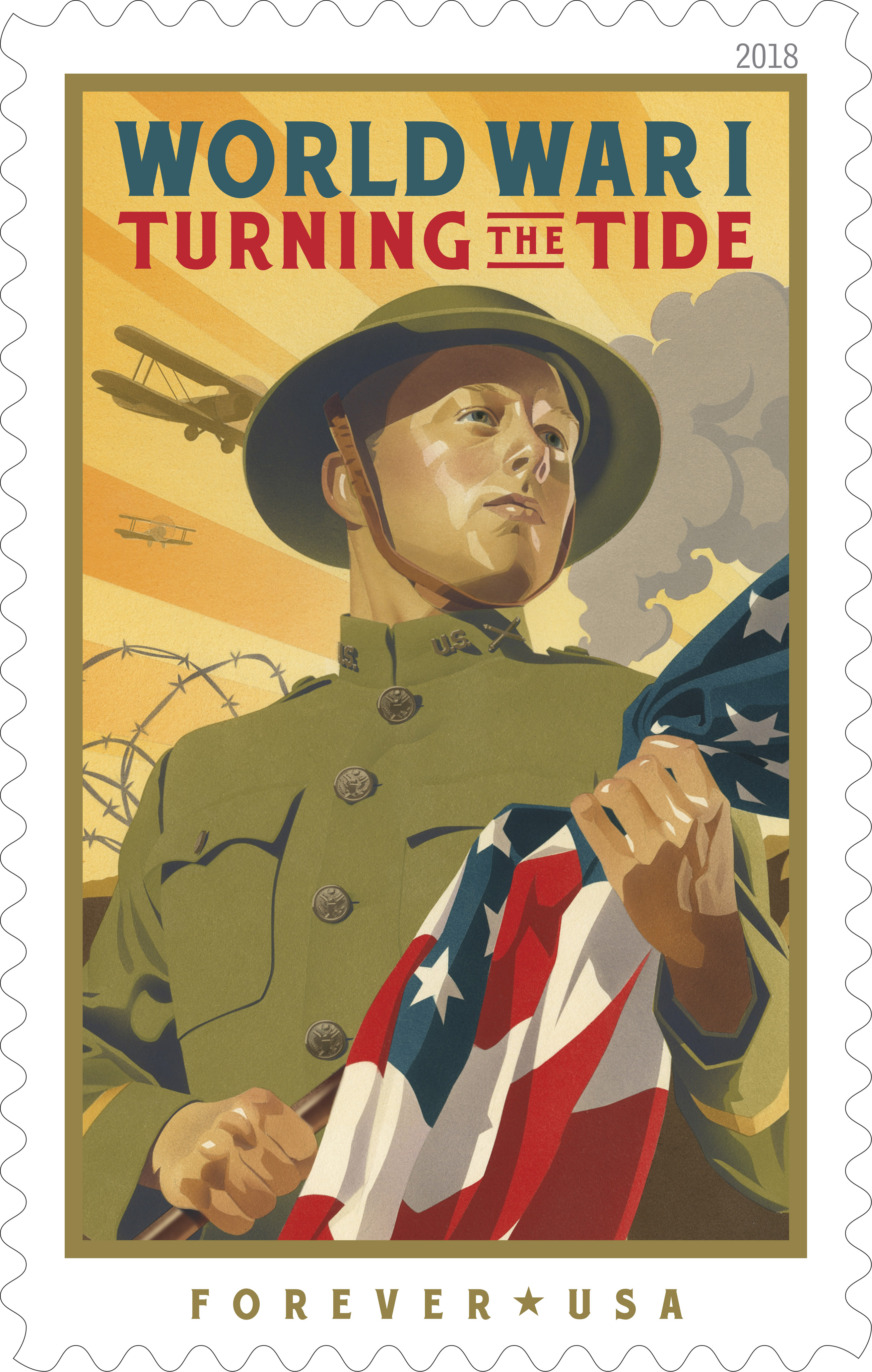 In the words of the Postal Service, Turning the Tide "honors the millions of Americans, both at home and abroad, who participated in World War I"
Rebekah Wilson: Sure. Like I said, we were down at that first Commission meeting, and there was a lot of spit-balling, like, "What are we going to do for the Centennial?" I remember, it was Jerry Hester raised his hand and he said, "We need a stamp. We need stamps, a series of stamps for the Centennial." Then in 2015, we decided to make it a priority, and we started doing research. How do we get a stamp? We found out that we were already late. Stamps are decided three years in advance, but we didn't give up there. That's when we decided to start a campaign to get a stamp.
Theo Mayer: How did you go about building the interest and getting people on board to get that done?
Rebekah Wilson: There were different ways to go about it. The Citizens Stamp Advisory Committee takes in letters for what the citizens want for a stamp. We thought, "Okay, we can send in our own letter, but it's easy to ignore one letter. It's not easy to ignore a whole bag of letters, or a constant stream of letters coming in about World War I." We had a few options. Ultimately, it was decided that the most important thing is that we got a stamp for World War I, and that the specific details were less important. I think one of the key things we did was say, "Hey, any volunteer, any organization who wants to, we encourage you to write a letter, but you tell them which World War I stamp you want, and why."
The volunteers in our organization, over the course of six to eight months, continued to push that, and we had a great response. The volunteers in the organization, Congressman Cleaver's office, and the Army at the Pentagon all started getting involved in this process. We just heard about more and more letters going into the Stamp Committee, and kind of created this groundswell by constantly keeping it in the foreground and asking people to write this letter week after week, throughout that six to eight month period in 2015.
Theo Mayer: Now that the U.S. Postal Service has issued a stamp, what do you think of it? What do you think of the experience?
Rebekah Wilson: For me, I don't think I realized the importance or the sweat equity involved in getting a stamp until I found out that they were announcing the stamp, and I found out through Meredith Carr. She sent me an email. I really burst into tears, because I couldn't believe it. To put so much effort into something, and to have it come to fruition, I was really taken aback, just in awe of what we could do. Since then, it's become real to me, imagining people carrying it around or purchasing it, or just seeing it on letters. That's important to me, to have the Postal Service say that World War I is important. I think it says something about a tide turning for people commemorating the centennial of World War I. It really gave me hope for the Commission, and it really gave me hope for the National Memorial in Washington, D.C.
Theo Mayer: Well, we've got a coin. Now we have a stamp, and we're going to have a memorial. Rebekah, you tell a wonderful story, and it's been great talking with you.
Rebekah Wilson: Thank you. Thanks for having me.
Theo Mayer: Rebekah Wilson was one of the original members of the fledgling World War I Centennial Commission staff.
Podcast Notes and links
https://about.usps.com/news/national-releases/2018/pr18_ma042.htm
https://store.usps.com/store/product/buy-stamps/wwi-turning-the-tide-S_477404
https://www.youtube.com/watch?v=KV3js_2YYfk