
































From the World War I Centennial News Podcast
Remembering Veterans:
The Daughter's of the American Revolution's Tracy Robinson, and the "re-chickenization" of France
 In August 3rd's WW1 Centennial News Podcast, Episode 83, Tracy Robinson joined us from the Daughters of the American Revolution to discuss the contributions of the DAR during the Great War, including the aptly named "re-chickenization" of France. The following is a transcript of the interview:
Theo Mayer: In a recent editorial planning session this subject came up, and although it's only part of our theme for this section, I'm really excited that we're about to tackle this very intriguing subject: the "re-chickenization" of France. Interesting, huh? It's part of what the DAR, the national society of the Daughters of the American Revolution, took on for post-war Europe. Joining us today is Tracy Robinson, Director of Archives and History for the National Society, Daughters of the American Revolution. Tracy, welcome to the podcast.
Tracy Robinson: Thank you, Theo. It's a pleasure to be with all of you today.
Theo Mayer: Tracy, could you start off by telling us a little bit about the Daughters of the American Revolution: when and how the group started, and how its mission has evolved over the years? The DAR, founded in 1890, is a volunteer service organization dedicated to patriotism, education, and historical preservation.
Tracy Robinson: DAR was founded in Washington DC during the fall of 1890 by four women, along with two of their colleagues, in response to the founding of the Sons of the American Revolution earlier that year in the spring. Very quickly after their founding (the SAR), they voted to exclude women from membership, which didn't go over very well with women who didn't think their patriotism should be discarded. on account of their sex.
DAR is a volunteer service organization. All of the service projects undertaken by chapters and state societies seek to honor in one way or another one or more of the society's three objectives: patriotism, education and historic preservation. All of these efforts include both fording active duty military personnel and assisting veterans program.
To join DAR, you must be a woman at least 18 years of age and be able to prove your direct descent from a revolutionary war patriot. When you consider as we will the enormous volume of work DAR members did to support the Allied effort during World War One, it becomes even more remarkable when you remember that DAR was relatively young. They hadn't celebrated their 27th birthday yet when United States entered the war in 1917 but they got themselves organized very quickly.
Theo Mayer: Well, they did a lot of wonderful things during the war and one of the programs just happens to fascinate me because I love the term. The DAR took on the challenge to "re-chickenize" France. Now, what does that mean and it begs the question, how did France get "de-chickenized"?
Tracy Robinson: Well, France got "de-fooded" pretty much during the war. In June 1918, the DAR learned of a plan. The American Committee for Devastated France had devised a plan to "rechickenize" France. The DAR responded with a bulletin proposing that Daughters organize local campaigns to involve their community's children in this project to sort of funny words that all they thought would appeal to children. The goal of the fundraising campaign was to supply the French people with much needed poultry farm to fill a gap in their food supply. A donation of only 10 cents placed a chick on a farm. A donation of 25 cents placed an egg in an incubator. $400 established a poultry farm with two incubators, a thousand eggs and one wounded soldier to work as the poultry man for one year. To encourage donations, the DAR created a button pin with a drawing of a chicken and the phrase, “I have a chicken in France,” which was given for those 10 and 25 cents donation.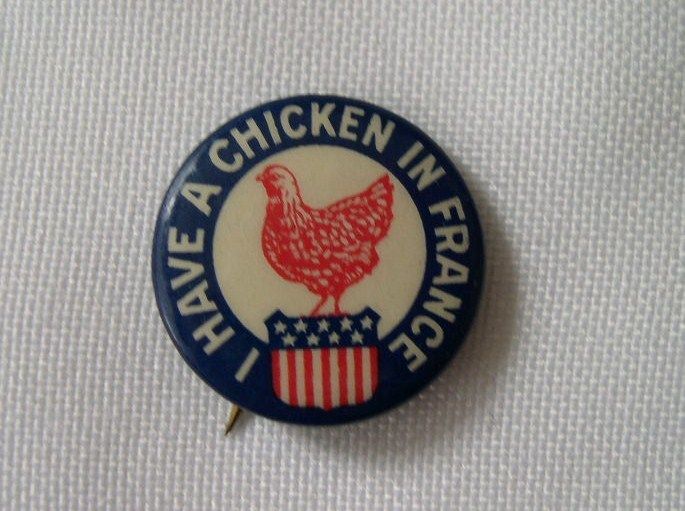 Pins such as these were given to people who donated to the DAR's Rechickenization program
Theo Mayer: Post-war, you played a huge role in establishing thousands of memorials in the US honoring those who served in World War One. Can you tell us more about that?
Tracy Robinson: The DAR has and has always had a very large historical marker program, generally speaking. There are not only thousands of markers in the US but in many other countries of the world as well especially in Belgium and France where World War One is concerned and our leadership has encouraged our membership to identify and report World War One memorial to the commission and also to apply to the 100 Cities/100 Memorials program as appropriate.
However, I think that the most important post-war memorial was a living memorial of sorts and involves an effort by DAR to rebuild the village of Tiloloy, France which is located in the central northern part of the country. The entire village had been destroyed in the war and subsequently the wife of the French ambassador contacted DAR leadership to ask for help. After much discussion and planning and a visit to Tiloloy by DAR leadership, the society decided to fund the complete water systems of the village and, this is the touching part, as repayment to France for its aid during the American Revolution, and it was finally finished and dedicated during the summer of 1921 with both DAR members and French leaders in attendance.
Everything DAR members do is in honor of the sacrifices their ancestors made while fighting the American Revolution and it must have been a proud moment and probably a very healing experience after witnessing so much devastation to have this opportunity to rebuild part of that village at least as partial payment to our greatest ally during the American Revolution.
Theo Mayer: I know we've had a number of DAR chapters sign up for our Bells of Peace. It's a national bell toll, the Centennial Armistice on November 11th at 11:00 am local. How do we invite all the chapters to join?
Tracy Robinson: One of DARs permanent committees, it's called the Commemorative Committee and they encourage DAR chapter members to join in local commemoration. Our plans on the national level aren't firm yet. We're still tossing some ideas around about November.
Theo Mayer: Tracy, it's been great speaking with you. Thank you for joining us today.
Tracy Robinson: Thanks, Theo.
Theo Mayer: Tracy Robinson is the director of archives and history for the national society, Daughters of the American Revolution. Learn more about the DAR, their archives and the role in World War One by following the links in the podcast notes.
Podcast Notes and links
www.dar.org/archives
https://www.dar.org/archives/women-resilience-dar-service-world-war-i
https://www.dar.org/sites/default/files/QuasquiFlashbackMJ15.pdf
https://blog.dar.org/celebrate-125-monday-daughters-aid-war-recovery