




























From the World War I Centennial News Podcast
Historian Corner:
An interview with Harley Davidson Archivist Bill Jackson
 In August 3rd's WW1 Centennial News Podcast, Episode 83, Bill Jackson, an archivist for Harley Davidson, joined us to tell the story of this iconic company and its motorcycles in the Great War. The following is a transcript of the interview:
Theo Mayer: This week in our Historian's Corner, the subject is hogs. No, not hogs like the farm animal, we're talking motorcycles, and specifically we're talking Harley-Davidson as our two friends from France, Christophe and Pierre, roll across America on their restored World War I era Harley for Operation Twin Links. We thought it would be a perfect time to reach out to Harley-Davidson to talk about their motorcycles in World War I. Their archives lead, Bill Jackson, took some time from his busy schedule to join us today and tell us more about the company and their iconic machines during World War One. Bill, it's great to have you on the podcast.
Bill Jackson: Thank you very much for having me.
Theo Mayer: Bill, how and when did Harley-Davidson itself get started?
Bill Jackson: William Harley and Arthur Davidson met as teenagers and there's some mystery about that early period for Harley but we know that they sold their first motorcycle to a friend of Arthur Davidson's in 1903. It could have been in '04, but we believe it's '03, in the back of the Davidson home here in Milwaukee.
Theo Mayer: Cars and motorized vehicles were brand new ideas at the turn of the century. How common or popular were motorcycles around 1914?
Bill Jackson: By 1914, they're getting more popular and there are a few major players, including Harley-Davidson. By then one of their emerging big competitors in the US was Indian Motorcycles out of Massachusetts. There were even robust motorcycle magazines in the period and motorcycle shows just like you can go to now. Just like there were car shows in those days. As you aptly put it, it was an exploding market.
Theo Mayer: I spoke to a Harley history buff a few years ago and as I recall from the conversation, it was Indian as a brand that probably shipped more units into Europe than Harley did in World War I. He also said that this was what gave Harley a break locally because it opened up the business in America because Indian was busy building stuff for the military.
Bill Jackson: There's a lot of truth to that. The first year of military production specifically was 1917, and about half of Harley's production went to the military. But by 1918, the vast majority of Harley's production was going to the military so both Harley and Indian were suppliers. Harley, by that point had a very robust dealer network and they had already been growing in dealer networks outside the US borders.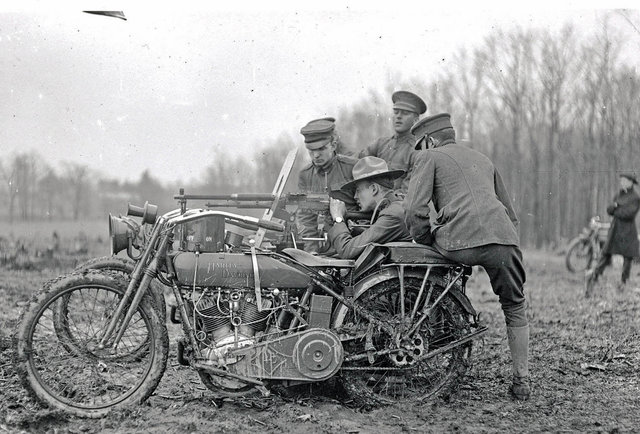 Americans troops with a Harley Davidson Model 17 F/J. The U.S. military primarily used the motorcycle for dispatch, carrier, and escort purposes.
Theo Mayer: A couple of questions. What was the role of motorcycles in World War I and how do this affect the industry and the Harley product in particular?
Bill Jackson: One of the biggest uses was the Motor Dispatch Service, MDS. People sometimes misunderstand the motorcycle as a combat vehicle, which of course it wasn't.
Theo Mayer: I think what people are probably thinking about is that pretty well-known picture of the Harley with an installed machine gun.
Bill Jackson: Right. That specific vehicle was developmental. As far as we know that was actually never used in the field but for things like dispatch use, carrier use, sometimes escort service and it actually stemmed from Harley providing motorcycles to the US military prior to World War One for the US- Mexico border conflict. You would commonly these motorcycles that were really not much different than what the civilians could buy.
Theo Mayer: Do you have a particular story or incident about World War One and about Harley that you can share?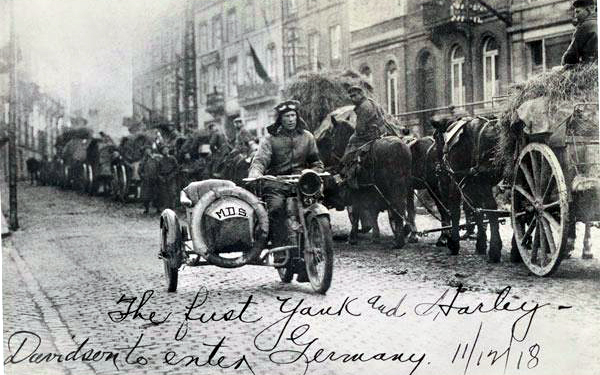 Corporal Roy Holtz on his Harley
Bill Jackson: Absolutely. The very first American who set foot on German soil in November 12 of 1918, the day after the Armistice, was a corporal named Roy Holtz of the US Army and he actually entered Germany riding a Harley-Davidson motorcycle and sidecar. A curious part of the story is that the photo appeared in Harley-Davidson's The Enthusiast Magazine and lo and behold a few years later, Roy Holtz showed up for a factory tour in Milwaukee. He said, “By the way, I'm the guy in that photo,” and they really had this amazing reaction, like “Oh my gosh, it's you.” They got some good play out of that, that Roy Holtz, the first American to enter Germany right after the war ended actually showed up here for a factory tour.
Theo Mayer: That's a great story. Now, it's interesting that a lot of veterans wind up really interested in riding motorcycles.
Bill Jackson: There are many veteran riders, including before, during, and after war time as they come home. Then you'll even find Harley-Davidson dealerships deliberately set up near military bases because there's such a huge crossover passion for the motorcycle and motorcycling enthusiasm on the part of service people.
Theo Mayer: Well, so relative to this, let's talk about our friends from France and Operation Twin Links. That's the expedition where the boys, Christophe and Pierre, are crossing the country on a reconstructed WWI Harley. Have you met them?
Bill Jackson: I actually did not get the chance to meet them when they were here. I was actually looking out our office window when I saw them coming up on the intersection closest to the museum. It's not every day you see a 1918 Harley-Davidson with a sidecar in the streets of Milwaukee. They had a very busy schedule but I got a good look at the bike. It's clear to me, it's one of these works of passion, getting this old machine running and capable. I think their goal when that's all set and done is to cover 5,000 miles in the US. Very impressive.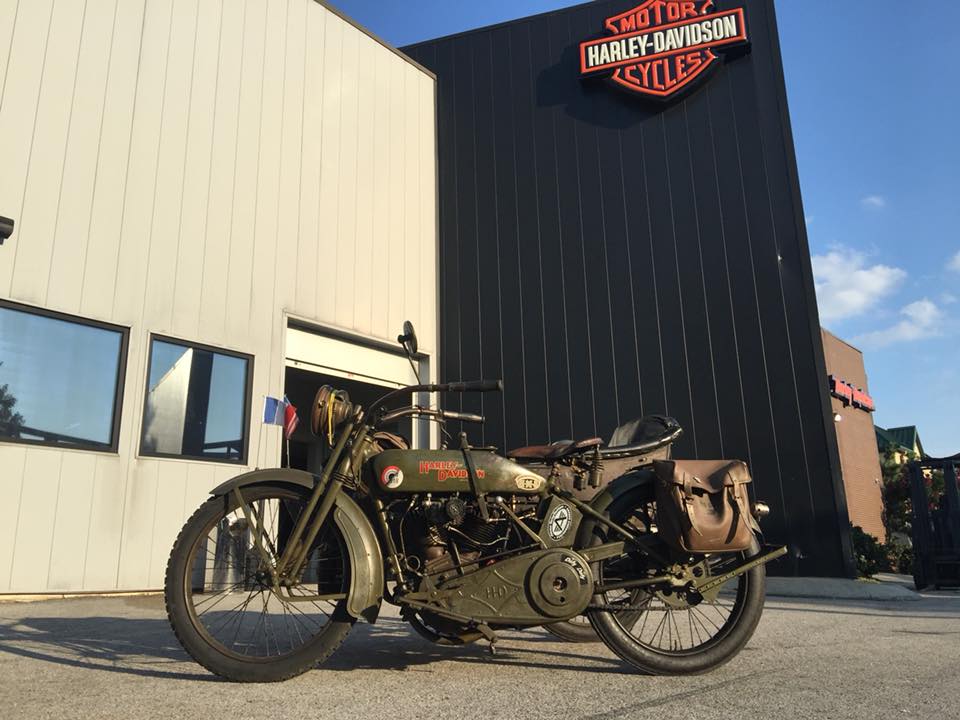 Christophe de Goulaine and Pierre Lauvergeat are traveling across the United States in this WW1-era Harley Davidson motorcycle (courtesy of Operation Twin Links on Facebook)
Theo Mayer: Well, they're an interesting couple of guys. They're not really sponsored. They're taking a nice ride. I mean, that's really what they're doing and it's on your Harley! Of course, it's a great testament to Harley if a century old machine can still cross the country.
Bill Jackson: Absolutely. We are the oldest manufacturer. Not many out there can say that they're hundred years old. It happens to be, I'm sure as you know, that we're also celebrating 115th anniversary of the company.
Theo Mayer: Congratulations on that. Well, thank you so much for joining us. Our listeners love motorcycles and they love Harley so thank you for coming by.
Bill Jackson: You're very welcome. Thank you.
Theo Mayer: Bill Jackson is the archive lead for Harley-Davidson. Learn more about Harley-Davidson and the history of motorcycles in war time by following the links in the podcast notes.
Podcast Notes and links
https://www.harley-davidson.com/us/en/museum/explore/archives.html
http://www.ridingvintage.com/2012/12/war-machines-american-motorcycles-of-wwi.html
https://www.thrillist.com/cars/history-of-u-s-military-motorcycles
http://www.foxnews.com/auto/2018/06/29/100-year-old-harley-davidson-returns-from-france-to-honor-american-wwi-soldiers.html