


































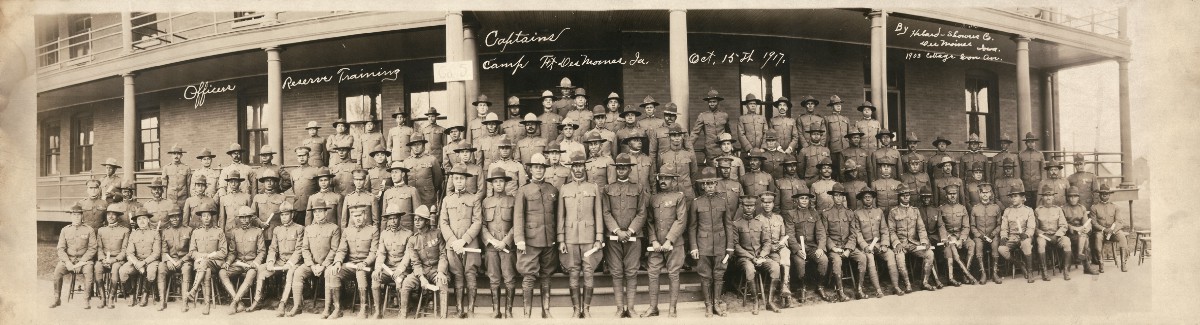
 Dr. Hosea J. Nichols could be in this photo of Officer Reserve Training Camp in Fort De Moines, Iowa, as he was sent to the camp in September 1917 to train with other African-American officers. | Photo courtesy of the Historical Society of Quincy and Adams County
Black physician who served in WWI was mover, shaker
By Arlis Dittmer
via the Herald-Whig (Quincy, IL) newspaper web site
Dr. Hosea J. Nichols was one of the 104 doctors of African-American descent who were physicians in World War I.
His father, William Nichols, who had been born a slave, served with the Union Army in the 59th U.S. Colored Infantry during the Civil War. Hosea was born in 1870. He and his six siblings were raised in Sardis, Miss.
Nichols attended an American Missionary Association school, organized for freed men, in Memphis, Tenn., where he trained as a teacher. He taught for two years before enrolling in medical school. He graduated from Howard University Medical College in Washington, D. C., in 1899.
After graduation, Dr. Nichols moved to Quincy and opened a practice at 234½ N. Sixth. He married Annie M. Davis, who was a trained nurse, in 1901. They lived at 819 N. Eighth, where they raised three daughters.
Although Dr. Nichols only lived in Quincy about 20 years, he was involved in many organizations and for a time, was the only African-American physician in Quincy.
Whenever a spokesman or committee was needed, Dr. Nichols' name was included. The black community objected to the proposed location of Lincoln School in 1908.
Dr. Nichols and two other gentlemen presented a petition to the school board saying, "We consider it a menace to our welfare, as a people, to have our children educated in the vicinity of Adams row, which is the dwelling place of all manner of vice and crime and which is the rock of Gibraltar to the police station."
Read the entire article on the Herald-Whig web site here:
External Web Site Notice: This page contains information directly presented from an external source. The terms and conditions of this page may not be the same as those of this website. Click here to read the full disclaimer notice for external web sites. Thank you.