



















From the World War I Centennial News Podcast
Labor Day 1918
 In August 31st's WW1 Centennial News Podcast, Episode 87, we took a look back at a truly exciting, and consequential, time in American history: the first week of September 1918. The following is a transcript from the Podcast:
Theo Mayer: We're going to kick off the first week of September and the Labor Day weekend with a look at some amazing domestic events from a hundred years ago. We'll weave together Labor Day, the unions, sedition, bombs, baseball, the Babe, and Butte, Montana as we jump into our centennial time machine to explore the war that changed the world.
We're back in 1918 and this week the nation celebrates Labor Day, a holiday with an interesting heritage and major heft in 1918. The holiday has its genesis in the late 1800s, a time when the trade union and labor movement grew. In the US, a September holiday called Labor Day was first proposed in the early 1880s. By the time it became an official federal holiday in 1894, 30 US states were already celebrating Labor Day. This year, 1918, is the 24th anniversary of the holiday and the Wilson Administration is determined to make this the biggest Labor Day celebration in the nation's history, to remind the American worker of their important role in the war effort.
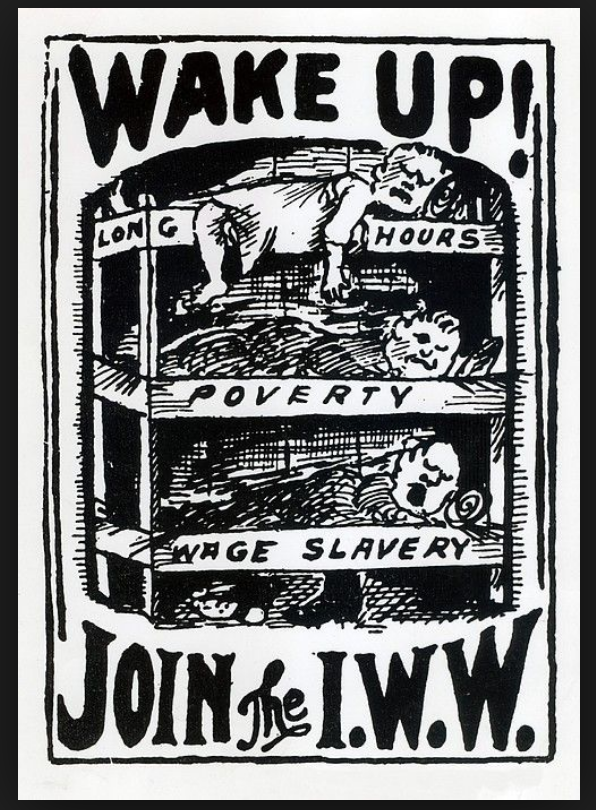 Founded in Chicago in 1905, the IWW broke ranks with most American labor unions and strongly opposed the war. Now, most labor unions are strong supporters of the war. It's an opportune time to leverage the war requirements for recognition and higher wages for their workers. The unions are helping to minimize strikes as wages soar and full employment is reached and the unions blossom. American Federation of Labor, or AFL, membership soars to 2.4 million in 1917. To keep the factories running smoothly, in April of this year in 1918, President Wilson establishes the National War Labor Board, which literally forces management to negotiate with the existing labor unions. In these days, the government is strongly pro-labor and the big unions, the AFL and the Railway Brotherhoods, are pro-war, strongly encouraging their young men to enlist in the military - but not all unions are onboard with this.
This resistance is exemplified by the anti-war, socialist-leaning IWW, the Industrial Workers of the World, also known as the Wobblies. The Wobblies feel that war represents a struggle among capitalists in which the rich profit and the working poor are pawns, dying at the hands of other pawns, with their blood flowing into the wallets of the capitalists. The IWW's anti-war stance makes it highly unpopular in this patriotic national moment. Indeed, one Wobbly, Frank Little, the IWW's most outspoken war opponent, is lynched in Butte, Montana in August of 1917, just four months after the U.S. declaration of war. As our regular listeners may remember, a succession of laws starting with the Espionage Act of 1917 and bolstered by the Sedition Act of 1918 give the government sweeping powers to hammer down descent of any kind at this time- and they do.
Okay, we'll get back to that in a moment. Meanwhile, it's Labor Day Monday, September 2nd, 1918 and America holds the biggest Labor Day parade in its nation's history, with 100,000 union members marching down 5th Avenue in New York, while the most public, fascinating technology of the day, airplanes, fly overhead dropping leaflets. It's a big day.
Just two days later, on Thursday September 4th, the shocking headline in the New York Times reads, "Dateline September 4, 1918. Headline, IWW Bomb Kills Four in Chicago. Explosion shatters Post Office federal building... Woman and sailor among the dead." The story reads, "Four persons, one woman and one sailor were killed this afternoon and dozens more injured when a bomb of terrific force was exploded in the Adam Street entrance of the Chicago Post Office building. The blast was so powerful it tore down an 18-inch wall, hurled tons of debris about, and wreaked havoc in the entire north end of the building. Police and government operatives at once began to work on the theory that the members of the IWW, or some of their anarchist sympathizers, placed the bomb."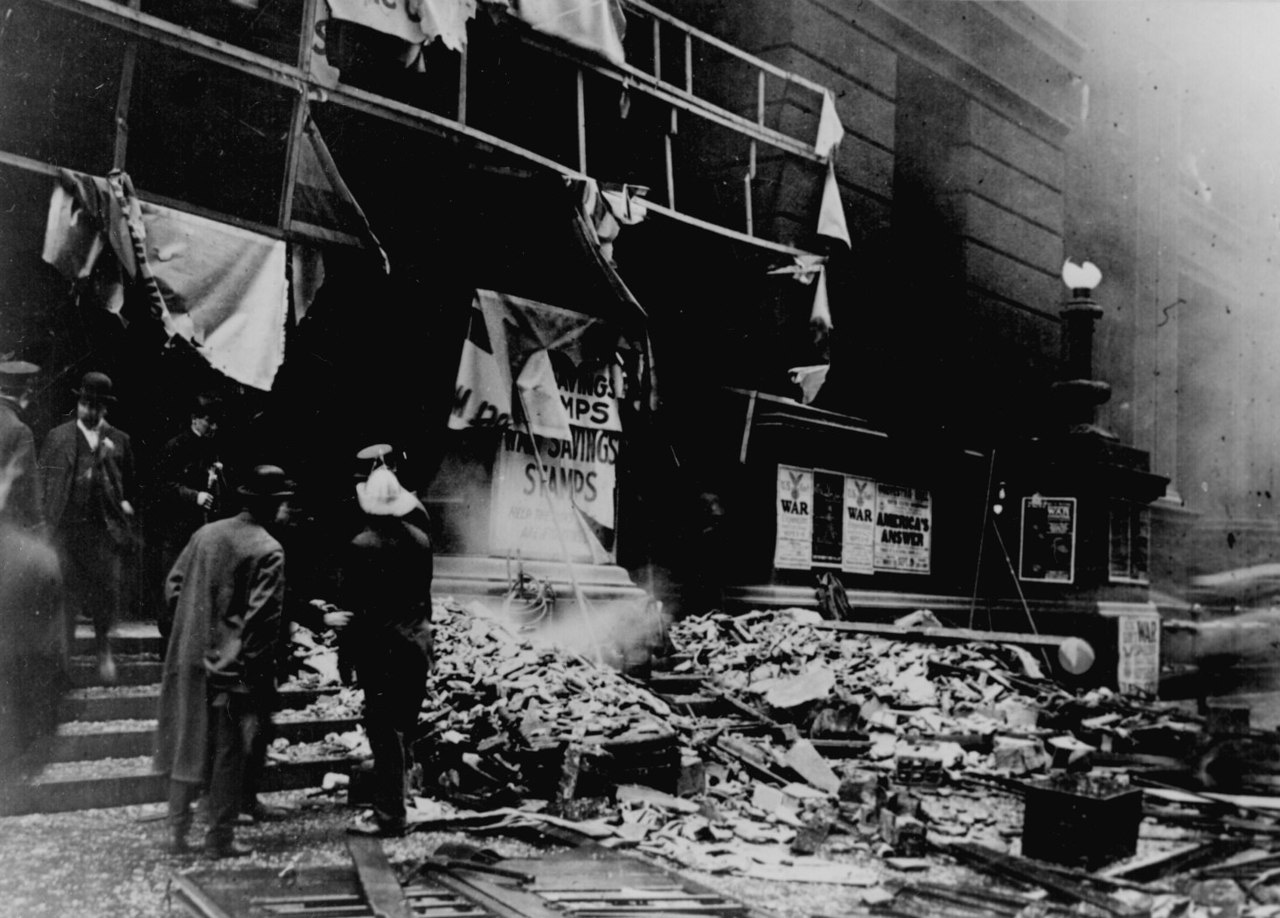 The Chicago federal building and post office, shortly after the September 4th bombing
Well, though it was never actually proved, suspicion from the bombing falls on the IWW. By this point, the Wilson Administration has effectively declared war on the Wobblies. In April of this year, the government arrests 100 IWW members and puts them on trial. One of the IWW founders, big Bill Haywood, is among them and after the longest trial in the nation's history, he's convicted and just happens to be in a holding cell in that very building when the bomb goes off. Meanwhile, in June, the government arrests another founder of the IWW, Eugene Debs. After he delivers an anti-war speech in Canton, Ohio, Debs is arrested, tried, and sentenced to 10 years in prison under the Sedition Act. Given all this, it's no surprise that the suspicion immediately falls on the IWW.
Haywood denies it, saying, "Uh-uh. No IWW member would be so foolish as to do such a thing. It must have been German fear propaganda." Despite the fact that a large percentage of the Chicago public and the police believe that the IWW was involved in the bombing, no convictions were ever made and the case remains unsolved. Unsurprisingly, the bombing freaks out the City of Chicago, at a time when the city is plenty distracted by other things.
There's a war on and over at Comiskey Park, tomorrow, on September 5th, is the opening game of the 1918 World Series. It's the Boston Red Sox versus the hometown Cubbies. The 1918 season has ended early and the World Series is being played in September because of the war. Just a couple of weeks ago Secretary of War, Newton Baker, clearly not a baseball fan, announces that baseball players of draft age are not exempt from the draft like the movie actors are. He declares that the work or fight order for baseball players is effective as of September 1. You're going to war, boys!
Well, that forces the premature end of the regular season and the 1918 World Series will be the only one played entirely in the month of September. Neither the players nor the fans seem to have their head in the game. It's a pretty lackluster, forgettable six game series with neither team scoring more than three runs in any one game, each team is shut out once, and not a single home run in the series. Not very exciting unless you like great pitching. Starting pitchers Babe Ruth and Carl Mays win two games each and help clinch the 1918 series for the Red Sox.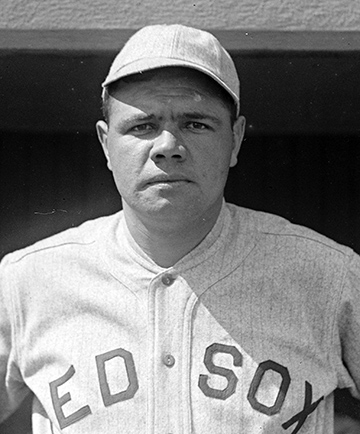 A young George Herman "Babe" Ruth in his Red Sox uniform, 1918.
Well, the bombing on September 4th doesn't really lighten the mood in Chicago whatsoever. In a city jittery over the bombing and weary of the war, game one of the series on September 5th attracts fewer than 20,000 fans, the smallest World Series crowd in years. During the seventh inning stretch, the Navy Band, who's the official band for the game, decides to play the Star Spangled Banner ... And suddenly, spontaneously, the entire stadium, which has been down and subdued, joins in a swelling patriotic chorus. (Singing). Now, it's important to realize that in September of 1918, playing the Star Spangled Banner is not a standard part for any kind of ballgame. In fact, the Star Spangled Banner is not even the official National Anthem, but in this moment in 1918, this spontaneous patriotic outburst is picked up on and written about by the Chicago papers. In the future, a number of historians will see this moment as the genesis for the song, not only being played at sports events, but becoming the National Anthem of the nation. Another moment that shapes our every day lives today, courtesy of the war that changed the world.
Links
https://timesmachine.nytimes.com/timesmachine/1918/09/05/97024579.pdf
https://www.worldwar1centennial.org/index.php/communicate/press-media/wwi-centennial-news/2708-cubs-red-sox-world-series-in-1918-key-in-u-s-love-affair-with-national-anthem.html
https://postalmuseum.si.edu/behindthebadge/chicago-bombs.html
https://www.iww.org/sv/history/resolutions/Convention_war_1916
https://www.marxists.org/history/usa/unions/iww/1918/0904-defensenews-chicagobomb.pdf
http://time.com/4955623/history-national-anthem-sports-nfl
http://www.baseball-almanac.com/ws/yr1918ws.shtml
http://www.chicagotribune.com/sports/baseball/ct-wrigley-field-national-anthem-20170703-story.html
https://www.baseball-reference.com/bullpen/1918_World_Series