































From the World War I Centennial News Podcast
WW1 Then: September Roundtable
 In September 7th's WW1 Centennial News Podcast, Episode 88, our own Theo Mayer and Katherine Akey joined forces with podcast regular Dr. Edward Lengel for a roundtable discussion about the month of September, 1918. The following is a transcript of the conversation:
Theo Mayer: To provide a context for September 1918, Dr. Edward Lengel, Katherine Akey, and I got together to explore what was happening a hundred years ago this month, the overarching themes, the events, and the happenings of September 1918. Here's what we talked about. Ed, let's start with you. In September, what was the main theme?
Edward Lengel: World War One kicks into high gear for the American Forces on the Western Front and indeed for the Allies in general. Ferdinand Foch's master plan for concentric offensives on the Western Front goes into operation with the different Allies attacking from different points along the front. The Americans first enter into combat with the US First Army. This is the first time an American commanded army will launch an offensive on the Western Front at Saint-Mihiel on September 12th. Then it [the First Army] shifts over to the northward on September 26th as a part of Foch's plan to launch the massive Meuse-Argonne offensive that's going to pull in one million American troops, and to this day, it remains the bloodiest and largest battle in American military history.
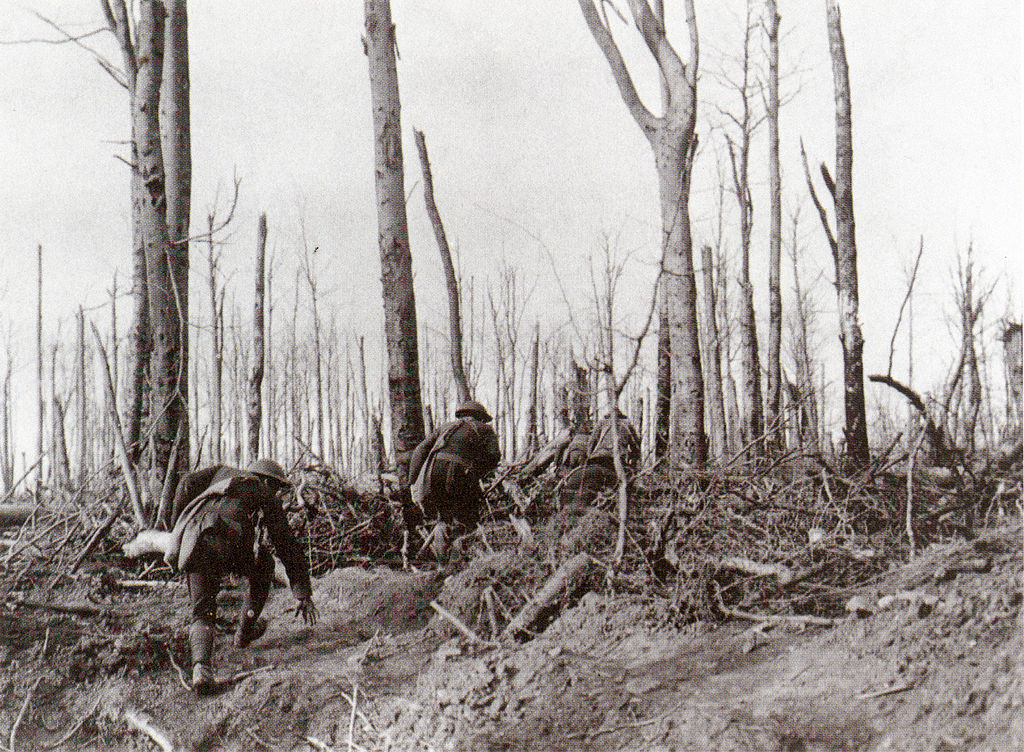 American Marines maneuver during the Meuse Argonne Campaign, 1918.
Theo Mayer: Back to the Battle of Saint-Mihiel, Pershing not only command the US Army but he also had a sizable number -over a hundred thousand- French under his command there, didn't he?
Edward Lengel: Yes, he did. A lot of armies on the Western Front now were interchangeable to some degree and the French and British Armies can have troops of other nations under their command including Americans. Now, when the American First Army is created in August and moves into action in September, it incorporates a large number of French troops including aircraft, tanks, artillery, and infantry under Pershing's command. This is also a first in American history.
Theo Mayer: Katherine, you had mentioned to me that this really was truly one of the first major modern battles. Why did you say that?
Katherine Akey: Because of the inclusion of many of the branches of the military. You have the largest ever assembly of aircraft supporting the ground troops, some 1,500 aircraft. Very many of them were American. Some 40% are American flown planes in American Units. The rest are British, French, and Italian. There's also nine bomber squadrons, although those were not specifically under Pershing's operational control, they were provided for the battle as well. So you have tons of aircraft and then you also have lots and lots of tanks despite it being terrible weather conditions; it had been raining for an entire day before, heavy driving wind. It was extremely muddy. The men were knee deep in mud and water, and that of course proved very difficult for the tanks. When you picture in your mind infantry troops moving forward with tanks, with planes flying overhead providing cover, it looks like a World War Two battle, but these are still World War One technologies. They're still early tanks, early planes and this is one of the first times that they're being used altogether in these numbers.
Theo Mayer: Now, Ed, you'd mentioned that there are some names that come to light here that we normally associate with World War Two.
Edward Lengel: There's a whole list of names I could give. Billy Mitchell is the office who coordinates American Air Forces in Saint-Mihiel and will also do so in the Meuse-Argonne. He will become famous after the war for expressing his views on the dominance of air power over all other branches of the service that will have a huge impact on American military history. Then you have folks who are better known in World War Two such as George Patton, Douglas MacArthur, Mark Clark, Harry Truman and many others who will get their first taste of combat this month.
Theo Mayer: Ed, as we continue on, and maybe the both of you can explain this, there's a line called the Hindenburg Line and late this month the Allies start to encroach on it and actually surpass it. What was the Hindenburg Line?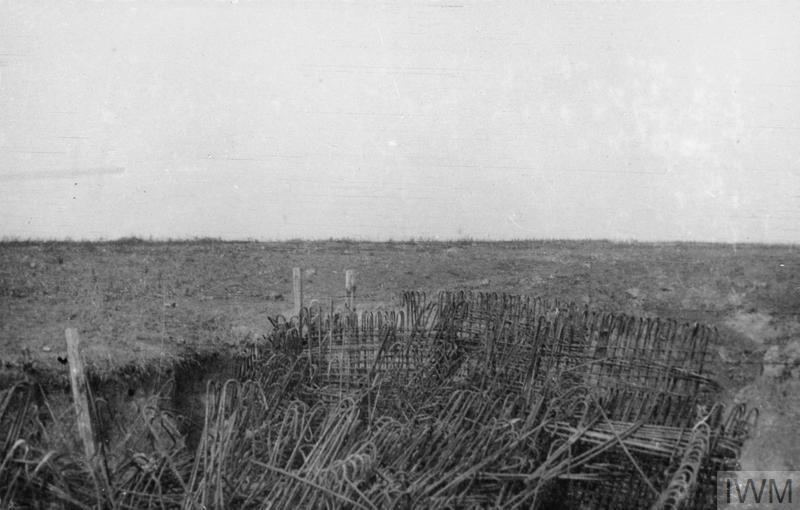 An unfinished pillbox on the Hindenburg Line, a lengthy network of fortifications protecting the German border.
Edward Lengel: American forces are going to take part in the assault on the Hindenburg Line and the Meuse-Argonne offensive later in the month. The Hindenburg Line exists in multiple stages, multiple installments along the Western Front. It marks the boundary between Germany being on the offensive west of the Hindenburg Line and to France and Germany being on the defensive east of the Hindenburg Line. The Hindenburg Line is designed to protect the German homeland to slow down any Allied assault to the East and to inflict maximum causalities. It's not a major military fortification along the scale of the Maginot Line later on but it is a significant defensive line with pillboxes, earthworks, trenches, artillery machineguns and all the rest. It marks an important boundary.
Theo Mayer: Well, Katherine, it's also an important psychological line, isn't it?
Katherine Akey: Oh, very much. I think it's highly symbolic. The Allied troops are pushing back in dozens of battles this month. The Australians, the New Zealanders, the Canadians, the French, everybody is involved in small battles all along the Western Front, and they're pushing the German's back to and beyond the Hindenburg Line. The Germans are losing places they've held for years but are being pushed back to this line that was their backup, their last resort. It's their last super-prepared defensive position. This must be very demoralizing.
Theo Mayer: Well, at the big battle that we get through at the end of the month is the Meuse-Argonne and really this month we only hit phase one of the battle or the first phase but it's really significant.
Edward Lengel: Again, as part of Foch's grand plan for attacking the Hindenburg Line from multiple concentric points, there is an important strategic objective which is to capture a railway junction at a place called Messier that feeds much of the German territory on the Western Front. What this symbolizes is that we are making some very important strategic decisions at this point. The battle of Saint-Mihiel on September 12th to 15th is very important because it clears a major German held salient south of Verdun. Many American leaders including Pershing and Douglas MacArthur believed that the American forces should simply continue to the East toward the town of Metz and attack in to Germany. Instead, Foch convinces the Americans to shift their forces from Saint-Mihiel to the north to Meuse-Argonne region. George C. Marshall, another figure who will become better known in World War Two and beyond, is the officer who's put in charge of managing this huge logistical shift of troops from Saint-Mihiel to the Meuse-Argonne and then you'll have nine full American divisions followed by several more American divisions- again, ultimately over a million troops attacking into a very a forbidding, waterlogged terrain. There are ravines, there are forests. It's very easily defensible terrain and it's held by German troops who are determined to fight to the finish. The Germans are not trading territory for time in the Meuse-Argonne. They're intending to stop the Americans cold, and the casualties that we suffer in the first few days verge on the catastrophic. It's a major wake-up call for the United States.
Theo Mayer: That's all of the stuff that's going on the Western Front, but there is also some very interesting action that's going on way up North in Siberia.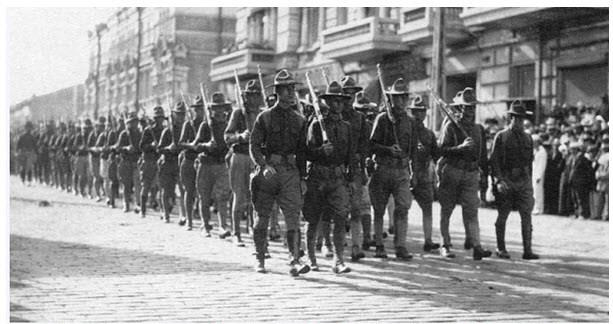 US troops in Vladivostok, 1918.
Edward Lengel: Yes. American troops land in Vladivostok in the far east of Siberia on September 1st and then a few days later they land in Arkhangelsk in North Russia. These are troops at the regimental level. They're in the hundreds rather than the tens or hundreds of thousands but it's a significance strategic commitment for us to place troops on the periphery of this gigantic country of Russia with the hopes of intervening in the Russian Civil War, assisting the White Russians and somehow defeating the Red Russians. It's an odd undertaking but it's going to have at least for the American troops who are committed there along some British and French troops a terrible, demoralizing effect. They have to stay there until 1920 before they're finally withdrawn and they have to watch their comrades who are deployed on the Western Front and elsewhere get to go home in 1919 while they stay in Russia. Not a fun experience for them.
Theo Mayer: Katherine, there's a lot of stuff going on in the Middle East and in the Balkans and so forth. What's happening there?
Katherine Akey: Yeah. There's a lot of action in September and there's a lot that pretty much starts to shut down, mostly in favor of the Allied Forces. In the Balkans, there's this Vardar Offensive being fought between an Allied Force that's made up of Serbians, French and Greek troops. Some Italians fighting against Bulgarian-held trenches and territories in present day Macedonia. This offensive is extremely effective, the offensive by the Allies against the Bulgarians. There are mass Bulgarian desertions and then eventually the Bulgarians actually sign an armistice with the Allies on September 29th, at the end of this month. Then the Allies are able to capture more major territory in modern day Macedonia and effectively shut down this Balkan front. All of this fighting in the Balkans is a result of the Austro-Hungarian empire losing control of its territory and the dozens of different ethnic and religious groups that made up its constituency before it started to fall apart over course of the war.
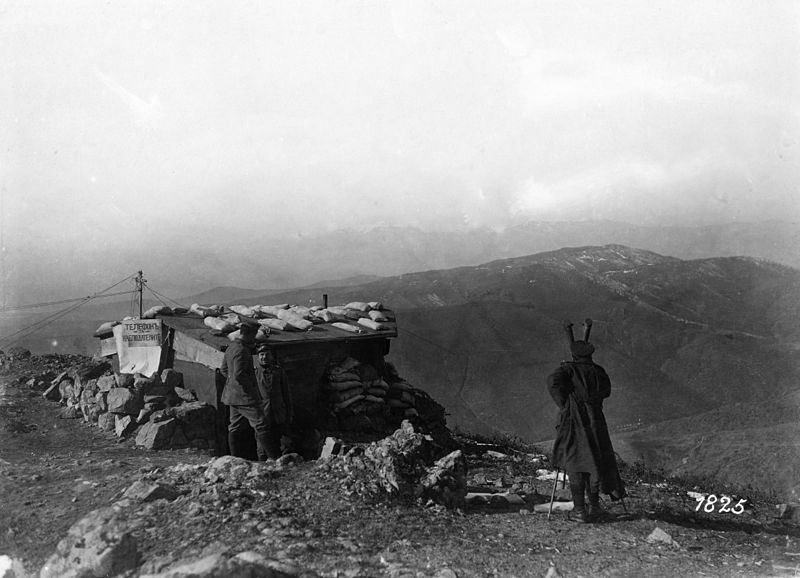 Bulgarian outpost overlooking Lake Dorian, present-day Macedonia. The Allies would soon knock Bulgaria out of the war. Theo Mayer: What's happening the Ottomans?
Katherine Akey: Well, big news out in the Middle East. The Battle of Megiddo, a series of a number of attacks and smaller battles against Ottoman forces by both the British and the Egyptian expeditionary force, a subsidiary of the British. This is along with the Arab uprising and TE Lawrence. They managed to take a massive amount of territory from the Ottomans stretching from the Mediterranean coast all the way to the Judean mountains. This also is part of the Middle Eastern front that gets pretty much shut down and left in the hands of the Allies by the end of the month. The last one I would mention is in modern day Azerbaijan. There's a port city Baku on the Caspian Sea that had been under the control of a very short-lived dictatorship, the Centro-Caspian Dictatorship and a combine Ottoman and Azerbaijani force recaptures this port city. Once they do, there's a very large refugee and civilian population in that city. A lot of whom are Armenians and many of them are massacred. Some 30,000 of them are massacred once when the Ottomans regain control of this port city.
Theo Mayer: Let me take this as an opportunity to switch subjects slightly to the war in the sky and the war on the sea really combining this month. What's that story?
Katherine Akey: The British produced on September 14th the first official aircraft carrier, the HMS Argus. This is considered the first contemporary aircraft carrier because it has an unobstructed flight deck, the whole length of the ship. In fact, some 10 days after it's first launched on the 24th of September, a British fighter pilot managed us to complete the first true aircraft carrier landing in history. He lands a Sopwith 1 1/2 Strutter on the bare steel flight deck of this contemporary aircraft carrier. It doesn't quite look like the air craft carriers we know from World War Two and it's not nearly as large but it is a huge step forward along with the kind of fighting we're seeing in Saint-Mihiel this month towards the technology and the all arms, all different branches of the military combined warfare that we get in World War Two.
Theo Mayer: Well, for our listeners who may not know, they had been launching airplanes into the air with catapults off of ships but mostly those were pontoon airplanes and then they would land on the water and be hold back aboard the ship so this is a big change to an actual aircraft carrier?
Katherine Akey: Yeah. It's a huge change. These are not marine planes being launched and then pulled back out of the ocean, they are true aircraft being landed on the deck of the ship.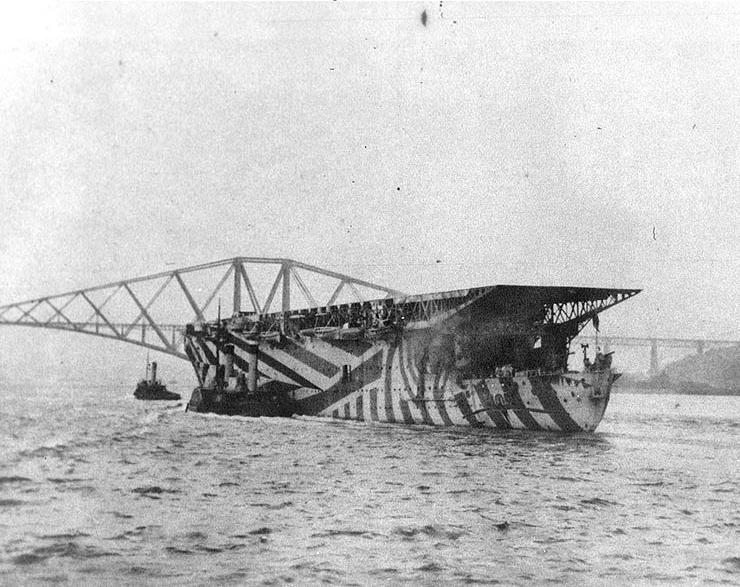 The HMS Argus, 1918.
Theo Mayer: There is a lot going on, on the domestic front in the US at this point as well, isn't there?
Edward Lengel: Yes. September first of all is a very important month in African-American history. If you stay on the Western Front, African-American troops enter into combat on a very large scale for the first time with the 92nd and 93rd division troops entering into combat in around the Meuse-Argonne. Back home in the United States, the final stage in what has been a sad and tragic event takes place in early September when several black soldiers who had participated in the Camp Logan riots in Houston of 1917 are hanged at the beginning of September. They have been found guilty and are executed for their alleged participation in these race riots which were really sparked by mistreatment of African-American troops who are assigned to Houston in the era of Jim Crowe and segregation. The clash with local whites and the local police department and eventually erupt in a large riot. Again, that's a very tragic episode. On the brighter side, at the end of September and September 30th, President Woodrow-Wilson comes out officially to endorse women suffrage which is a big deal for him because he had before many years actively opposed women suffrage as a federal suffrage as a federal law and then passively opposed and dealt with the demonstrators in front of the white house for quite some time so now we're going to move toward eventual women suffrage on the federal level.
Katherine Akey: It's worth mentioning, a bill for women's suffrage does make it to the senate this month but it doesn't get the votes that it needs to pass so they're making progress but slow and steady.
Theo Mayer: Then wrapping things up, I wanna touch just for a moment on the other battle that's going on and that's a battle for health and the Spanish flu. It's resurging this month, isn't it?
Katherine Akey: Yeah. The Spanish flu is about to go into its largest peak over the course of its reign so to speak. We have this peak in the Spanish flu back in the late spring, early summer but here in the fall starting at the end of September and going especially into October and November, we're gonna go from five deaths per thousand people to 25 deaths per thousand people. There's some interesting statistics on who exactly is getting knocked out by this flu. When you look at charts of who the flu killed in 1917, it's mostly children under 4 and people over 75 but then when you see charts of people dying from the flu in 1918, you get this spike right in the middle of that chart which covers individuals aged 20 to 45 basically fighting aged men and women. We're about to go into this period where not only are five times the number of people about to die from this flu as had been back when it first struck earlier in the year but we're also seeing it hitting healthy prime of your life men and women in their 20s and 30s.
Theo Mayer: Ed, did the flue affect the fighting front directly?
Edward Lengel: Yes, it did. It first of all impacted the German army, really sapped their frontline strength. That's something that's going on as early as the beginning of the summer and as you move in to the fall, it's going to have a really terrible effect on the Germans as well as Austro-Hungarians and others but it's spreading now of course into the Allied camp and the Americans, French, the British are all dealing with the flu as well. It wears down all of the combatants and has affect on the fighting.
Theo Mayer: This is not a great march to victory. This is a pretty rough time?
Edward Lengel: Yeah. We tend by hindsight to look back on this period and I'll mention that as an aside. We almost have the same view about the end of World War Two as if this is a period when we're celebrating and flags are waving and trumpets are blowing and we're all marching toward the inevitable victory and everybody is happy. In fact, this is a time of great fear and uncertainty as well as tragedy. People everywhere across the globe are worried and fearful about how this war is going to end, what's going to happen next, so it's a time of great tension.